

A first injection of 200 L at 0.08% volumetric concentration was carried out for
1.7 pore volume (PV). The concentration was a little below the recommendations
formulated on the basis of laboratory work, because of high surfactant viscosity
which causes problems with its injection flow. At this concentration, the interfacial
tension, σ ow , reduced only from 35 to 15 mN m
À1 , which did not significantly
improve the recovery rate (Fig. 2.58). No increase in DNAPL thickness was
observed in the recovery well.
A second injection was carried out with 200 L of surfactant at 0.5% volumetric
concentration after 6.5 PV recirculation. At this concentration, the interfacial tension, σ ow, should have reached 8 mN m
À1 . However, it did not decrease below
15 mN m
À1 (Fig. 2.58). This may be due to variations in the water’s salinity (deep
water being more saline than surface water), and/or due to the preferential flow.
After 10 PV, the height of the water/DNAPL interface increased by more than
1.5 m above the initial level. Unfortunately, experiments had to be stopped although
the level of the water/DNAPL interface was still increasing. In the end, 35 L of
DNAPL (i.e., 1.2% of the DNAPL) were recovered. This amount is probably
a) Pumping without surfactant
b) Pumping with surfactant (SDBS at the critical micelle
concentration)
1.0-0.6
0.6-0.5
0.5-0.4
0.4-0.3
0.3-0.2
0.2-0.1
0.1-0.01
0.01-0.00
DNAPL
saturation
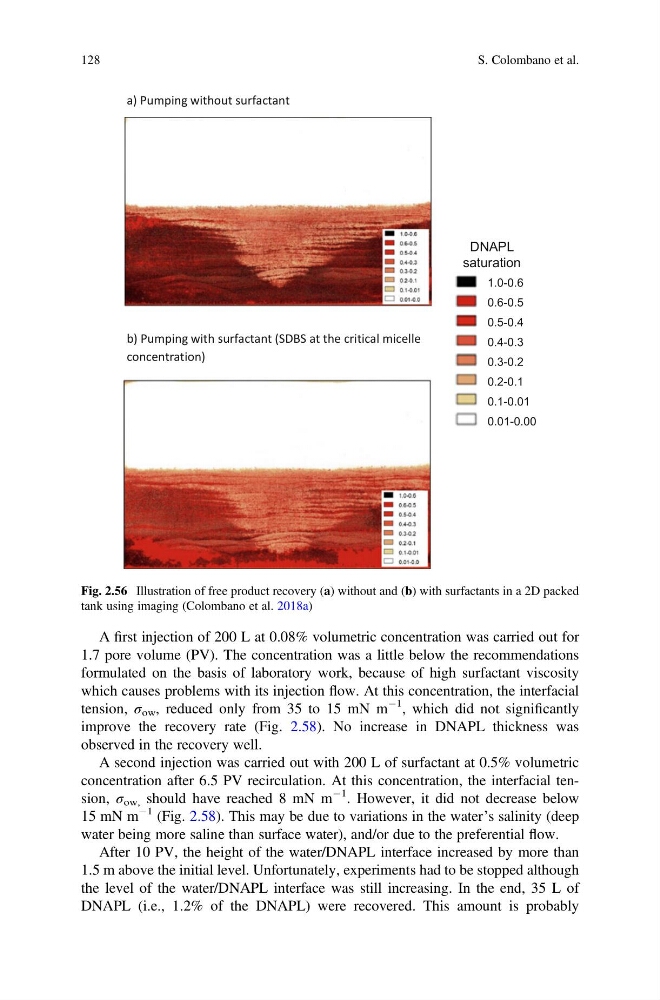
Fig. 2.56 Illustration of free product recovery (a) without and (b) with surfactants in a 2D packed
tank using imaging (Colombano et al. 2018a)
128
S. Colombano et al.
1.7 pore volume (PV). The concentration was a little below the recommendations
formulated on the basis of laboratory work, because of high surfactant viscosity
which causes problems with its injection flow. At this concentration, the interfacial
tension, σ ow , reduced only from 35 to 15 mN m
À1 , which did not significantly
improve the recovery rate (Fig. 2.58). No increase in DNAPL thickness was
observed in the recovery well.
A second injection was carried out with 200 L of surfactant at 0.5% volumetric
concentration after 6.5 PV recirculation. At this concentration, the interfacial tension, σ ow, should have reached 8 mN m
À1 . However, it did not decrease below
15 mN m
À1 (Fig. 2.58). This may be due to variations in the water’s salinity (deep
water being more saline than surface water), and/or due to the preferential flow.
After 10 PV, the height of the water/DNAPL interface increased by more than
1.5 m above the initial level. Unfortunately, experiments had to be stopped although
the level of the water/DNAPL interface was still increasing. In the end, 35 L of
DNAPL (i.e., 1.2% of the DNAPL) were recovered. This amount is probably
a) Pumping without surfactant
b) Pumping with surfactant (SDBS at the critical micelle
concentration)
1.0-0.6
0.6-0.5
0.5-0.4
0.4-0.3
0.3-0.2
0.2-0.1
0.1-0.01
0.01-0.00
DNAPL
saturation
Fig. 2.56 Illustration of free product recovery (a) without and (b) with surfactants in a 2D packed
tank using imaging (Colombano et al. 2018a)
128
S. Colombano et al.