

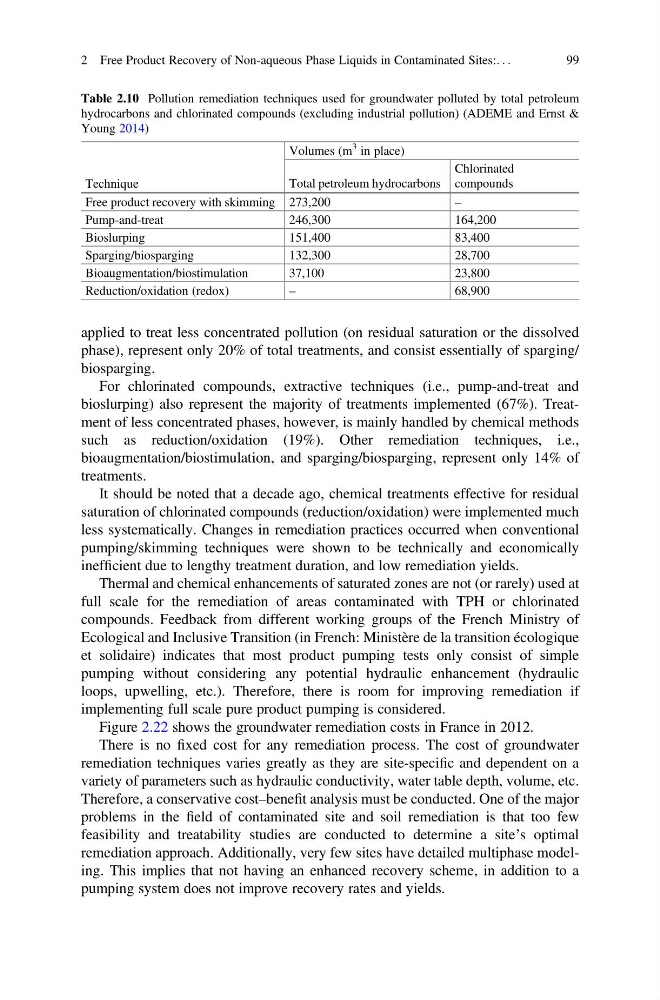
applied to treat less concentrated pollution (on residual saturation or the dissolved
phase), represent only 20% of total treatments, and consist essentially of sparging/
biosparging.
For chlorinated compounds, extractive techniques (i.e., pump-and-treat and
bioslurping) also represent the majority of treatments implemented (67%). Treatment of less concentrated phases, however, is mainly handled by chemical methods
such as reduction/oxidation (19%). Other remediation techniques, i.e.,
bioaugmentation/biostimulation, and sparging/biosparging, represent only 14% of
treatments.
It should be noted that a decade ago, chemical treatments effective for residual
saturation of chlorinated compounds (reduction/oxidation) were implemented much
less systematically. Changes in remediation practices occurred when conventional
pumping/skimming techniques were shown to be technically and economically
inefficient due to lengthy treatment duration, and low remediation yields.
Thermal and chemical enhancements of saturated zones are not (or rarely) used at
full scale for the remediation of areas contaminated with TPH or chlorinated
compounds. Feedback from different working groups of the French Ministry of
Ecological and Inclusive Transition (in French: Ministère de la transition écologique
et solidaire) indicates that most product pumping tests only consist of simple
pumping without considering any potential hydraulic enhancement (hydraulic
loops, upwelling, etc.). Therefore, there is room for improving remediation if
implementing full scale pure product pumping is considered.
Figure 2.22 shows the groundwater remediation costs in France in 2012.
There is no fixed cost for any remediation process. The cost of groundwater
remediation techniques varies greatly as they are site-specific and dependent on a
variety of parameters such as hydraulic conductivity, water table depth, volume, etc.
Therefore, a conservative cost–benefit analysis must be conducted. One of the major
problems in the field of contaminated site and soil remediation is that too few
feasibility and treatability studies are conducted to determine a site’s optimal
remediation approach. Additionally, very few sites have detailed multiphase modeling. This implies that not having an enhanced recovery scheme, in addition to a
pumping system does not improve recovery rates and yields.
Table 2.10 Pollution remediation techniques used for groundwater polluted by total petroleum
hydrocarbons and chlorinated compounds (excluding industrial pollution) (ADEME and Ernst &
Young 2014)
Technique
Volumes (m
3 in place)
Total petroleum hydrocarbons
Chlorinated
compounds
Free product recovery with skimming 273,200
–
Pump-and-treat
246,300
164,200
Bioslurping
151,400
83,400
Sparging/biosparging
132,300
28,700
Bioaugmentation/biostimulation
37,100
23,800
Reduction/oxidation (redox)
–
68,900
2 Free Product Recovery of Non-aqueous Phase Liquids in Contaminated Sites:. . .
99
phase), represent only 20% of total treatments, and consist essentially of sparging/
biosparging.
For chlorinated compounds, extractive techniques (i.e., pump-and-treat and
bioslurping) also represent the majority of treatments implemented (67%). Treatment of less concentrated phases, however, is mainly handled by chemical methods
such as reduction/oxidation (19%). Other remediation techniques, i.e.,
bioaugmentation/biostimulation, and sparging/biosparging, represent only 14% of
treatments.
It should be noted that a decade ago, chemical treatments effective for residual
saturation of chlorinated compounds (reduction/oxidation) were implemented much
less systematically. Changes in remediation practices occurred when conventional
pumping/skimming techniques were shown to be technically and economically
inefficient due to lengthy treatment duration, and low remediation yields.
Thermal and chemical enhancements of saturated zones are not (or rarely) used at
full scale for the remediation of areas contaminated with TPH or chlorinated
compounds. Feedback from different working groups of the French Ministry of
Ecological and Inclusive Transition (in French: Ministère de la transition écologique
et solidaire) indicates that most product pumping tests only consist of simple
pumping without considering any potential hydraulic enhancement (hydraulic
loops, upwelling, etc.). Therefore, there is room for improving remediation if
implementing full scale pure product pumping is considered.
Figure 2.22 shows the groundwater remediation costs in France in 2012.
There is no fixed cost for any remediation process. The cost of groundwater
remediation techniques varies greatly as they are site-specific and dependent on a
variety of parameters such as hydraulic conductivity, water table depth, volume, etc.
Therefore, a conservative cost–benefit analysis must be conducted. One of the major
problems in the field of contaminated site and soil remediation is that too few
feasibility and treatability studies are conducted to determine a site’s optimal
remediation approach. Additionally, very few sites have detailed multiphase modeling. This implies that not having an enhanced recovery scheme, in addition to a
pumping system does not improve recovery rates and yields.
Table 2.10 Pollution remediation techniques used for groundwater polluted by total petroleum
hydrocarbons and chlorinated compounds (excluding industrial pollution) (ADEME and Ernst &
Young 2014)
Technique
Volumes (m
3 in place)
Total petroleum hydrocarbons
Chlorinated
compounds
Free product recovery with skimming 273,200
–
Pump-and-treat
246,300
164,200
Bioslurping
151,400
83,400
Sparging/biosparging
132,300
28,700
Bioaugmentation/biostimulation
37,100
23,800
Reduction/oxidation (redox)
–
68,900
2 Free Product Recovery of Non-aqueous Phase Liquids in Contaminated Sites:. . .
99