

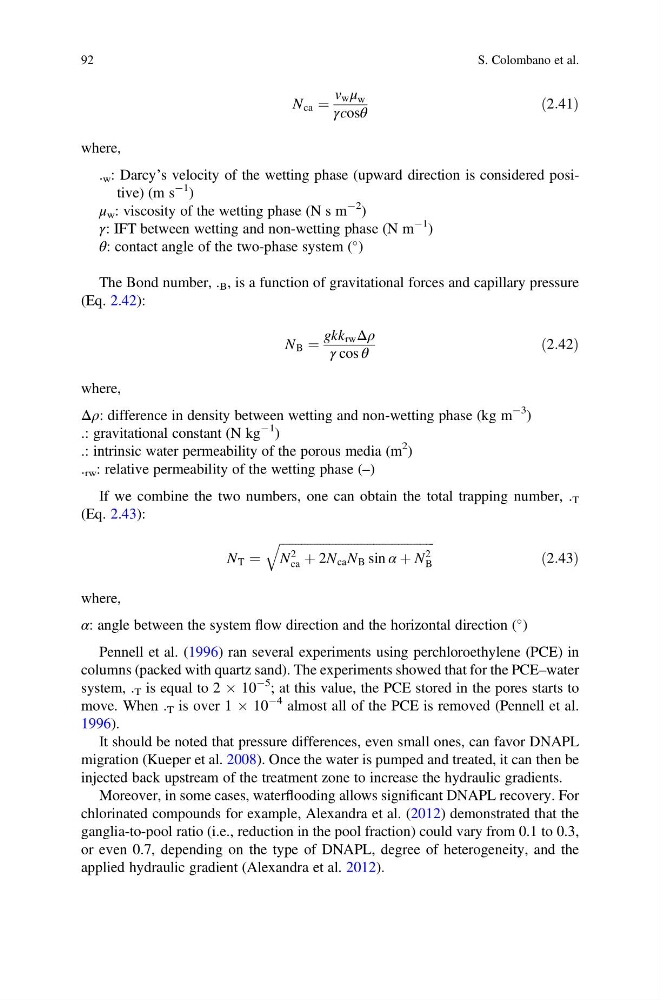
N ca ¼
v w μ w
γcosθ
ð2:41Þ
where,
. w : Darcy’s velocity of the wetting phase (upward direction is considered positive) (m s
À1 )
μ w : viscosity of the wetting phase (N s m
À2 )
γ: IFT between wetting and non-wetting phase (N m
À1 )
θ: contact angle of the two-phase system (
)
The Bond number, . B , is a function of gravitational forces and capillary pressure
(Eq. 2.42):
N B ¼
gkk rw Δρ
γ cos θ
ð2:42Þ
where,
Δρ: difference in density between wetting and non-wetting phase (kg m
À3 )
.: gravitational constant (N kg
À1 )
.: intrinsic water permeability of the porous media (m
2 )
. rw : relative permeability of the wetting phase (–)
If we combine the two numbers, one can obtain the total trapping number, . T
(Eq. 2.43):
N T ¼
ffiffiffiffiffiffiffiffiffiffiffiffiffiffiffiffiffiffiffiffiffiffiffiffiffiffiffiffiffiffiffiffiffiffiffiffiffiffiffiffiffiffiffiffiffiffiffiffiffi ffi
N
2
ca þ 2N ca N B sin α þ N
2
B
q
ð2:43Þ
where,
α: angle between the system flow direction and the horizontal direction (
)
Pennell et al. (1996) ran several experiments using perchloroethylene (PCE) in
columns (packed with quartz sand). The experiments showed that for the PCE–water
system, . T is equal to 2 Â 10
À5 ; at this value, the PCE stored in the pores starts to
move. When . T is over 1 Â 10
À4 almost all of the PCE is removed (Pennell et al.
1996).
It should be noted that pressure differences, even small ones, can favor DNAPL
migration (Kueper et al. 2008). Once the water is pumped and treated, it can then be
injected back upstream of the treatment zone to increase the hydraulic gradients.
Moreover, in some cases, waterflooding allows significant DNAPL recovery. For
chlorinated compounds for example, Alexandra et al. (2012) demonstrated that the
ganglia-to-pool ratio (i.e., reduction in the pool fraction) could vary from 0.1 to 0.3,
or even 0.7, depending on the type of DNAPL, degree of heterogeneity, and the
applied hydraulic gradient (Alexandra et al. 2012).
92
S. Colombano et al.
v w μ w
γcosθ
ð2:41Þ
where,
. w : Darcy’s velocity of the wetting phase (upward direction is considered positive) (m s
À1 )
μ w : viscosity of the wetting phase (N s m
À2 )
γ: IFT between wetting and non-wetting phase (N m
À1 )
θ: contact angle of the two-phase system (
)
The Bond number, . B , is a function of gravitational forces and capillary pressure
(Eq. 2.42):
N B ¼
gkk rw Δρ
γ cos θ
ð2:42Þ
where,
Δρ: difference in density between wetting and non-wetting phase (kg m
À3 )
.: gravitational constant (N kg
À1 )
.: intrinsic water permeability of the porous media (m
2 )
. rw : relative permeability of the wetting phase (–)
If we combine the two numbers, one can obtain the total trapping number, . T
(Eq. 2.43):
N T ¼
ffiffiffiffiffiffiffiffiffiffiffiffiffiffiffiffiffiffiffiffiffiffiffiffiffiffiffiffiffiffiffiffiffiffiffiffiffiffiffiffiffiffiffiffiffiffiffiffiffi ffi
N
2
ca þ 2N ca N B sin α þ N
2
B
q
ð2:43Þ
where,
α: angle between the system flow direction and the horizontal direction (
)
Pennell et al. (1996) ran several experiments using perchloroethylene (PCE) in
columns (packed with quartz sand). The experiments showed that for the PCE–water
system, . T is equal to 2 Â 10
À5 ; at this value, the PCE stored in the pores starts to
move. When . T is over 1 Â 10
À4 almost all of the PCE is removed (Pennell et al.
1996).
It should be noted that pressure differences, even small ones, can favor DNAPL
migration (Kueper et al. 2008). Once the water is pumped and treated, it can then be
injected back upstream of the treatment zone to increase the hydraulic gradients.
Moreover, in some cases, waterflooding allows significant DNAPL recovery. For
chlorinated compounds for example, Alexandra et al. (2012) demonstrated that the
ganglia-to-pool ratio (i.e., reduction in the pool fraction) could vary from 0.1 to 0.3,
or even 0.7, depending on the type of DNAPL, degree of heterogeneity, and the
applied hydraulic gradient (Alexandra et al. 2012).
92
S. Colombano et al.