

DNAPL will migrate if the left-hand side of Eq. (2.40) is greater than the righthand side, as follows:
Δρ
ρ w
L sin α þ Δh >
P c L
ð Þ À P c 0
ð Þ
ρ w g
ð2:40Þ
where,
Δρ: difference between DNAPL density ρ D and water density ρ w (kg m
À3 )
α: dip of the bed below horizontal (
)
.: gravitational acceleration (m s
À2 )
Δh: difference in hydraulic head between the top and bottom of the pool (.(0) À .
(L)) (m)
. c (L): capillary pressure at the bottom of the pool (Pa)
. c (0): capillary pressure at the top of the pool (Pa)
2. Another approach considers the fact that DNAPL mobilization occurs when the
interfacial tension (IFT) between the wetting (water) and non-wetting (DNAPL)
phases decreases. This decrease in IFT coupled with the change of viscosity in the
non-wetting phase allows the capillary pressure (which draws the DNAPL in the
pores) to be overcome (Pennell et al. 2014). Pennell et al. (1996) used a method to
estimate DNAPL mobilization in the porous medium (Pennell et al. 1996). This
method uses two types of numbers: the capillary number (N ca ), and the Bond
number (N B ). The capillary number can be expressed as in Eq. (2.41):
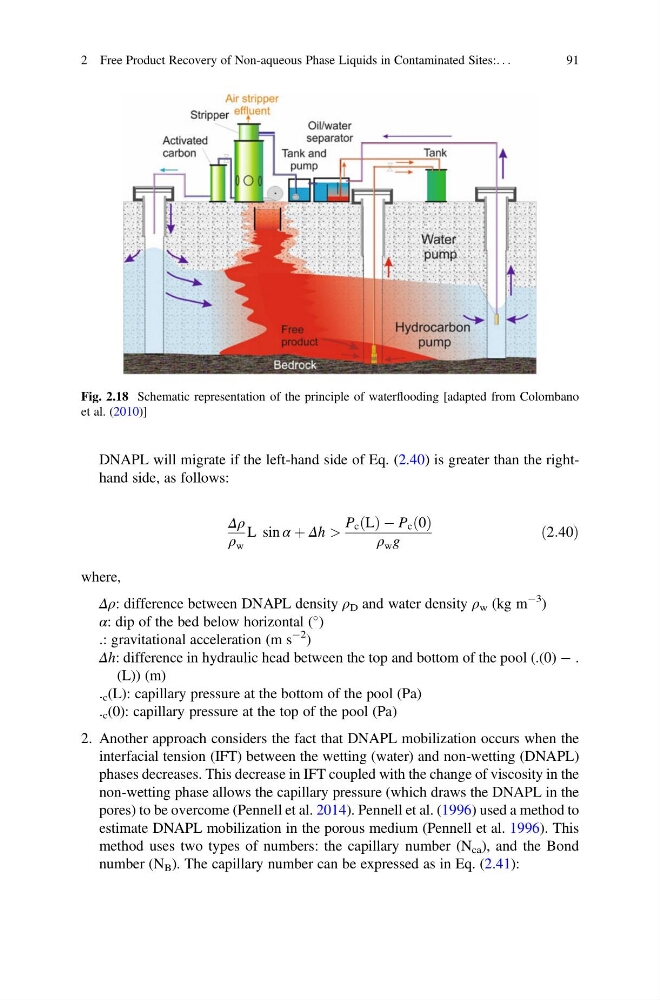
Fig. 2.18 Schematic representation of the principle of waterflooding [adapted from Colombano
et al. (2010)]
2 Free Product Recovery of Non-aqueous Phase Liquids in Contaminated Sites:. . .
91
Δρ
ρ w
L sin α þ Δh >
P c L
ð Þ À P c 0
ð Þ
ρ w g
ð2:40Þ
where,
Δρ: difference between DNAPL density ρ D and water density ρ w (kg m
À3 )
α: dip of the bed below horizontal (
)
.: gravitational acceleration (m s
À2 )
Δh: difference in hydraulic head between the top and bottom of the pool (.(0) À .
(L)) (m)
. c (L): capillary pressure at the bottom of the pool (Pa)
. c (0): capillary pressure at the top of the pool (Pa)
2. Another approach considers the fact that DNAPL mobilization occurs when the
interfacial tension (IFT) between the wetting (water) and non-wetting (DNAPL)
phases decreases. This decrease in IFT coupled with the change of viscosity in the
non-wetting phase allows the capillary pressure (which draws the DNAPL in the
pores) to be overcome (Pennell et al. 2014). Pennell et al. (1996) used a method to
estimate DNAPL mobilization in the porous medium (Pennell et al. 1996). This
method uses two types of numbers: the capillary number (N ca ), and the Bond
number (N B ). The capillary number can be expressed as in Eq. (2.41):
Fig. 2.18 Schematic representation of the principle of waterflooding [adapted from Colombano
et al. (2010)]
2 Free Product Recovery of Non-aqueous Phase Liquids in Contaminated Sites:. . .
91