

effectively, efficiently and synergistically across its many different uses for food,
feed, fuel and fibre (Johnson and Virgin 2010).
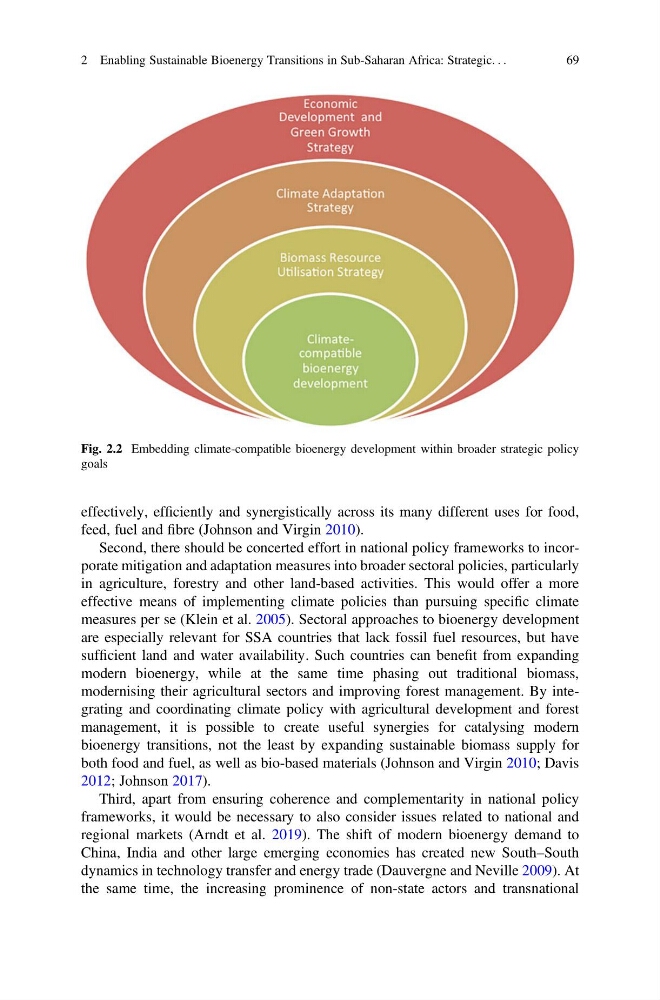
Second, there should be concerted effort in national policy frameworks to incorporate mitigation and adaptation measures into broader sectoral policies, particularly
in agriculture, forestry and other land-based activities. This would offer a more
effective means of implementing climate policies than pursuing specific climate
measures per se (Klein et al. 2005). Sectoral approaches to bioenergy development
are especially relevant for SSA countries that lack fossil fuel resources, but have
sufficient land and water availability. Such countries can benefit from expanding
modern bioenergy, while at the same time phasing out traditional biomass,
modernising their agricultural sectors and improving forest management. By integrating and coordinating climate policy with agricultural development and forest
management, it is possible to create useful synergies for catalysing modern
bioenergy transitions, not the least by expanding sustainable biomass supply for
both food and fuel, as well as bio-based materials (Johnson and Virgin 2010; Davis
2012; Johnson 2017).
Third, apart from ensuring coherence and complementarity in national policy
frameworks, it would be necessary to also consider issues related to national and
regional markets (Arndt et al. 2019). The shift of modern bioenergy demand to
China, India and other large emerging economies has created new South–South
dynamics in technology transfer and energy trade (Dauvergne and Neville 2009). At
the same time, the increasing prominence of non-state actors and transnational
Fig. 2.2 Embedding climate-compatible bioenergy development within broader strategic policy
goals
2 Enabling Sustainable Bioenergy Transitions in Sub-Saharan Africa: Strategic. . .
69
feed, fuel and fibre (Johnson and Virgin 2010).
Second, there should be concerted effort in national policy frameworks to incorporate mitigation and adaptation measures into broader sectoral policies, particularly
in agriculture, forestry and other land-based activities. This would offer a more
effective means of implementing climate policies than pursuing specific climate
measures per se (Klein et al. 2005). Sectoral approaches to bioenergy development
are especially relevant for SSA countries that lack fossil fuel resources, but have
sufficient land and water availability. Such countries can benefit from expanding
modern bioenergy, while at the same time phasing out traditional biomass,
modernising their agricultural sectors and improving forest management. By integrating and coordinating climate policy with agricultural development and forest
management, it is possible to create useful synergies for catalysing modern
bioenergy transitions, not the least by expanding sustainable biomass supply for
both food and fuel, as well as bio-based materials (Johnson and Virgin 2010; Davis
2012; Johnson 2017).
Third, apart from ensuring coherence and complementarity in national policy
frameworks, it would be necessary to also consider issues related to national and
regional markets (Arndt et al. 2019). The shift of modern bioenergy demand to
China, India and other large emerging economies has created new South–South
dynamics in technology transfer and energy trade (Dauvergne and Neville 2009). At
the same time, the increasing prominence of non-state actors and transnational
Fig. 2.2 Embedding climate-compatible bioenergy development within broader strategic policy
goals
2 Enabling Sustainable Bioenergy Transitions in Sub-Saharan Africa: Strategic. . .
69