

stakeholders, including the private sector and vulnerable communities (NAP-GSP
2017). However, this is particularly difficult considering the challenges in forming
effective partnerships on the continent (Sect. 1.2.17).
1.2.14 SDG 14: Life Below Water
SSA contains 38 coastal and island states, which collectively oversee 13 million km
2
of exclusive economic zones and have a combined coastline stretching over
47,000 km (UNECA 2016b). Most major coastal and marine habitats throughout
the continent face significant degradation due to habitat loss/change,
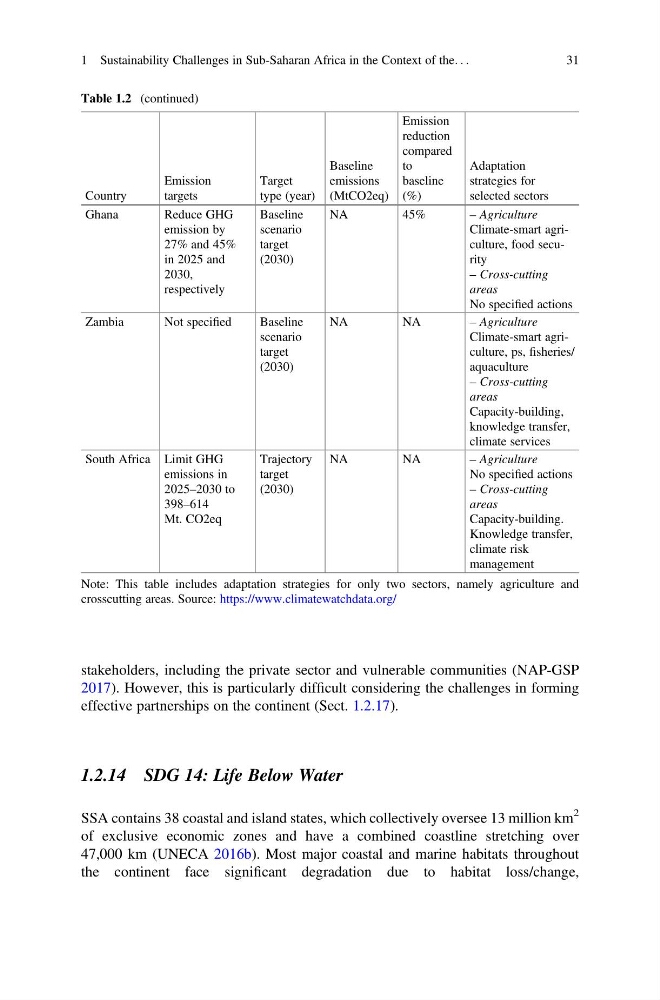
Table 1.2 (continued)
Country
Emission
targets
Target
type (year)
Baseline
emissions
(MtCO2eq)
Emission
reduction
compared
to
baseline
(%)
Adaptation
strategies for
selected sectors
Ghana
Reduce GHG
emission by
27% and 45%
in 2025 and
2030,
respectively
Baseline
scenario
target
(2030)
NA
45%
– Agriculture
Climate-smart agriculture, food security
– Cross-cutting
areas
No specified actions
Zambia
Not specified
Baseline
scenario
target
(2030)
NA
NA
– Agriculture
Climate-smart agriculture, ps, fisheries/
aquaculture
– Cross-cutting
areas
Capacity-building,
knowledge transfer,
climate services
South Africa Limit GHG
emissions in
2025–2030 to
398–614
Mt. CO2eq
Trajectory
target
(2030)
NA
NA
– Agriculture
No specified actions
– Cross-cutting
areas
Capacity-building.
Knowledge transfer,
climate risk
management
Note: This table includes adaptation strategies for only two sectors, namely agriculture and
crosscutting areas. Source: https://www.climatewatchdata.org/
1 Sustainability Challenges in Sub-Saharan Africa in the Context of the. . .
31
2017). However, this is particularly difficult considering the challenges in forming
effective partnerships on the continent (Sect. 1.2.17).
1.2.14 SDG 14: Life Below Water
SSA contains 38 coastal and island states, which collectively oversee 13 million km
2
of exclusive economic zones and have a combined coastline stretching over
47,000 km (UNECA 2016b). Most major coastal and marine habitats throughout
the continent face significant degradation due to habitat loss/change,
Table 1.2 (continued)
Country
Emission
targets
Target
type (year)
Baseline
emissions
(MtCO2eq)
Emission
reduction
compared
to
baseline
(%)
Adaptation
strategies for
selected sectors
Ghana
Reduce GHG
emission by
27% and 45%
in 2025 and
2030,
respectively
Baseline
scenario
target
(2030)
NA
45%
– Agriculture
Climate-smart agriculture, food security
– Cross-cutting
areas
No specified actions
Zambia
Not specified
Baseline
scenario
target
(2030)
NA
NA
– Agriculture
Climate-smart agriculture, ps, fisheries/
aquaculture
– Cross-cutting
areas
Capacity-building,
knowledge transfer,
climate services
South Africa Limit GHG
emissions in
2025–2030 to
398–614
Mt. CO2eq
Trajectory
target
(2030)
NA
NA
– Agriculture
No specified actions
– Cross-cutting
areas
Capacity-building.
Knowledge transfer,
climate risk
management
Note: This table includes adaptation strategies for only two sectors, namely agriculture and
crosscutting areas. Source: https://www.climatewatchdata.org/
1 Sustainability Challenges in Sub-Saharan Africa in the Context of the. . .
31