

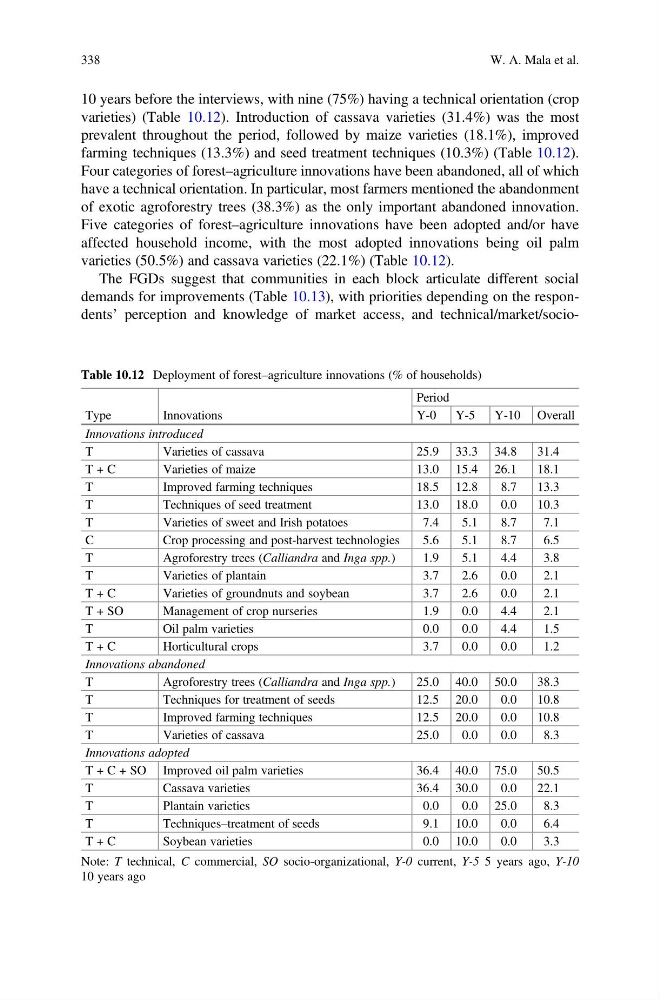
10 years before the interviews, with nine (75%) having a technical orientation (crop
varieties) (Table 10.12). Introduction of cassava varieties (31.4%) was the most
prevalent throughout the period, followed by maize varieties (18.1%), improved
farming techniques (13.3%) and seed treatment techniques (10.3%) (Table 10.12).
Four categories of forest–agriculture innovations have been abandoned, all of which
have a technical orientation. In particular, most farmers mentioned the abandonment
of exotic agroforestry trees (38.3%) as the only important abandoned innovation.
Five categories of forest–agriculture innovations have been adopted and/or have
affected household income, with the most adopted innovations being oil palm
varieties (50.5%) and cassava varieties (22.1%) (Table 10.12).
The FGDs suggest that communities in each block articulate different social
demands for improvements (Table 10.13), with priorities depending on the respondents’ perception and knowledge of market access, and technical/market/socioTable 10.12 Deployment of forest–agriculture innovations (% of households)
Type
Innovations
Period
Y-0
Y-5
Y-10 Overall
Innovations introduced
T
Varieties of cassava
25.9 33.3 34.8
31.4
T + C
Varieties of maize
13.0 15.4 26.1
18.1
T
Improved farming techniques
18.5 12.8
8.7
13.3
T
Techniques of seed treatment
13.0 18.0
0.0
10.3
T
Varieties of sweet and Irish potatoes
7.4
5.1
8.7
7.1
C
Crop processing and post-harvest technologies
5.6
5.1
8.7
6.5
T
Agroforestry trees (Calliandra and Inga spp.)
1.9
5.1
4.4
3.8
T
Varieties of plantain
3.7
2.6
0.0
2.1
T + C
Varieties of groundnuts and soybean
3.7
2.6
0.0
2.1
T + SO
Management of crop nurseries
1.9
0.0
4.4
2.1
T
Oil palm varieties
0.0
0.0
4.4
1.5
T + C
Horticultural crops
3.7
0.0
0.0
1.2
Innovations abandoned
T
Agroforestry trees (Calliandra and Inga spp.)
25.0 40.0 50.0
38.3
T
Techniques for treatment of seeds
12.5 20.0
0.0
10.8
T
Improved farming techniques
12.5 20.0
0.0
10.8
T
Varieties of cassava
25.0
0.0
0.0
8.3
Innovations adopted
T + C + SO Improved oil palm varieties
36.4 40.0 75.0
50.5
T
Cassava varieties
36.4 30.0
0.0
22.1
T
Plantain varieties
0.0
0.0 25.0
8.3
T
Techniques–treatment of seeds
9.1 10.0
0.0
6.4
T + C
Soybean varieties
0.0 10.0
0.0
3.3
Note: T technical, C commercial, SO socio-organizational, Y-0 current, Y-5 5 years ago, Y-10
10 years ago
338
W. A. Mala et al.
varieties) (Table 10.12). Introduction of cassava varieties (31.4%) was the most
prevalent throughout the period, followed by maize varieties (18.1%), improved
farming techniques (13.3%) and seed treatment techniques (10.3%) (Table 10.12).
Four categories of forest–agriculture innovations have been abandoned, all of which
have a technical orientation. In particular, most farmers mentioned the abandonment
of exotic agroforestry trees (38.3%) as the only important abandoned innovation.
Five categories of forest–agriculture innovations have been adopted and/or have
affected household income, with the most adopted innovations being oil palm
varieties (50.5%) and cassava varieties (22.1%) (Table 10.12).
The FGDs suggest that communities in each block articulate different social
demands for improvements (Table 10.13), with priorities depending on the respondents’ perception and knowledge of market access, and technical/market/socioTable 10.12 Deployment of forest–agriculture innovations (% of households)
Type
Innovations
Period
Y-0
Y-5
Y-10 Overall
Innovations introduced
T
Varieties of cassava
25.9 33.3 34.8
31.4
T + C
Varieties of maize
13.0 15.4 26.1
18.1
T
Improved farming techniques
18.5 12.8
8.7
13.3
T
Techniques of seed treatment
13.0 18.0
0.0
10.3
T
Varieties of sweet and Irish potatoes
7.4
5.1
8.7
7.1
C
Crop processing and post-harvest technologies
5.6
5.1
8.7
6.5
T
Agroforestry trees (Calliandra and Inga spp.)
1.9
5.1
4.4
3.8
T
Varieties of plantain
3.7
2.6
0.0
2.1
T + C
Varieties of groundnuts and soybean
3.7
2.6
0.0
2.1
T + SO
Management of crop nurseries
1.9
0.0
4.4
2.1
T
Oil palm varieties
0.0
0.0
4.4
1.5
T + C
Horticultural crops
3.7
0.0
0.0
1.2
Innovations abandoned
T
Agroforestry trees (Calliandra and Inga spp.)
25.0 40.0 50.0
38.3
T
Techniques for treatment of seeds
12.5 20.0
0.0
10.8
T
Improved farming techniques
12.5 20.0
0.0
10.8
T
Varieties of cassava
25.0
0.0
0.0
8.3
Innovations adopted
T + C + SO Improved oil palm varieties
36.4 40.0 75.0
50.5
T
Cassava varieties
36.4 30.0
0.0
22.1
T
Plantain varieties
0.0
0.0 25.0
8.3
T
Techniques–treatment of seeds
9.1 10.0
0.0
6.4
T + C
Soybean varieties
0.0 10.0
0.0
3.3
Note: T technical, C commercial, SO socio-organizational, Y-0 current, Y-5 5 years ago, Y-10
10 years ago
338
W. A. Mala et al.