

crop varieties, (c) introduction of new crop varieties and/or tree species,
(d) introduction of improved crop varieties, (e) introduction of improved farming
methods and (f) use of local pesticides.
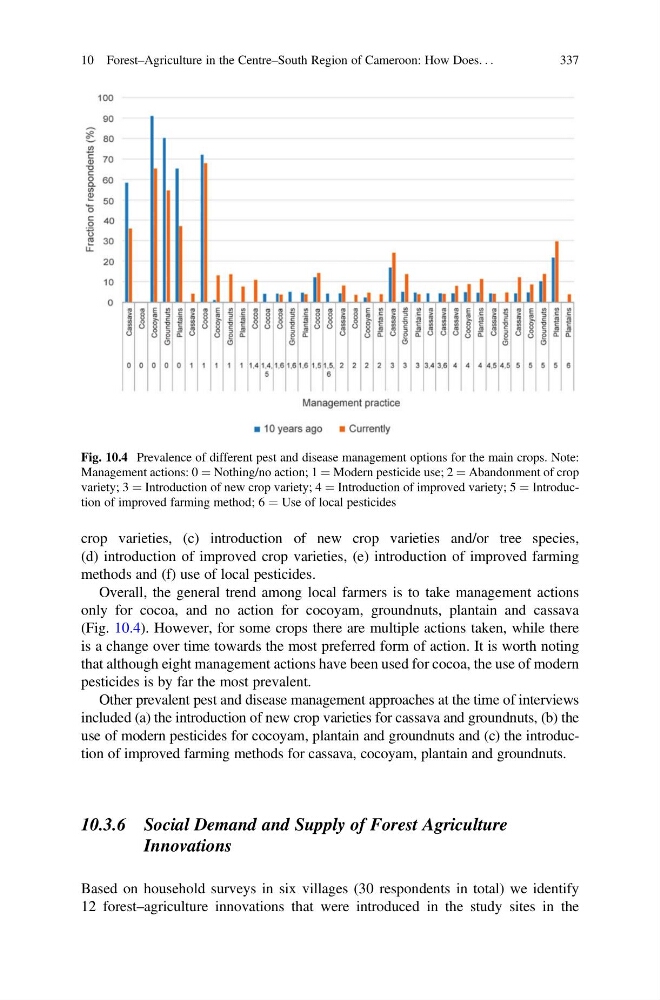
Overall, the general trend among local farmers is to take management actions
only for cocoa, and no action for cocoyam, groundnuts, plantain and cassava
(Fig. 10.4). However, for some crops there are multiple actions taken, while there
is a change over time towards the most preferred form of action. It is worth noting
that although eight management actions have been used for cocoa, the use of modern
pesticides is by far the most prevalent.
Other prevalent pest and disease management approaches at the time of interviews
included (a) the introduction of new crop varieties for cassava and groundnuts, (b) the
use of modern pesticides for cocoyam, plantain and groundnuts and (c) the introduction of improved farming methods for cassava, cocoyam, plantain and groundnuts.
10.3.6 Social Demand and Supply of Forest Agriculture
Innovations
Based on household surveys in six villages (30 respondents in total) we identify
12 forest–agriculture innovations that were introduced in the study sites in the
Fig. 10.4 Prevalence of different pest and disease management options for the main crops. Note:
Management actions: 0 ¼ Nothing/no action; 1 ¼ Modern pesticide use; 2 ¼ Abandonment of crop
variety; 3 ¼ Introduction of new crop variety; 4 ¼ Introduction of improved variety; 5 ¼ Introduction of improved farming method; 6 ¼ Use of local pesticides
10 Forest–Agriculture in the Centre–South Region of Cameroon: How Does. . .
337
(d) introduction of improved crop varieties, (e) introduction of improved farming
methods and (f) use of local pesticides.
Overall, the general trend among local farmers is to take management actions
only for cocoa, and no action for cocoyam, groundnuts, plantain and cassava
(Fig. 10.4). However, for some crops there are multiple actions taken, while there
is a change over time towards the most preferred form of action. It is worth noting
that although eight management actions have been used for cocoa, the use of modern
pesticides is by far the most prevalent.
Other prevalent pest and disease management approaches at the time of interviews
included (a) the introduction of new crop varieties for cassava and groundnuts, (b) the
use of modern pesticides for cocoyam, plantain and groundnuts and (c) the introduction of improved farming methods for cassava, cocoyam, plantain and groundnuts.
10.3.6 Social Demand and Supply of Forest Agriculture
Innovations
Based on household surveys in six villages (30 respondents in total) we identify
12 forest–agriculture innovations that were introduced in the study sites in the
Fig. 10.4 Prevalence of different pest and disease management options for the main crops. Note:
Management actions: 0 ¼ Nothing/no action; 1 ¼ Modern pesticide use; 2 ¼ Abandonment of crop
variety; 3 ¼ Introduction of new crop variety; 4 ¼ Introduction of improved variety; 5 ¼ Introduction of improved farming method; 6 ¼ Use of local pesticides
10 Forest–Agriculture in the Centre–South Region of Cameroon: How Does. . .
337