

9.3.2.2 Determinants of Vegetation
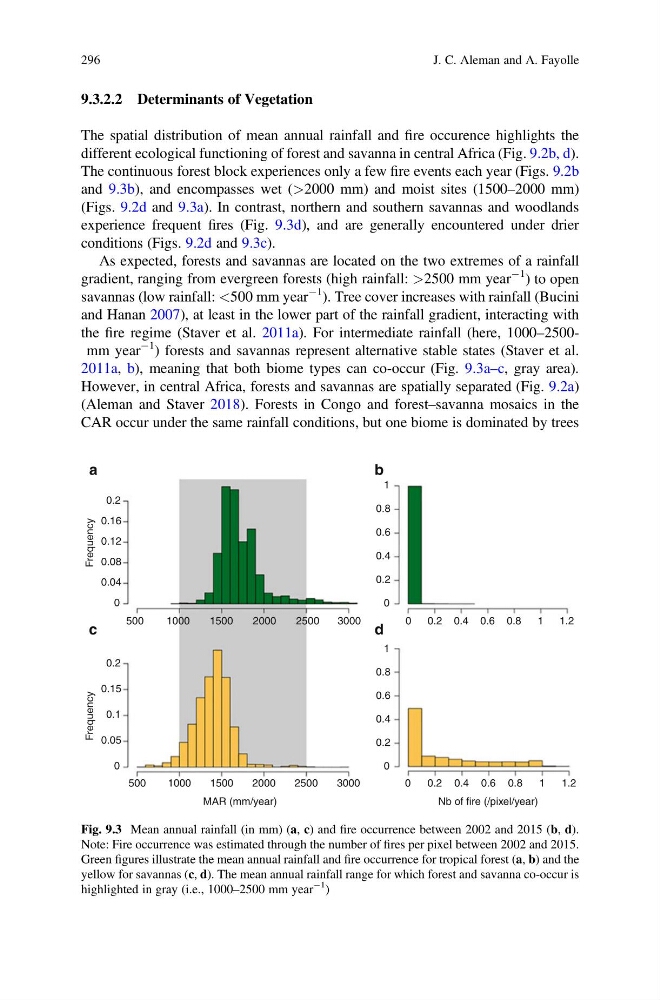
The spatial distribution of mean annual rainfall and fire occurence highlights the
different ecological functioning of forest and savanna in central Africa (Fig. 9.2b, d).
The continuous forest block experiences only a few fire events each year (Figs. 9.2b
and 9.3b), and encompasses wet (>2000 mm) and moist sites (1500–2000 mm)
(Figs. 9.2d and 9.3a). In contrast, northern and southern savannas and woodlands
experience frequent fires (Fig. 9.3d), and are generally encountered under drier
conditions (Figs. 9.2d and 9.3c).
As expected, forests and savannas are located on the two extremes of a rainfall
gradient, ranging from evergreen forests (high rainfall: >2500 mm year
À1 ) to open
savannas (low rainfall: <500 mm year
À1 ). Tree cover increases with rainfall (Bucini
and Hanan 2007), at least in the lower part of the rainfall gradient, interacting with
the fire regime (Staver et al. 2011a). For intermediate rainfall (here, 1000–2500mm year
À1 ) forests and savannas represent alternative stable states (Staver et al.
2011a, b), meaning that both biome types can co-occur (Fig. 9.3a–c, gray area).
However, in central Africa, forests and savannas are spatially separated (Fig. 9.2a)
(Aleman and Staver 2018). Forests in Congo and forest–savanna mosaics in the
CAR occur under the same rainfall conditions, but one biome is dominated by trees
0.2
0.16
0.12
0.08
0.04
0
1
0.8
0.6
0.4
0.2
0
1
0.8
0.6
0.4
0.2
0
500
1000
1500
2000
2500
3000
500
1000
1500
2000
2500
3000
Frequency
0.2
0.15
0.1
0.05
0
Frequency
MAR (mm/year)
Nb of fire (/pixel/year)
0
0.2 0.4 0.6 0.8
1
1.2
0
0.2 0.4 0.6 0.8
1
1.2
a
b
c
d
Fig. 9.3 Mean annual rainfall (in mm) (a, c) and fire occurrence between 2002 and 2015 (b, d).
Note: Fire occurrence was estimated through the number of fires per pixel between 2002 and 2015.
Green figures illustrate the mean annual rainfall and fire occurrence for tropical forest (a, b) and the
yellow for savannas (c, d). The mean annual rainfall range for which forest and savanna co-occur is
highlighted in gray (i.e., 1000–2500 mm year
À1
)
296
J. C. Aleman and A. Fayolle
The spatial distribution of mean annual rainfall and fire occurence highlights the
different ecological functioning of forest and savanna in central Africa (Fig. 9.2b, d).
The continuous forest block experiences only a few fire events each year (Figs. 9.2b
and 9.3b), and encompasses wet (>2000 mm) and moist sites (1500–2000 mm)
(Figs. 9.2d and 9.3a). In contrast, northern and southern savannas and woodlands
experience frequent fires (Fig. 9.3d), and are generally encountered under drier
conditions (Figs. 9.2d and 9.3c).
As expected, forests and savannas are located on the two extremes of a rainfall
gradient, ranging from evergreen forests (high rainfall: >2500 mm year
À1 ) to open
savannas (low rainfall: <500 mm year
À1 ). Tree cover increases with rainfall (Bucini
and Hanan 2007), at least in the lower part of the rainfall gradient, interacting with
the fire regime (Staver et al. 2011a). For intermediate rainfall (here, 1000–2500mm year
À1 ) forests and savannas represent alternative stable states (Staver et al.
2011a, b), meaning that both biome types can co-occur (Fig. 9.3a–c, gray area).
However, in central Africa, forests and savannas are spatially separated (Fig. 9.2a)
(Aleman and Staver 2018). Forests in Congo and forest–savanna mosaics in the
CAR occur under the same rainfall conditions, but one biome is dominated by trees
0.2
0.16
0.12
0.08
0.04
0
1
0.8
0.6
0.4
0.2
0
1
0.8
0.6
0.4
0.2
0
500
1000
1500
2000
2500
3000
500
1000
1500
2000
2500
3000
Frequency
0.2
0.15
0.1
0.05
0
Frequency
MAR (mm/year)
Nb of fire (/pixel/year)
0
0.2 0.4 0.6 0.8
1
1.2
0
0.2 0.4 0.6 0.8
1
1.2
a
b
c
d
Fig. 9.3 Mean annual rainfall (in mm) (a, c) and fire occurrence between 2002 and 2015 (b, d).
Note: Fire occurrence was estimated through the number of fires per pixel between 2002 and 2015.
Green figures illustrate the mean annual rainfall and fire occurrence for tropical forest (a, b) and the
yellow for savannas (c, d). The mean annual rainfall range for which forest and savanna co-occur is
highlighted in gray (i.e., 1000–2500 mm year
À1
)
296
J. C. Aleman and A. Fayolle