

8.3.1.3 Research Funding and Collaborative Research
The government is the main funder of the UG. However, according to the UG
Strategic Plan (2014–2024), government support has decreased from 90% to less
than 50% of the actual operating expenditure within the last decade (Table 8.2).
Other funding comes from internally generated funds (mainly from academic fees),
research grants and other sources.
Research fundraising has become a crucial avenue to raise funds for the UG
research activities and outputs. ORID facilitates research fundraising by offering
research support services, ranging from identifying research funding opportunities to
processing grant applications (Table 8.3). In 2013, ORID received support from the
Association of African Universities (AAU) to establish mechanisms for ensuring the
effective coordination of activities as diverse as fundraising, monitoring and evaluation and managing donor relations. For IAST, despite the identification of various
priority research areas, research funding for the period 2014–2017 was obtained
from only a few industries, mainly the Japan International Research Center for
Agricultural Sciences (JIRCAS) (USD 10,000), Bank of Ghana (USD 10,000) and
Fuji Oil (USD 10,000) (pers. comm. IAST 2017).
The research funding managed by ORID and IAST has progressively increased in
various key thematic areas (Table 8.4), in line with UGs vision to become a research
intensive institution in four prioritized areas for international research collaboration:
(a) malaria research, (b) climate change adaptation, (c) food production and
processing and (d) development policy and poverty monitoring and evaluation.
There is no funding that is being specifically allocated for sustainable development
research. However, the Centre for Climate and Sustainability Studies (C3SS)
(launched in March 2017) provides a Climate Change Resources Centre for
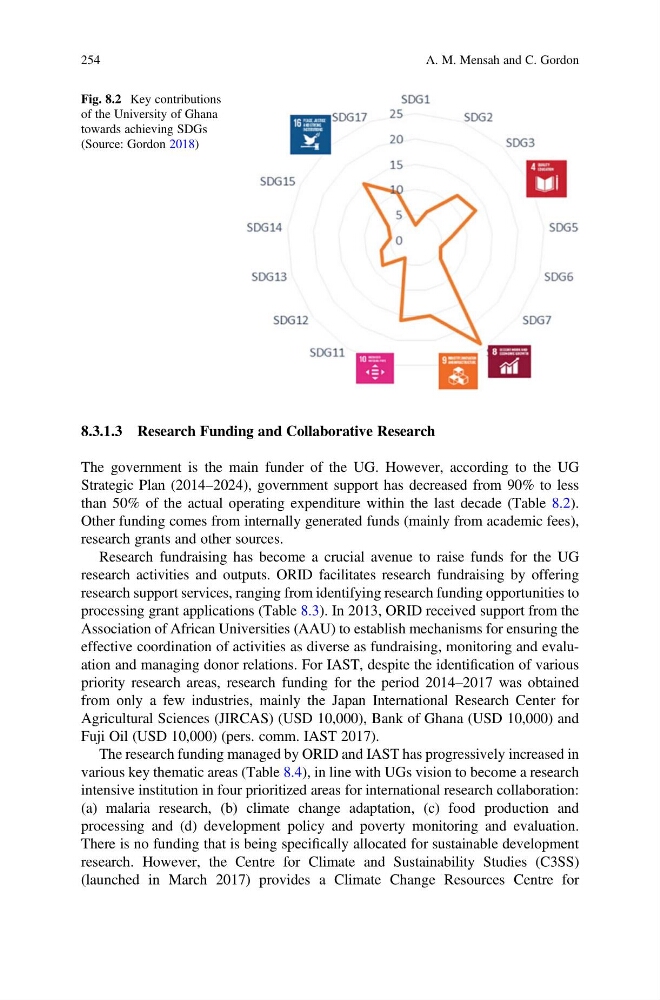
Fig. 8.2 Key contributions
of the University of Ghana
towards achieving SDGs
(Source: Gordon 2018)
254
A. M. Mensah and C. Gordon
The government is the main funder of the UG. However, according to the UG
Strategic Plan (2014–2024), government support has decreased from 90% to less
than 50% of the actual operating expenditure within the last decade (Table 8.2).
Other funding comes from internally generated funds (mainly from academic fees),
research grants and other sources.
Research fundraising has become a crucial avenue to raise funds for the UG
research activities and outputs. ORID facilitates research fundraising by offering
research support services, ranging from identifying research funding opportunities to
processing grant applications (Table 8.3). In 2013, ORID received support from the
Association of African Universities (AAU) to establish mechanisms for ensuring the
effective coordination of activities as diverse as fundraising, monitoring and evaluation and managing donor relations. For IAST, despite the identification of various
priority research areas, research funding for the period 2014–2017 was obtained
from only a few industries, mainly the Japan International Research Center for
Agricultural Sciences (JIRCAS) (USD 10,000), Bank of Ghana (USD 10,000) and
Fuji Oil (USD 10,000) (pers. comm. IAST 2017).
The research funding managed by ORID and IAST has progressively increased in
various key thematic areas (Table 8.4), in line with UGs vision to become a research
intensive institution in four prioritized areas for international research collaboration:
(a) malaria research, (b) climate change adaptation, (c) food production and
processing and (d) development policy and poverty monitoring and evaluation.
There is no funding that is being specifically allocated for sustainable development
research. However, the Centre for Climate and Sustainability Studies (C3SS)
(launched in March 2017) provides a Climate Change Resources Centre for
Fig. 8.2 Key contributions
of the University of Ghana
towards achieving SDGs
(Source: Gordon 2018)
254
A. M. Mensah and C. Gordon