

8.3 Results
8.3.1 University of Ghana
8.3.1.1 Policies and Regulatory Frameworks
The National Council for Tertiary Education (NCTE) coordinates the activities of the
UG as an institution of tertiary education in the country, alongside other specialized
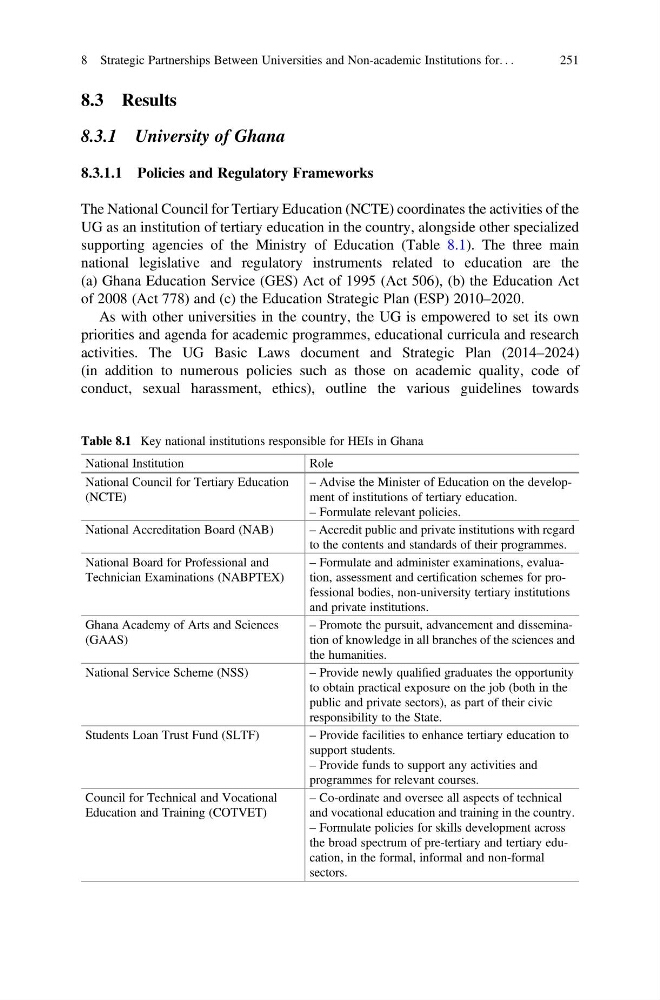
supporting agencies of the Ministry of Education (Table 8.1). The three main
national legislative and regulatory instruments related to education are the
(a) Ghana Education Service (GES) Act of 1995 (Act 506), (b) the Education Act
of 2008 (Act 778) and (c) the Education Strategic Plan (ESP) 2010–2020.
As with other universities in the country, the UG is empowered to set its own
priorities and agenda for academic programmes, educational curricula and research
activities. The UG Basic Laws document and Strategic Plan (2014–2024)
(in addition to numerous policies such as those on academic quality, code of
conduct, sexual harassment, ethics), outline the various guidelines towards
Table 8.1 Key national institutions responsible for HEIs in Ghana
National Institution
Role
National Council for Tertiary Education
(NCTE)
– Advise the Minister of Education on the development of institutions of tertiary education.
– Formulate relevant policies.
National Accreditation Board (NAB)
– Accredit public and private institutions with regard
to the contents and standards of their programmes.
National Board for Professional and
Technician Examinations (NABPTEX)
– Formulate and administer examinations, evaluation, assessment and certification schemes for professional bodies, non-university tertiary institutions
and private institutions.
Ghana Academy of Arts and Sciences
(GAAS)
– Promote the pursuit, advancement and dissemination of knowledge in all branches of the sciences and
the humanities.
National Service Scheme (NSS)
– Provide newly qualified graduates the opportunity
to obtain practical exposure on the job (both in the
public and private sectors), as part of their civic
responsibility to the State.
Students Loan Trust Fund (SLTF)
– Provide facilities to enhance tertiary education to
support students.
– Provide funds to support any activities and
programmes for relevant courses.
Council for Technical and Vocational
Education and Training (COTVET)
– Co-ordinate and oversee all aspects of technical
and vocational education and training in the country.
– Formulate policies for skills development across
the broad spectrum of pre-tertiary and tertiary education, in the formal, informal and non-formal
sectors.
8 Strategic Partnerships Between Universities and Non-academic Institutions for. . .
251
8.3.1 University of Ghana
8.3.1.1 Policies and Regulatory Frameworks
The National Council for Tertiary Education (NCTE) coordinates the activities of the
UG as an institution of tertiary education in the country, alongside other specialized
supporting agencies of the Ministry of Education (Table 8.1). The three main
national legislative and regulatory instruments related to education are the
(a) Ghana Education Service (GES) Act of 1995 (Act 506), (b) the Education Act
of 2008 (Act 778) and (c) the Education Strategic Plan (ESP) 2010–2020.
As with other universities in the country, the UG is empowered to set its own
priorities and agenda for academic programmes, educational curricula and research
activities. The UG Basic Laws document and Strategic Plan (2014–2024)
(in addition to numerous policies such as those on academic quality, code of
conduct, sexual harassment, ethics), outline the various guidelines towards
Table 8.1 Key national institutions responsible for HEIs in Ghana
National Institution
Role
National Council for Tertiary Education
(NCTE)
– Advise the Minister of Education on the development of institutions of tertiary education.
– Formulate relevant policies.
National Accreditation Board (NAB)
– Accredit public and private institutions with regard
to the contents and standards of their programmes.
National Board for Professional and
Technician Examinations (NABPTEX)
– Formulate and administer examinations, evaluation, assessment and certification schemes for professional bodies, non-university tertiary institutions
and private institutions.
Ghana Academy of Arts and Sciences
(GAAS)
– Promote the pursuit, advancement and dissemination of knowledge in all branches of the sciences and
the humanities.
National Service Scheme (NSS)
– Provide newly qualified graduates the opportunity
to obtain practical exposure on the job (both in the
public and private sectors), as part of their civic
responsibility to the State.
Students Loan Trust Fund (SLTF)
– Provide facilities to enhance tertiary education to
support students.
– Provide funds to support any activities and
programmes for relevant courses.
Council for Technical and Vocational
Education and Training (COTVET)
– Co-ordinate and oversee all aspects of technical
and vocational education and training in the country.
– Formulate policies for skills development across
the broad spectrum of pre-tertiary and tertiary education, in the formal, informal and non-formal
sectors.
8 Strategic Partnerships Between Universities and Non-academic Institutions for. . .
251