

The Triple Helix model has evolved over time with various interpretations and
critiques (Etzkowitz 2003; Etzkowitz and Leydesdorff 2000; Leydesdorff 2010)
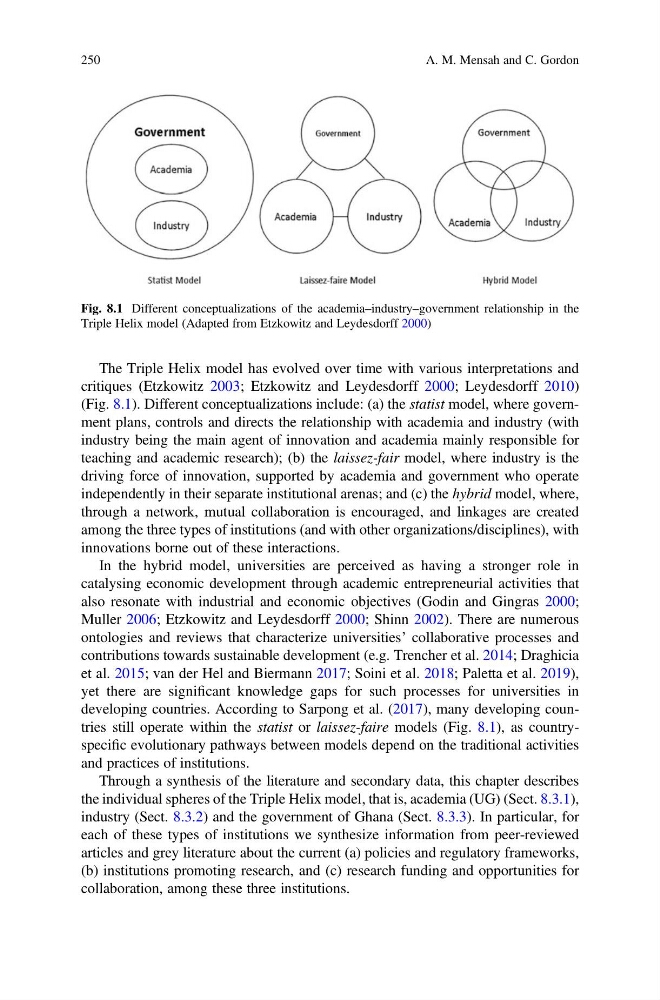
(Fig. 8.1). Different conceptualizations include: (a) the statist model, where government plans, controls and directs the relationship with academia and industry (with
industry being the main agent of innovation and academia mainly responsible for
teaching and academic research); (b) the laissez-fair model, where industry is the
driving force of innovation, supported by academia and government who operate
independently in their separate institutional arenas; and (c) the hybrid model, where,
through a network, mutual collaboration is encouraged, and linkages are created
among the three types of institutions (and with other organizations/disciplines), with
innovations borne out of these interactions.
In the hybrid model, universities are perceived as having a stronger role in
catalysing economic development through academic entrepreneurial activities that
also resonate with industrial and economic objectives (Godin and Gingras 2000;
Muller 2006; Etzkowitz and Leydesdorff 2000; Shinn 2002). There are numerous
ontologies and reviews that characterize universities’ collaborative processes and
contributions towards sustainable development (e.g. Trencher et al. 2014; Draghicia
et al. 2015; van der Hel and Biermann 2017; Soini et al. 2018; Paletta et al. 2019),
yet there are significant knowledge gaps for such processes for universities in
developing countries. According to Sarpong et al. (2017), many developing countries still operate within the statist or laissez-faire models (Fig. 8.1), as countryspecific evolutionary pathways between models depend on the traditional activities
and practices of institutions.
Through a synthesis of the literature and secondary data, this chapter describes
the individual spheres of the Triple Helix model, that is, academia (UG) (Sect. 8.3.1),
industry (Sect. 8.3.2) and the government of Ghana (Sect. 8.3.3). In particular, for
each of these types of institutions we synthesize information from peer-reviewed
articles and grey literature about the current (a) policies and regulatory frameworks,
(b) institutions promoting research, and (c) research funding and opportunities for
collaboration, among these three institutions.
Fig. 8.1 Different conceptualizations of the academia–industry–government relationship in the
Triple Helix model (Adapted from Etzkowitz and Leydesdorff 2000)
250
A. M. Mensah and C. Gordon
critiques (Etzkowitz 2003; Etzkowitz and Leydesdorff 2000; Leydesdorff 2010)
(Fig. 8.1). Different conceptualizations include: (a) the statist model, where government plans, controls and directs the relationship with academia and industry (with
industry being the main agent of innovation and academia mainly responsible for
teaching and academic research); (b) the laissez-fair model, where industry is the
driving force of innovation, supported by academia and government who operate
independently in their separate institutional arenas; and (c) the hybrid model, where,
through a network, mutual collaboration is encouraged, and linkages are created
among the three types of institutions (and with other organizations/disciplines), with
innovations borne out of these interactions.
In the hybrid model, universities are perceived as having a stronger role in
catalysing economic development through academic entrepreneurial activities that
also resonate with industrial and economic objectives (Godin and Gingras 2000;
Muller 2006; Etzkowitz and Leydesdorff 2000; Shinn 2002). There are numerous
ontologies and reviews that characterize universities’ collaborative processes and
contributions towards sustainable development (e.g. Trencher et al. 2014; Draghicia
et al. 2015; van der Hel and Biermann 2017; Soini et al. 2018; Paletta et al. 2019),
yet there are significant knowledge gaps for such processes for universities in
developing countries. According to Sarpong et al. (2017), many developing countries still operate within the statist or laissez-faire models (Fig. 8.1), as countryspecific evolutionary pathways between models depend on the traditional activities
and practices of institutions.
Through a synthesis of the literature and secondary data, this chapter describes
the individual spheres of the Triple Helix model, that is, academia (UG) (Sect. 8.3.1),
industry (Sect. 8.3.2) and the government of Ghana (Sect. 8.3.3). In particular, for
each of these types of institutions we synthesize information from peer-reviewed
articles and grey literature about the current (a) policies and regulatory frameworks,
(b) institutions promoting research, and (c) research funding and opportunities for
collaboration, among these three institutions.
Fig. 8.1 Different conceptualizations of the academia–industry–government relationship in the
Triple Helix model (Adapted from Etzkowitz and Leydesdorff 2000)
250
A. M. Mensah and C. Gordon