

Box 7.1 (continued)
significant productivity gains. However, similar to the GS process, it requires
capacity building and the provision of necessary materials.
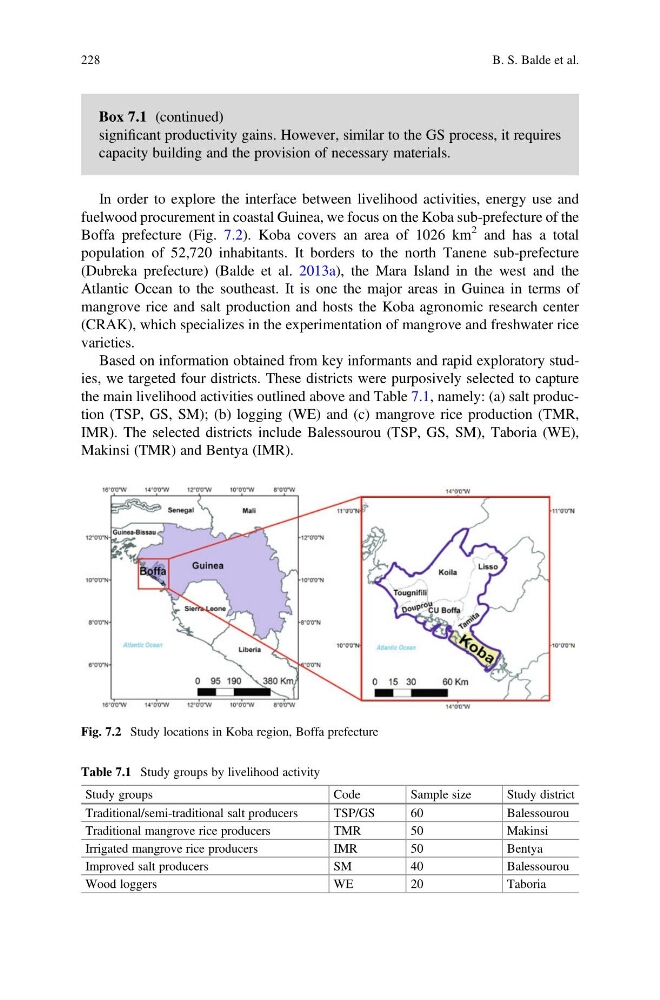
In order to explore the interface between livelihood activities, energy use and
fuelwood procurement in coastal Guinea, we focus on the Koba sub-prefecture of the
Boffa prefecture (Fig. 7.2). Koba covers an area of 1026 km
2 and has a total
population of 52,720 inhabitants. It borders to the north Tanene sub-prefecture
(Dubreka prefecture) (Balde et al. 2013a), the Mara Island in the west and the
Atlantic Ocean to the southeast. It is one the major areas in Guinea in terms of
mangrove rice and salt production and hosts the Koba agronomic research center
(CRAK), which specializes in the experimentation of mangrove and freshwater rice
varieties.
Based on information obtained from key informants and rapid exploratory studies, we targeted four districts. These districts were purposively selected to capture
the main livelihood activities outlined above and Table 7.1, namely: (a) salt production (TSP, GS, SM); (b) logging (WE) and (c) mangrove rice production (TMR,
IMR). The selected districts include Balessourou (TSP, GS, SM), Taboria (WE),
Makinsi (TMR) and Bentya (IMR).
Fig. 7.2 Study locations in Koba region, Boffa prefecture
Table 7.1 Study groups by livelihood activity
Study groups
Code
Sample size
Study district
Traditional/semi-traditional salt producers
TSP/GS
60
Balessourou
Traditional mangrove rice producers
TMR
50
Makinsi
Irrigated mangrove rice producers
IMR
50
Bentya
Improved salt producers
SM
40
Balessourou
Wood loggers
WE
20
Taboria
228
B. S. Balde et al.
significant productivity gains. However, similar to the GS process, it requires
capacity building and the provision of necessary materials.
In order to explore the interface between livelihood activities, energy use and
fuelwood procurement in coastal Guinea, we focus on the Koba sub-prefecture of the
Boffa prefecture (Fig. 7.2). Koba covers an area of 1026 km
2 and has a total
population of 52,720 inhabitants. It borders to the north Tanene sub-prefecture
(Dubreka prefecture) (Balde et al. 2013a), the Mara Island in the west and the
Atlantic Ocean to the southeast. It is one the major areas in Guinea in terms of
mangrove rice and salt production and hosts the Koba agronomic research center
(CRAK), which specializes in the experimentation of mangrove and freshwater rice
varieties.
Based on information obtained from key informants and rapid exploratory studies, we targeted four districts. These districts were purposively selected to capture
the main livelihood activities outlined above and Table 7.1, namely: (a) salt production (TSP, GS, SM); (b) logging (WE) and (c) mangrove rice production (TMR,
IMR). The selected districts include Balessourou (TSP, GS, SM), Taboria (WE),
Makinsi (TMR) and Bentya (IMR).
Fig. 7.2 Study locations in Koba region, Boffa prefecture
Table 7.1 Study groups by livelihood activity
Study groups
Code
Sample size
Study district
Traditional/semi-traditional salt producers
TSP/GS
60
Balessourou
Traditional mangrove rice producers
TMR
50
Makinsi
Irrigated mangrove rice producers
IMR
50
Bentya
Improved salt producers
SM
40
Balessourou
Wood loggers
WE
20
Taboria
228
B. S. Balde et al.