

ecological resilience, elderly men in flood- and drought-prone communities consistently report higher scores for all the three sub-dimensions of engineering resilience,
including DRR knowledge and preparedness, physical infrastructure and planning
systems. Elderly women report moderately higher scores compared to young adults
(Fig. 3). One of the resilience elements mentioned by FGD participants includes the
decline in use of local farming technologies. As a FGD participant from Kpalgun
mentioned:
I have been employing for many years the zai method, which involves digging pits in the soil
to store water and compost. Even though, this local soil improvement technology has served
many people in this community well since our forefathers, its use is in decline partly because
of the prolonged drought.
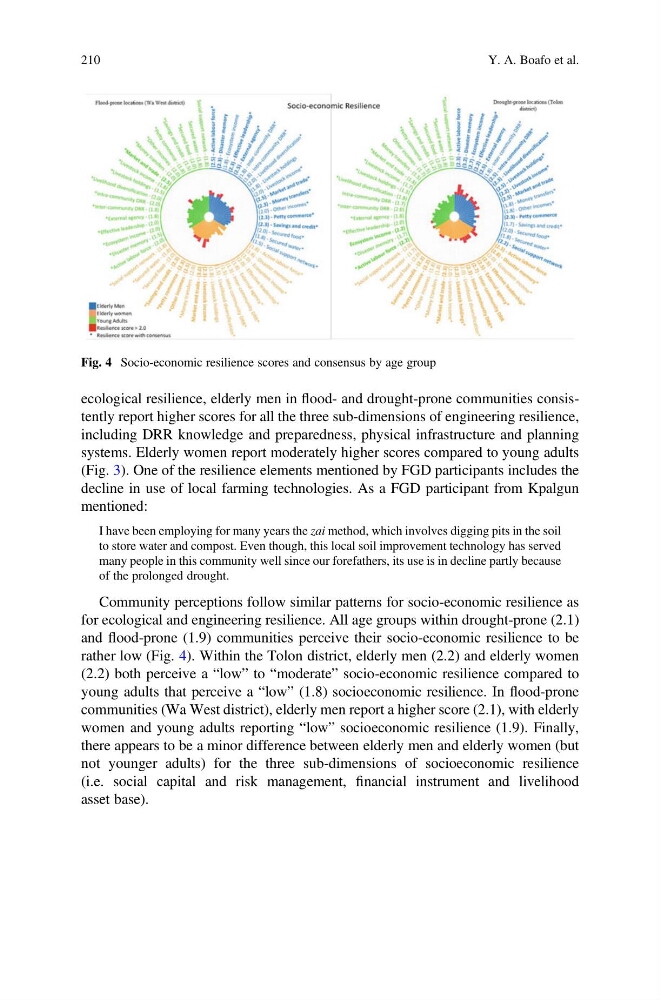
Community perceptions follow similar patterns for socio-economic resilience as
for ecological and engineering resilience. All age groups within drought-prone (2.1)
and flood-prone (1.9) communities perceive their socio-economic resilience to be
rather low (Fig. 4). Within the Tolon district, elderly men (2.2) and elderly women
(2.2) both perceive a “low” to “moderate” socio-economic resilience compared to
young adults that perceive a “low” (1.8) socioeconomic resilience. In flood-prone
communities (Wa West district), elderly men report a higher score (2.1), with elderly
women and young adults reporting “low” socioeconomic resilience (1.9). Finally,
there appears to be a minor difference between elderly men and elderly women (but
not younger adults) for the three sub-dimensions of socioeconomic resilience
(i.e. social capital and risk management, financial instrument and livelihood
asset base).
Fig. 4 Socio-economic resilience scores and consensus by age group
210
Y. A. Boafo et al.
including DRR knowledge and preparedness, physical infrastructure and planning
systems. Elderly women report moderately higher scores compared to young adults
(Fig. 3). One of the resilience elements mentioned by FGD participants includes the
decline in use of local farming technologies. As a FGD participant from Kpalgun
mentioned:
I have been employing for many years the zai method, which involves digging pits in the soil
to store water and compost. Even though, this local soil improvement technology has served
many people in this community well since our forefathers, its use is in decline partly because
of the prolonged drought.
Community perceptions follow similar patterns for socio-economic resilience as
for ecological and engineering resilience. All age groups within drought-prone (2.1)
and flood-prone (1.9) communities perceive their socio-economic resilience to be
rather low (Fig. 4). Within the Tolon district, elderly men (2.2) and elderly women
(2.2) both perceive a “low” to “moderate” socio-economic resilience compared to
young adults that perceive a “low” (1.8) socioeconomic resilience. In flood-prone
communities (Wa West district), elderly men report a higher score (2.1), with elderly
women and young adults reporting “low” socioeconomic resilience (1.9). Finally,
there appears to be a minor difference between elderly men and elderly women (but
not younger adults) for the three sub-dimensions of socioeconomic resilience
(i.e. social capital and risk management, financial instrument and livelihood
asset base).
Fig. 4 Socio-economic resilience scores and consensus by age group
210
Y. A. Boafo et al.