

3.3.2.4 Food Utilization
Studies related to the “food utilization” pillar are relatively scarce, and focus mostly
on the negative effects of female engagement in industrial crop production (and paid
employment in plantations in particular) (Table 3.7). This is usually linked to time
loss for household activities, and especially meal preparation, feeding children and
general unpaid care time (e.g. Arndt et al. 2011; Bosch and Zeller 2013). Some
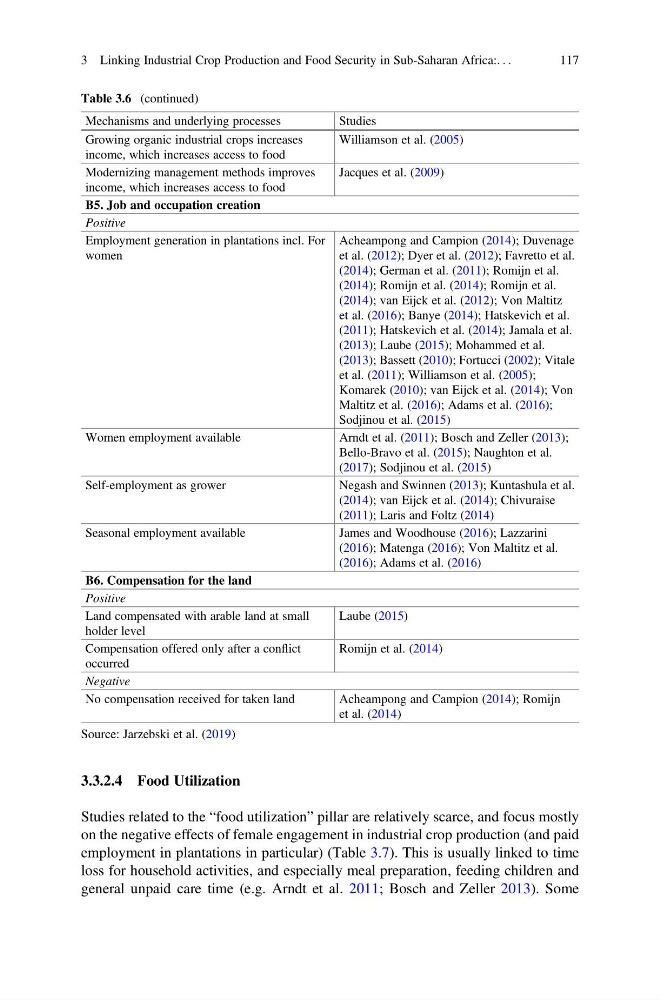
Table 3.6 (continued)
Mechanisms and underlying processes
Studies
Growing organic industrial crops increases
income, which increases access to food
Williamson et al. (2005)
Modernizing management methods improves
income, which increases access to food
Jacques et al. (2009)
B5. Job and occupation creation
Positive
Employment generation in plantations incl. For
women
Acheampong and Campion (2014); Duvenage
et al. (2012); Dyer et al. (2012); Favretto et al.
(2014); German et al. (2011); Romijn et al.
(2014); Romijn et al. (2014); Romijn et al.
(2014); van Eijck et al. (2012); Von Maltitz
et al. (2016); Banye (2014); Hatskevich et al.
(2011); Hatskevich et al. (2014); Jamala et al.
(2013); Laube (2015); Mohammed et al.
(2013); Bassett (2010); Fortucci (2002); Vitale
et al. (2011); Williamson et al. (2005);
Komarek (2010); van Eijck et al. (2014); Von
Maltitz et al. (2016); Adams et al. (2016);
Sodjinou et al. (2015)
Women employment available
Arndt et al. (2011); Bosch and Zeller (2013);
Bello-Bravo et al. (2015); Naughton et al.
(2017); Sodjinou et al. (2015)
Self-employment as grower
Negash and Swinnen (2013); Kuntashula et al.
(2014); van Eijck et al. (2014); Chivuraise
(2011); Laris and Foltz (2014)
Seasonal employment available
James and Woodhouse (2016); Lazzarini
(2016); Matenga (2016); Von Maltitz et al.
(2016); Adams et al. (2016)
B6. Compensation for the land
Positive
Land compensated with arable land at small
holder level
Laube (2015)
Compensation offered only after a conflict
occurred
Romijn et al. (2014)
Negative
No compensation received for taken land
Acheampong and Campion (2014); Romijn
et al. (2014)
Source: Jarzebski et al. (2019)
3 Linking Industrial Crop Production and Food Security in Sub-Saharan Africa:. . .
117
Studies related to the “food utilization” pillar are relatively scarce, and focus mostly
on the negative effects of female engagement in industrial crop production (and paid
employment in plantations in particular) (Table 3.7). This is usually linked to time
loss for household activities, and especially meal preparation, feeding children and
general unpaid care time (e.g. Arndt et al. 2011; Bosch and Zeller 2013). Some
Table 3.6 (continued)
Mechanisms and underlying processes
Studies
Growing organic industrial crops increases
income, which increases access to food
Williamson et al. (2005)
Modernizing management methods improves
income, which increases access to food
Jacques et al. (2009)
B5. Job and occupation creation
Positive
Employment generation in plantations incl. For
women
Acheampong and Campion (2014); Duvenage
et al. (2012); Dyer et al. (2012); Favretto et al.
(2014); German et al. (2011); Romijn et al.
(2014); Romijn et al. (2014); Romijn et al.
(2014); van Eijck et al. (2012); Von Maltitz
et al. (2016); Banye (2014); Hatskevich et al.
(2011); Hatskevich et al. (2014); Jamala et al.
(2013); Laube (2015); Mohammed et al.
(2013); Bassett (2010); Fortucci (2002); Vitale
et al. (2011); Williamson et al. (2005);
Komarek (2010); van Eijck et al. (2014); Von
Maltitz et al. (2016); Adams et al. (2016);
Sodjinou et al. (2015)
Women employment available
Arndt et al. (2011); Bosch and Zeller (2013);
Bello-Bravo et al. (2015); Naughton et al.
(2017); Sodjinou et al. (2015)
Self-employment as grower
Negash and Swinnen (2013); Kuntashula et al.
(2014); van Eijck et al. (2014); Chivuraise
(2011); Laris and Foltz (2014)
Seasonal employment available
James and Woodhouse (2016); Lazzarini
(2016); Matenga (2016); Von Maltitz et al.
(2016); Adams et al. (2016)
B6. Compensation for the land
Positive
Land compensated with arable land at small
holder level
Laube (2015)
Compensation offered only after a conflict
occurred
Romijn et al. (2014)
Negative
No compensation received for taken land
Acheampong and Campion (2014); Romijn
et al. (2014)
Source: Jarzebski et al. (2019)
3 Linking Industrial Crop Production and Food Security in Sub-Saharan Africa:. . .
117