

intercropping that minimizes land competition (e.g. Duvenage et al. 2012; Dyer et al.
2012; Favretto et al. 2014; Grimsby et al. 2012; Romijn et al. 2014; Leathers 1999).
Studies related to the “labour and capital” mechanism (A4) overwhelmingly
focus on the high labour needs of smallholder-based industrial crop production
often requires intensive labour, which often takes a toll on the availability of family
labour for food crop production (e.g. Adams et al. 2016; Naughton et al. 2017;
Fortucci 2002; Laris et al. 2015; Leathers 1999). Such employment diversion effects
are also reported and for large-scale plantations (e.g. Ismael et al. 2002; Kaminski
et al. 2011; Laris and Foltz 2014). Few studies have pointed that labour diversion
from industrial crop production (especially in large plantation settings) can increase
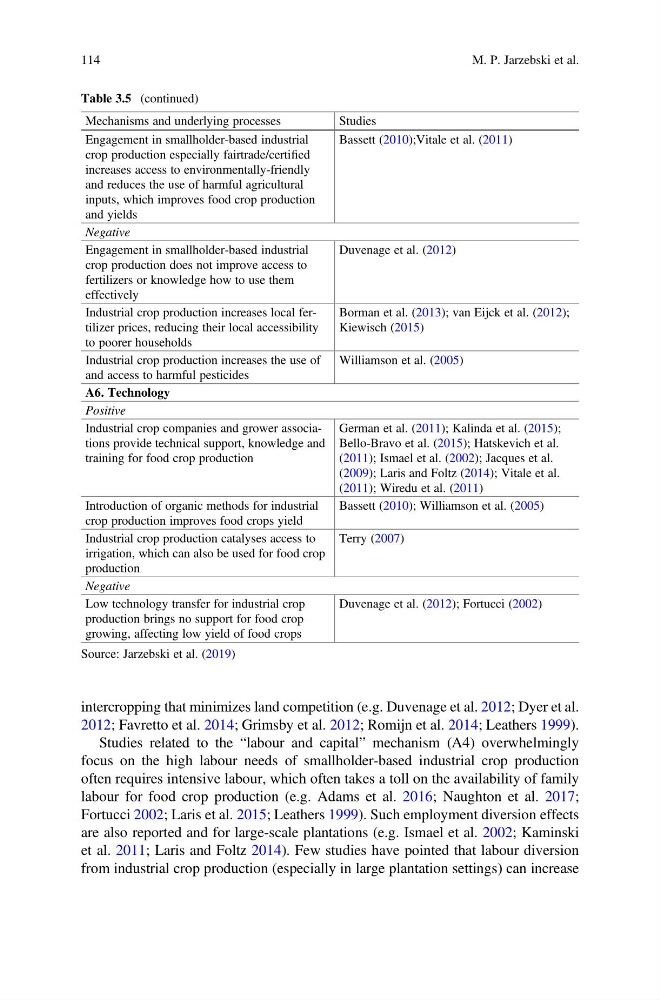
Table 3.5 (continued)
Mechanisms and underlying processes
Studies
Engagement in smallholder-based industrial
crop production especially fairtrade/certified
increases access to environmentally-friendly
and reduces the use of harmful agricultural
inputs, which improves food crop production
and yields
Bassett (2010);Vitale et al. (2011)
Negative
Engagement in smallholder-based industrial
crop production does not improve access to
fertilizers or knowledge how to use them
effectively
Duvenage et al. (2012)
Industrial crop production increases local fertilizer prices, reducing their local accessibility
to poorer households
Borman et al. (2013); van Eijck et al. (2012);
Kiewisch (2015)
Industrial crop production increases the use of
and access to harmful pesticides
Williamson et al. (2005)
A6. Technology
Positive
Industrial crop companies and grower associations provide technical support, knowledge and
training for food crop production
German et al. (2011); Kalinda et al. (2015);
Bello-Bravo et al. (2015); Hatskevich et al.
(2011); Ismael et al. (2002); Jacques et al.
(2009); Laris and Foltz (2014); Vitale et al.
(2011); Wiredu et al. (2011)
Introduction of organic methods for industrial
crop production improves food crops yield
Bassett (2010); Williamson et al. (2005)
Industrial crop production catalyses access to
irrigation, which can also be used for food crop
production
Terry (2007)
Negative
Low technology transfer for industrial crop
production brings no support for food crop
growing, affecting low yield of food crops
Duvenage et al. (2012); Fortucci (2002)
Source: Jarzebski et al. (2019)
114
M. P. Jarzebski et al.
2012; Favretto et al. 2014; Grimsby et al. 2012; Romijn et al. 2014; Leathers 1999).
Studies related to the “labour and capital” mechanism (A4) overwhelmingly
focus on the high labour needs of smallholder-based industrial crop production
often requires intensive labour, which often takes a toll on the availability of family
labour for food crop production (e.g. Adams et al. 2016; Naughton et al. 2017;
Fortucci 2002; Laris et al. 2015; Leathers 1999). Such employment diversion effects
are also reported and for large-scale plantations (e.g. Ismael et al. 2002; Kaminski
et al. 2011; Laris and Foltz 2014). Few studies have pointed that labour diversion
from industrial crop production (especially in large plantation settings) can increase
Table 3.5 (continued)
Mechanisms and underlying processes
Studies
Engagement in smallholder-based industrial
crop production especially fairtrade/certified
increases access to environmentally-friendly
and reduces the use of harmful agricultural
inputs, which improves food crop production
and yields
Bassett (2010);Vitale et al. (2011)
Negative
Engagement in smallholder-based industrial
crop production does not improve access to
fertilizers or knowledge how to use them
effectively
Duvenage et al. (2012)
Industrial crop production increases local fertilizer prices, reducing their local accessibility
to poorer households
Borman et al. (2013); van Eijck et al. (2012);
Kiewisch (2015)
Industrial crop production increases the use of
and access to harmful pesticides
Williamson et al. (2005)
A6. Technology
Positive
Industrial crop companies and grower associations provide technical support, knowledge and
training for food crop production
German et al. (2011); Kalinda et al. (2015);
Bello-Bravo et al. (2015); Hatskevich et al.
(2011); Ismael et al. (2002); Jacques et al.
(2009); Laris and Foltz (2014); Vitale et al.
(2011); Wiredu et al. (2011)
Introduction of organic methods for industrial
crop production improves food crops yield
Bassett (2010); Williamson et al. (2005)
Industrial crop production catalyses access to
irrigation, which can also be used for food crop
production
Terry (2007)
Negative
Low technology transfer for industrial crop
production brings no support for food crop
growing, affecting low yield of food crops
Duvenage et al. (2012); Fortucci (2002)
Source: Jarzebski et al. (2019)
114
M. P. Jarzebski et al.