

3.3.1.2 National Perspectives
General Patterns
Different countries across SSA have promoted a wide variety of industrial crops
(FAOSTAT 2019), through different modes of production and for different policy
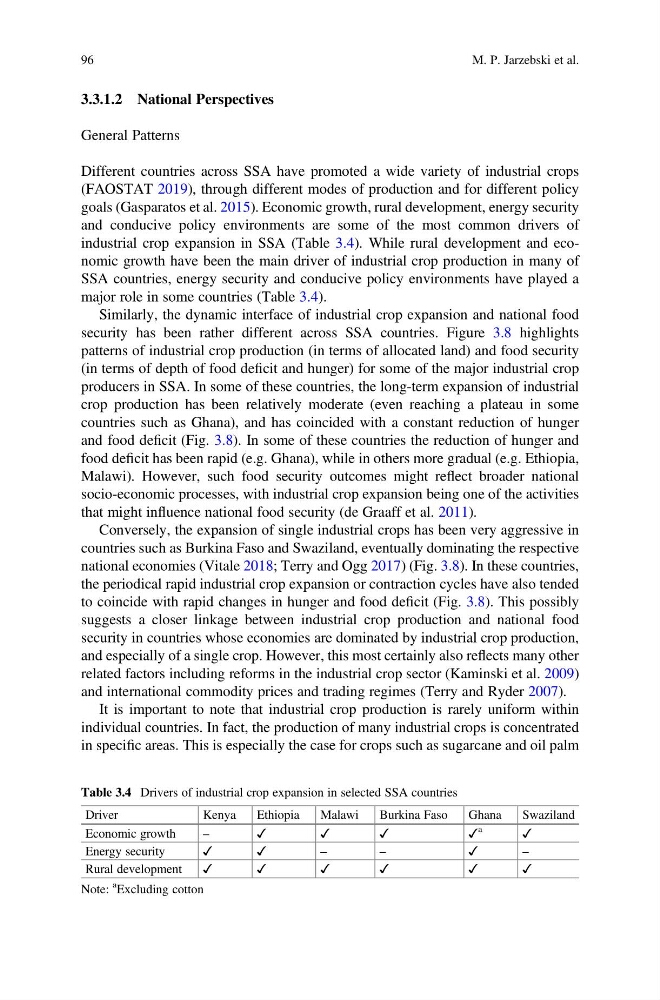
goals (Gasparatos et al. 2015). Economic growth, rural development, energy security
and conducive policy environments are some of the most common drivers of
industrial crop expansion in SSA (Table 3.4). While rural development and economic growth have been the main driver of industrial crop production in many of
SSA countries, energy security and conducive policy environments have played a
major role in some countries (Table 3.4).
Similarly, the dynamic interface of industrial crop expansion and national food
security has been rather different across SSA countries. Figure 3.8 highlights
patterns of industrial crop production (in terms of allocated land) and food security
(in terms of depth of food deficit and hunger) for some of the major industrial crop
producers in SSA. In some of these countries, the long-term expansion of industrial
crop production has been relatively moderate (even reaching a plateau in some
countries such as Ghana), and has coincided with a constant reduction of hunger
and food deficit (Fig. 3.8). In some of these countries the reduction of hunger and
food deficit has been rapid (e.g. Ghana), while in others more gradual (e.g. Ethiopia,
Malawi). However, such food security outcomes might reflect broader national
socio-economic processes, with industrial crop expansion being one of the activities
that might influence national food security (de Graaff et al. 2011).
Conversely, the expansion of single industrial crops has been very aggressive in
countries such as Burkina Faso and Swaziland, eventually dominating the respective
national economies (Vitale 2018; Terry and Ogg 2017) (Fig. 3.8). In these countries,
the periodical rapid industrial crop expansion or contraction cycles have also tended
to coincide with rapid changes in hunger and food deficit (Fig. 3.8). This possibly
suggests a closer linkage between industrial crop production and national food
security in countries whose economies are dominated by industrial crop production,
and especially of a single crop. However, this most certainly also reflects many other
related factors including reforms in the industrial crop sector (Kaminski et al. 2009)
and international commodity prices and trading regimes (Terry and Ryder 2007).
It is important to note that industrial crop production is rarely uniform within
individual countries. In fact, the production of many industrial crops is concentrated
in specific areas. This is especially the case for crops such as sugarcane and oil palm
Table 3.4 Drivers of industrial crop expansion in selected SSA countries
Driver
Kenya
Ethiopia
Malawi
Burkina Faso
Ghana
Swaziland
Economic growth
–
✓
✓
✓
✓
a
✓
Energy security
✓
✓
–
–
✓
–
Rural development
✓
✓
✓
✓
✓
✓
Note:
a Excluding cotton
96
M. P. Jarzebski et al.
General Patterns
Different countries across SSA have promoted a wide variety of industrial crops
(FAOSTAT 2019), through different modes of production and for different policy
goals (Gasparatos et al. 2015). Economic growth, rural development, energy security
and conducive policy environments are some of the most common drivers of
industrial crop expansion in SSA (Table 3.4). While rural development and economic growth have been the main driver of industrial crop production in many of
SSA countries, energy security and conducive policy environments have played a
major role in some countries (Table 3.4).
Similarly, the dynamic interface of industrial crop expansion and national food
security has been rather different across SSA countries. Figure 3.8 highlights
patterns of industrial crop production (in terms of allocated land) and food security
(in terms of depth of food deficit and hunger) for some of the major industrial crop
producers in SSA. In some of these countries, the long-term expansion of industrial
crop production has been relatively moderate (even reaching a plateau in some
countries such as Ghana), and has coincided with a constant reduction of hunger
and food deficit (Fig. 3.8). In some of these countries the reduction of hunger and
food deficit has been rapid (e.g. Ghana), while in others more gradual (e.g. Ethiopia,
Malawi). However, such food security outcomes might reflect broader national
socio-economic processes, with industrial crop expansion being one of the activities
that might influence national food security (de Graaff et al. 2011).
Conversely, the expansion of single industrial crops has been very aggressive in
countries such as Burkina Faso and Swaziland, eventually dominating the respective
national economies (Vitale 2018; Terry and Ogg 2017) (Fig. 3.8). In these countries,
the periodical rapid industrial crop expansion or contraction cycles have also tended
to coincide with rapid changes in hunger and food deficit (Fig. 3.8). This possibly
suggests a closer linkage between industrial crop production and national food
security in countries whose economies are dominated by industrial crop production,
and especially of a single crop. However, this most certainly also reflects many other
related factors including reforms in the industrial crop sector (Kaminski et al. 2009)
and international commodity prices and trading regimes (Terry and Ryder 2007).
It is important to note that industrial crop production is rarely uniform within
individual countries. In fact, the production of many industrial crops is concentrated
in specific areas. This is especially the case for crops such as sugarcane and oil palm
Table 3.4 Drivers of industrial crop expansion in selected SSA countries
Driver
Kenya
Ethiopia
Malawi
Burkina Faso
Ghana
Swaziland
Economic growth
–
✓
✓
✓
✓
a
✓
Energy security
✓
✓
–
–
✓
–
Rural development
✓
✓
✓
✓
✓
✓
Note:
a Excluding cotton
96
M. P. Jarzebski et al.