

Microalgae Chlorella as a Sustainable Feedstock …
87
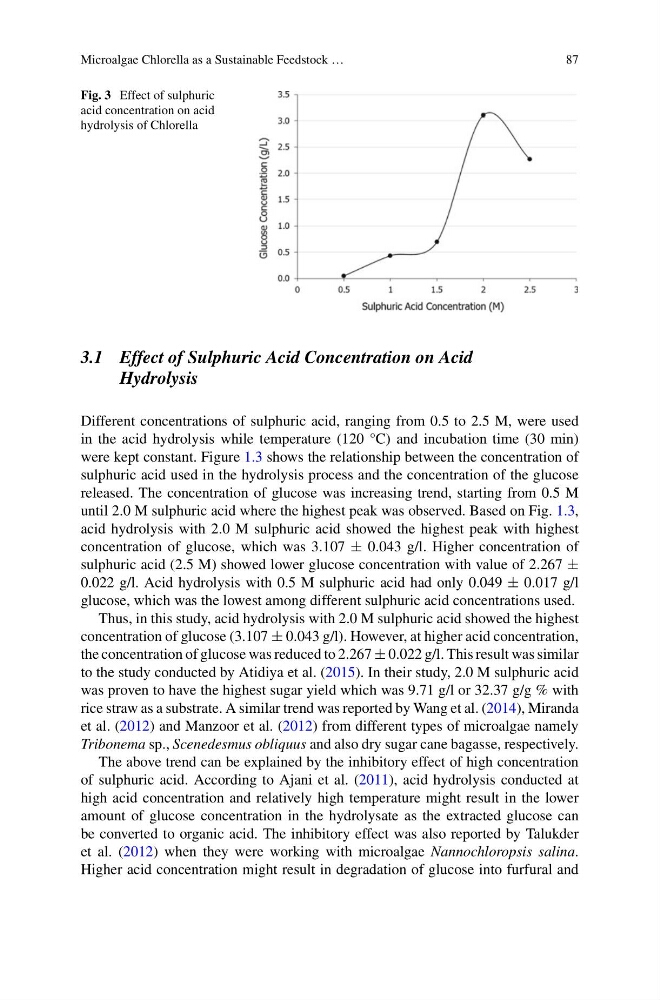
Fig. 3 Effect of sulphuric
acid concentration on acid
hydrolysis of Chlorella
3.1 Effect of Sulphuric Acid Concentration on Acid
Hydrolysis
Different concentrations of sulphuric acid, ranging from 0.5 to 2.5 M, were used
in the acid hydrolysis while temperature (120 °C) and incubation time (30 min)
were kept constant. Figure 1.3 shows the relationship between the concentration of
sulphuric acid used in the hydrolysis process and the concentration of the glucose
released. The concentration of glucose was increasing trend, starting from 0.5 M
until 2.0 M sulphuric acid where the highest peak was observed. Based on Fig. 1.3,
acid hydrolysis with 2.0 M sulphuric acid showed the highest peak with highest
concentration of glucose, which was 3.107 ± 0.043 g/l. Higher concentration of
sulphuric acid (2.5 M) showed lower glucose concentration with value of 2.267 ±
0.022 g/l. Acid hydrolysis with 0.5 M sulphuric acid had only 0.049 ± 0.017 g/l
glucose, which was the lowest among different sulphuric acid concentrations used.
Thus, in this study, acid hydrolysis with 2.0 M sulphuric acid showed the highest
concentration of glucose (3.107 ± 0.043 g/l). However, at higher acid concentration,
the concentration of glucose was reduced to 2.267 ± 0.022 g/l. This result was similar
to the study conducted by Atidiya et al. (2015). In their study, 2.0 M sulphuric acid
was proven to have the highest sugar yield which was 9.71 g/l or 32.37 g/g % with
rice straw as a substrate. A similar trend was reported by Wang et al. (2014), Miranda
et al. (2012) and Manzoor et al. (2012) from different types of microalgae namely
Tribonema sp., Scenedesmus obliquus and also dry sugar cane bagasse, respectively.
The above trend can be explained by the inhibitory effect of high concentration
of sulphuric acid. According to Ajani et al. (2011), acid hydrolysis conducted at
high acid concentration and relatively high temperature might result in the lower
amount of glucose concentration in the hydrolysate as the extracted glucose can
be converted to organic acid. The inhibitory effect was also reported by Talukder
et al. (2012) when they were working with microalgae Nannochloropsis salina.
Higher acid concentration might result in degradation of glucose into furfural and
87
Fig. 3 Effect of sulphuric
acid concentration on acid
hydrolysis of Chlorella
3.1 Effect of Sulphuric Acid Concentration on Acid
Hydrolysis
Different concentrations of sulphuric acid, ranging from 0.5 to 2.5 M, were used
in the acid hydrolysis while temperature (120 °C) and incubation time (30 min)
were kept constant. Figure 1.3 shows the relationship between the concentration of
sulphuric acid used in the hydrolysis process and the concentration of the glucose
released. The concentration of glucose was increasing trend, starting from 0.5 M
until 2.0 M sulphuric acid where the highest peak was observed. Based on Fig. 1.3,
acid hydrolysis with 2.0 M sulphuric acid showed the highest peak with highest
concentration of glucose, which was 3.107 ± 0.043 g/l. Higher concentration of
sulphuric acid (2.5 M) showed lower glucose concentration with value of 2.267 ±
0.022 g/l. Acid hydrolysis with 0.5 M sulphuric acid had only 0.049 ± 0.017 g/l
glucose, which was the lowest among different sulphuric acid concentrations used.
Thus, in this study, acid hydrolysis with 2.0 M sulphuric acid showed the highest
concentration of glucose (3.107 ± 0.043 g/l). However, at higher acid concentration,
the concentration of glucose was reduced to 2.267 ± 0.022 g/l. This result was similar
to the study conducted by Atidiya et al. (2015). In their study, 2.0 M sulphuric acid
was proven to have the highest sugar yield which was 9.71 g/l or 32.37 g/g % with
rice straw as a substrate. A similar trend was reported by Wang et al. (2014), Miranda
et al. (2012) and Manzoor et al. (2012) from different types of microalgae namely
Tribonema sp., Scenedesmus obliquus and also dry sugar cane bagasse, respectively.
The above trend can be explained by the inhibitory effect of high concentration
of sulphuric acid. According to Ajani et al. (2011), acid hydrolysis conducted at
high acid concentration and relatively high temperature might result in the lower
amount of glucose concentration in the hydrolysate as the extracted glucose can
be converted to organic acid. The inhibitory effect was also reported by Talukder
et al. (2012) when they were working with microalgae Nannochloropsis salina.
Higher acid concentration might result in degradation of glucose into furfural and