

74
H. A. Tajarudin et al.
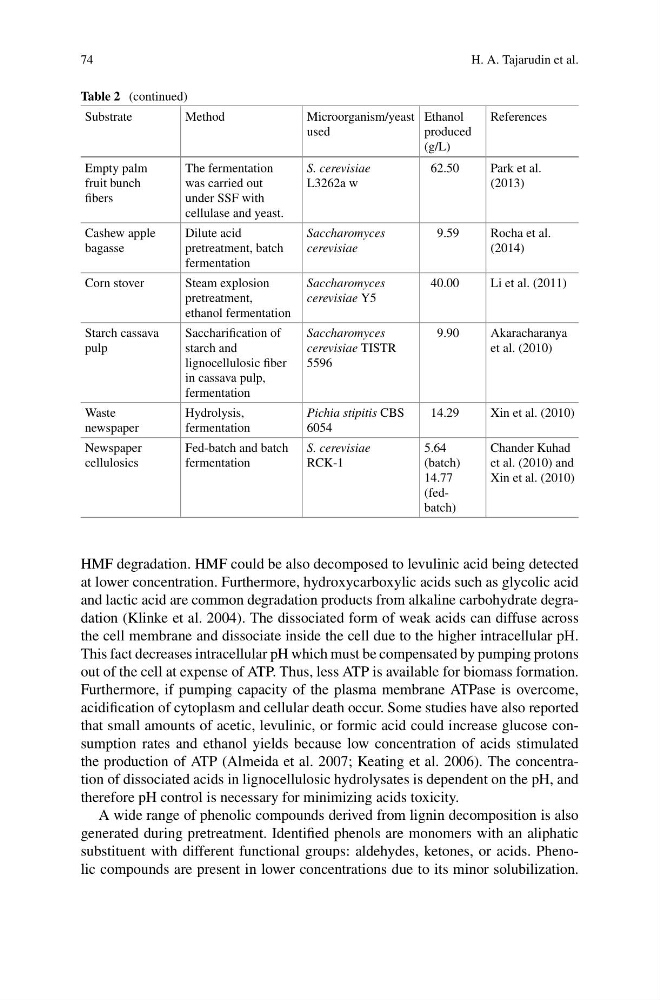
Table 2 (continued)
Substrate
Method
Microorganism/yeast
used
Ethanol
produced
(g/L)
References
Empty palm
fruit bunch
fibers
The fermentation
was carried out
under SSF with
cellulase and yeast.
S. cerevisiae
L3262a w
62.50
Park et al.
(2013)
Cashew apple
bagasse
Dilute acid
pretreatment, batch
fermentation
Saccharomyces
cerevisiae
9.59
Rocha et al.
(2014)
Corn stover
Steam explosion
pretreatment,
ethanol fermentation
Saccharomyces
cerevisiae Y5
40.00
Li et al. (2011)
Starch cassava
pulp
Saccharification of
starch and
lignocellulosic fiber
in cassava pulp,
fermentation
Saccharomyces
cerevisiae TISTR
5596
9.90
Akaracharanya
et al. (2010)
Waste
newspaper
Hydrolysis,
fermentation
Pichia stipitis CBS
6054
14.29
Xin et al. (2010)
Newspaper
cellulosics
Fed-batch and batch
fermentation
S. cerevisiae
RCK-1
5.64
(batch)
14.77
(fedbatch)
Chander Kuhad
et al. (2010) and
Xin et al. (2010)
HMF degradation. HMF could be also decomposed to levulinic acid being detected
at lower concentration. Furthermore, hydroxycarboxylic acids such as glycolic acid
and lactic acid are common degradation products from alkaline carbohydrate degradation (Klinke et al. 2004). The dissociated form of weak acids can diffuse across
the cell membrane and dissociate inside the cell due to the higher intracellular pH.
This fact decreases intracellular pH which must be compensated by pumping protons
out of the cell at expense of ATP. Thus, less ATP is available for biomass formation.
Furthermore, if pumping capacity of the plasma membrane ATPase is overcome,
acidification of cytoplasm and cellular death occur. Some studies have also reported
that small amounts of acetic, levulinic, or formic acid could increase glucose consumption rates and ethanol yields because low concentration of acids stimulated
the production of ATP (Almeida et al. 2007; Keating et al. 2006). The concentration of dissociated acids in lignocellulosic hydrolysates is dependent on the pH, and
therefore pH control is necessary for minimizing acids toxicity.
A wide range of phenolic compounds derived from lignin decomposition is also
generated during pretreatment. Identified phenols are monomers with an aliphatic
substituent with different functional groups: aldehydes, ketones, or acids. Phenolic compounds are present in lower concentrations due to its minor solubilization.
H. A. Tajarudin et al.
Table 2 (continued)
Substrate
Method
Microorganism/yeast
used
Ethanol
produced
(g/L)
References
Empty palm
fruit bunch
fibers
The fermentation
was carried out
under SSF with
cellulase and yeast.
S. cerevisiae
L3262a w
62.50
Park et al.
(2013)
Cashew apple
bagasse
Dilute acid
pretreatment, batch
fermentation
Saccharomyces
cerevisiae
9.59
Rocha et al.
(2014)
Corn stover
Steam explosion
pretreatment,
ethanol fermentation
Saccharomyces
cerevisiae Y5
40.00
Li et al. (2011)
Starch cassava
pulp
Saccharification of
starch and
lignocellulosic fiber
in cassava pulp,
fermentation
Saccharomyces
cerevisiae TISTR
5596
9.90
Akaracharanya
et al. (2010)
Waste
newspaper
Hydrolysis,
fermentation
Pichia stipitis CBS
6054
14.29
Xin et al. (2010)
Newspaper
cellulosics
Fed-batch and batch
fermentation
S. cerevisiae
RCK-1
5.64
(batch)
14.77
(fedbatch)
Chander Kuhad
et al. (2010) and
Xin et al. (2010)
HMF degradation. HMF could be also decomposed to levulinic acid being detected
at lower concentration. Furthermore, hydroxycarboxylic acids such as glycolic acid
and lactic acid are common degradation products from alkaline carbohydrate degradation (Klinke et al. 2004). The dissociated form of weak acids can diffuse across
the cell membrane and dissociate inside the cell due to the higher intracellular pH.
This fact decreases intracellular pH which must be compensated by pumping protons
out of the cell at expense of ATP. Thus, less ATP is available for biomass formation.
Furthermore, if pumping capacity of the plasma membrane ATPase is overcome,
acidification of cytoplasm and cellular death occur. Some studies have also reported
that small amounts of acetic, levulinic, or formic acid could increase glucose consumption rates and ethanol yields because low concentration of acids stimulated
the production of ATP (Almeida et al. 2007; Keating et al. 2006). The concentration of dissociated acids in lignocellulosic hydrolysates is dependent on the pH, and
therefore pH control is necessary for minimizing acids toxicity.
A wide range of phenolic compounds derived from lignin decomposition is also
generated during pretreatment. Identified phenols are monomers with an aliphatic
substituent with different functional groups: aldehydes, ketones, or acids. Phenolic compounds are present in lower concentrations due to its minor solubilization.