

Second-Generation Bioethanol: Advancement of Ethanologenic …
67
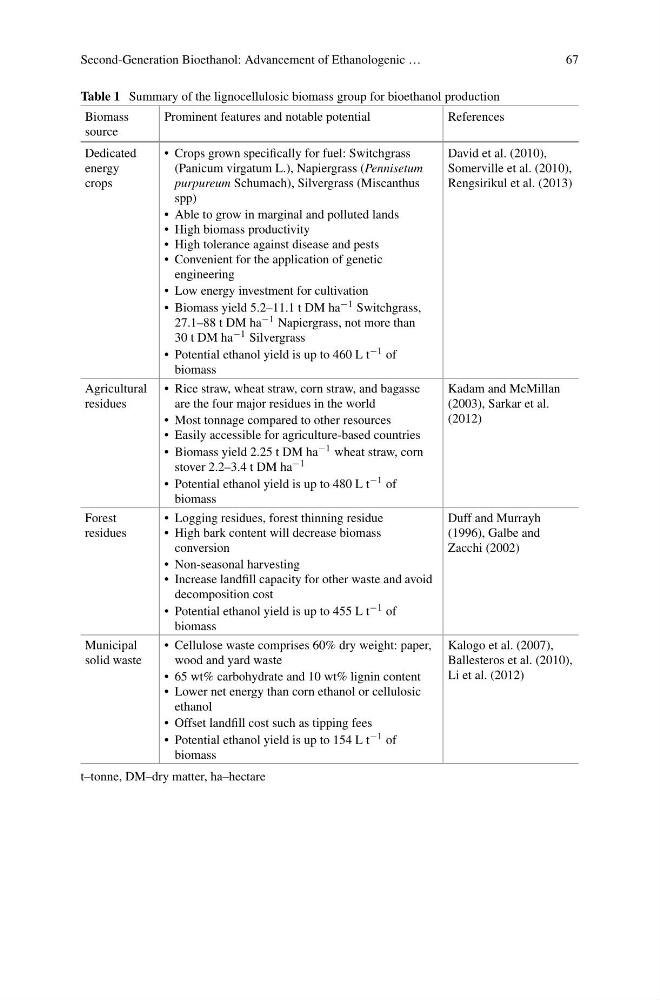
Table 1 Summary of the lignocellulosic biomass group for bioethanol production
Biomass
source
Prominent features and notable potential
References
Dedicated
energy
crops
• Crops grown specifically for fuel: Switchgrass
(Panicum virgatum L.), Napiergrass (Pennisetum
purpureum Schumach), Silvergrass (Miscanthus
spp)
• Able to grow in marginal and polluted lands
• High biomass productivity
• High tolerance against disease and pests
• Convenient for the application of genetic
engineering
• Low energy investment for cultivation
• Biomass yield 5.2–11.1 t DM ha −1 Switchgrass,
27.1–88 t DM ha −1 Napiergrass, not more than
30 t DM ha −1 Silvergrass
• Potential ethanol yield is up to 460 L t −1 of
biomass
David et al. (2010),
Somerville et al. (2010),
Rengsirikul et al. (2013)
Agricultural
residues
• Rice straw, wheat straw, corn straw, and bagasse
are the four major residues in the world
• Most tonnage compared to other resources
• Easily accessible for agriculture-based countries
• Biomass yield 2.25 t DM ha −1 wheat straw, corn
stover 2.2–3.4 t DM ha −1
• Potential ethanol yield is up to 480 L t −1 of
biomass
Kadam and McMillan
(2003), Sarkar et al.
(2012)
Forest
residues
• Logging residues, forest thinning residue
• High bark content will decrease biomass
conversion
• Non-seasonal harvesting
• Increase landfill capacity for other waste and avoid
decomposition cost
• Potential ethanol yield is up to 455 L t −1 of
biomass
Duff and Murrayh
(1996), Galbe and
Zacchi (2002)
Municipal
solid waste
• Cellulose waste comprises 60% dry weight: paper,
wood and yard waste
• 65 wt% carbohydrate and 10 wt% lignin content
• Lower net energy than corn ethanol or cellulosic
ethanol
• Offset landfill cost such as tipping fees
• Potential ethanol yield is up to 154 L t −1 of
biomass
Kalogo et al. (2007),
Ballesteros et al. (2010),
Li et al. (2012)
t–tonne, DM–dry matter, ha–hectare
67
Table 1 Summary of the lignocellulosic biomass group for bioethanol production
Biomass
source
Prominent features and notable potential
References
Dedicated
energy
crops
• Crops grown specifically for fuel: Switchgrass
(Panicum virgatum L.), Napiergrass (Pennisetum
purpureum Schumach), Silvergrass (Miscanthus
spp)
• Able to grow in marginal and polluted lands
• High biomass productivity
• High tolerance against disease and pests
• Convenient for the application of genetic
engineering
• Low energy investment for cultivation
• Biomass yield 5.2–11.1 t DM ha −1 Switchgrass,
27.1–88 t DM ha −1 Napiergrass, not more than
30 t DM ha −1 Silvergrass
• Potential ethanol yield is up to 460 L t −1 of
biomass
David et al. (2010),
Somerville et al. (2010),
Rengsirikul et al. (2013)
Agricultural
residues
• Rice straw, wheat straw, corn straw, and bagasse
are the four major residues in the world
• Most tonnage compared to other resources
• Easily accessible for agriculture-based countries
• Biomass yield 2.25 t DM ha −1 wheat straw, corn
stover 2.2–3.4 t DM ha −1
• Potential ethanol yield is up to 480 L t −1 of
biomass
Kadam and McMillan
(2003), Sarkar et al.
(2012)
Forest
residues
• Logging residues, forest thinning residue
• High bark content will decrease biomass
conversion
• Non-seasonal harvesting
• Increase landfill capacity for other waste and avoid
decomposition cost
• Potential ethanol yield is up to 455 L t −1 of
biomass
Duff and Murrayh
(1996), Galbe and
Zacchi (2002)
Municipal
solid waste
• Cellulose waste comprises 60% dry weight: paper,
wood and yard waste
• 65 wt% carbohydrate and 10 wt% lignin content
• Lower net energy than corn ethanol or cellulosic
ethanol
• Offset landfill cost such as tipping fees
• Potential ethanol yield is up to 154 L t −1 of
biomass
Kalogo et al. (2007),
Ballesteros et al. (2010),
Li et al. (2012)
t–tonne, DM–dry matter, ha–hectare