

Sewage Treatment in Campus for Recycling Purpose: A Review
209
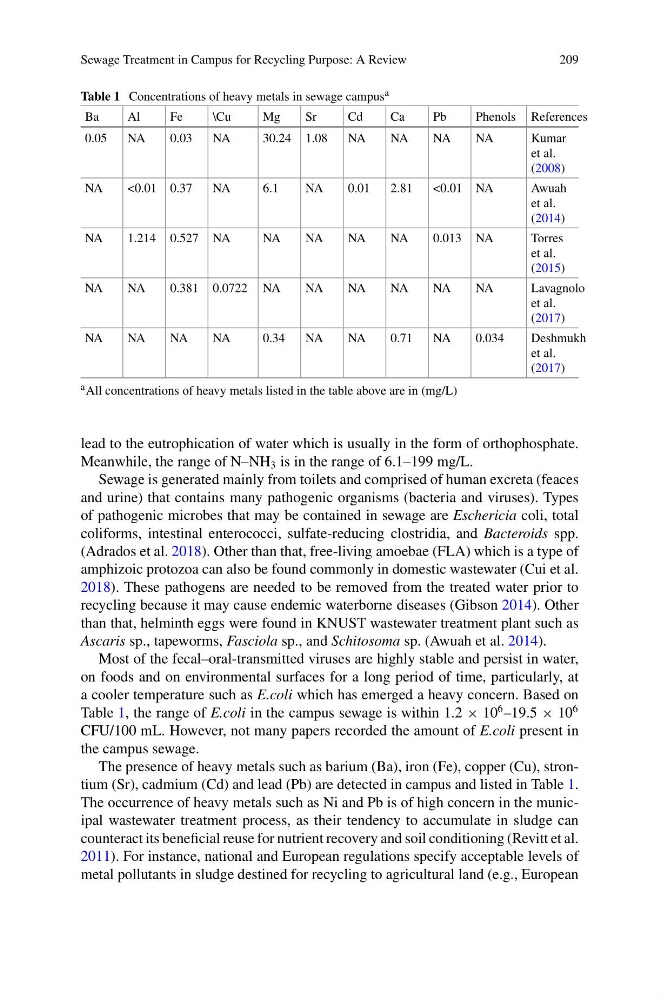
Table 1 Concentrations of heavy metals in sewage campus a
Ba
Al
Fe
\Cu
Mg
Sr
Cd
Ca
Pb
Phenols References
0.05
NA
0.03
NA
30.24 1.08
NA
NA
NA
NA
Kumar
et al.
(2008)
NA
<0.01 0.37
NA
6.1
NA
0.01
2.81
<0.01 NA
Awuah
et al.
(2014)
NA
1.214 0.527 NA
NA
NA
NA
NA
0.013 NA
Torres
et al.
(2015)
NA
NA
0.381 0.0722 NA
NA
NA
NA
NA
NA
Lavagnolo
et al.
(2017)
NA
NA
NA
NA
0.34
NA
NA
0.71
NA
0.034
Deshmukh
et al.
(2017)
a All concentrations of heavy metals listed in the table above are in (mg/L)
lead to the eutrophication of water which is usually in the form of orthophosphate.
Meanwhile, the range of N–NH 3 is in the range of 6.1–199 mg/L.
Sewage is generated mainly from toilets and comprised of human excreta (feaces
and urine) that contains many pathogenic organisms (bacteria and viruses). Types
of pathogenic microbes that may be contained in sewage are Eschericia coli, total
coliforms, intestinal enterococci, sulfate-reducing clostridia, and Bacteroids spp.
(Adrados et al. 2018). Other than that, free-living amoebae (FLA) which is a type of
amphizoic protozoa can also be found commonly in domestic wastewater (Cui et al.
2018). These pathogens are needed to be removed from the treated water prior to
recycling because it may cause endemic waterborne diseases (Gibson 2014). Other
than that, helminth eggs were found in KNUST wastewater treatment plant such as
Ascaris sp., tapeworms, Fasciola sp., and Schitosoma sp. (Awuah et al. 2014).
Most of the fecal–oral-transmitted viruses are highly stable and persist in water,
on foods and on environmental surfaces for a long period of time, particularly, at
a cooler temperature such as E.coli which has emerged a heavy concern. Based on
Table 1, the range of E.coli in the campus sewage is within 1.2 × 10
6 –19.5 × 10
6
CFU/100 mL. However, not many papers recorded the amount of E.coli present in
the campus sewage.
The presence of heavy metals such as barium (Ba), iron (Fe), copper (Cu), strontium (Sr), cadmium (Cd) and lead (Pb) are detected in campus and listed in Table 1.
The occurrence of heavy metals such as Ni and Pb is of high concern in the municipal wastewater treatment process, as their tendency to accumulate in sludge can
counteract its beneficial reuse for nutrient recovery and soil conditioning (Revitt et al.
2011). For instance, national and European regulations specify acceptable levels of
metal pollutants in sludge destined for recycling to agricultural land (e.g., European
209
Table 1 Concentrations of heavy metals in sewage campus a
Ba
Al
Fe
\Cu
Mg
Sr
Cd
Ca
Pb
Phenols References
0.05
NA
0.03
NA
30.24 1.08
NA
NA
NA
NA
Kumar
et al.
(2008)
NA
<0.01 0.37
NA
6.1
NA
0.01
2.81
<0.01 NA
Awuah
et al.
(2014)
NA
1.214 0.527 NA
NA
NA
NA
NA
0.013 NA
Torres
et al.
(2015)
NA
NA
0.381 0.0722 NA
NA
NA
NA
NA
NA
Lavagnolo
et al.
(2017)
NA
NA
NA
NA
0.34
NA
NA
0.71
NA
0.034
Deshmukh
et al.
(2017)
a All concentrations of heavy metals listed in the table above are in (mg/L)
lead to the eutrophication of water which is usually in the form of orthophosphate.
Meanwhile, the range of N–NH 3 is in the range of 6.1–199 mg/L.
Sewage is generated mainly from toilets and comprised of human excreta (feaces
and urine) that contains many pathogenic organisms (bacteria and viruses). Types
of pathogenic microbes that may be contained in sewage are Eschericia coli, total
coliforms, intestinal enterococci, sulfate-reducing clostridia, and Bacteroids spp.
(Adrados et al. 2018). Other than that, free-living amoebae (FLA) which is a type of
amphizoic protozoa can also be found commonly in domestic wastewater (Cui et al.
2018). These pathogens are needed to be removed from the treated water prior to
recycling because it may cause endemic waterborne diseases (Gibson 2014). Other
than that, helminth eggs were found in KNUST wastewater treatment plant such as
Ascaris sp., tapeworms, Fasciola sp., and Schitosoma sp. (Awuah et al. 2014).
Most of the fecal–oral-transmitted viruses are highly stable and persist in water,
on foods and on environmental surfaces for a long period of time, particularly, at
a cooler temperature such as E.coli which has emerged a heavy concern. Based on
Table 1, the range of E.coli in the campus sewage is within 1.2 × 10
6 –19.5 × 10
6
CFU/100 mL. However, not many papers recorded the amount of E.coli present in
the campus sewage.
The presence of heavy metals such as barium (Ba), iron (Fe), copper (Cu), strontium (Sr), cadmium (Cd) and lead (Pb) are detected in campus and listed in Table 1.
The occurrence of heavy metals such as Ni and Pb is of high concern in the municipal wastewater treatment process, as their tendency to accumulate in sludge can
counteract its beneficial reuse for nutrient recovery and soil conditioning (Revitt et al.
2011). For instance, national and European regulations specify acceptable levels of
metal pollutants in sludge destined for recycling to agricultural land (e.g., European