

204
N. Bolong and I. Saad
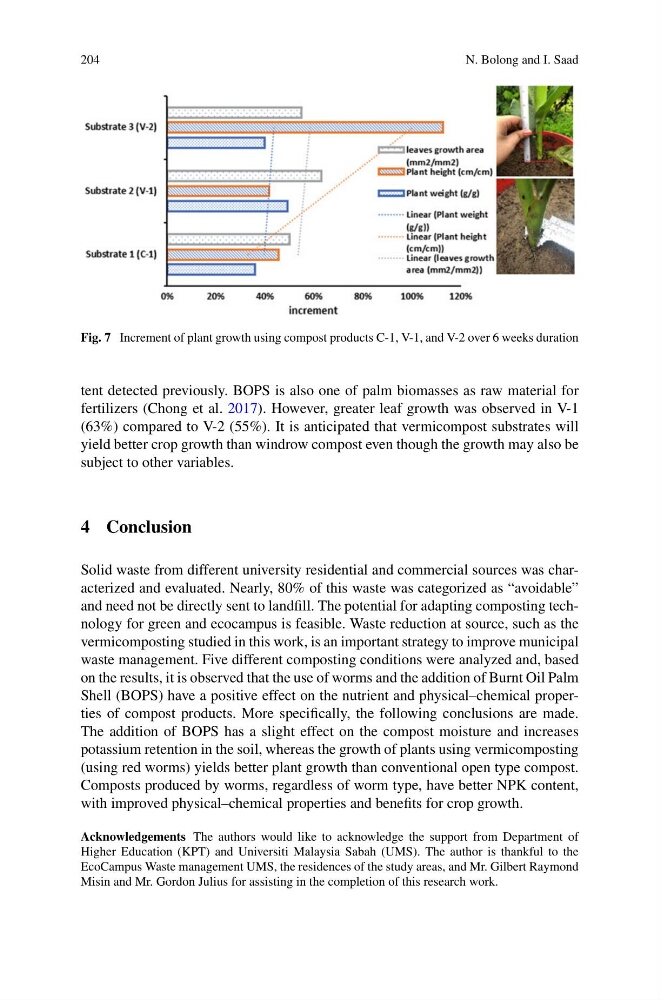
Fig. 7 Increment of plant growth using compost products C-1, V-1, and V-2 over 6 weeks duration
tent detected previously. BOPS is also one of palm biomasses as raw material for
fertilizers (Chong et al. 2017). However, greater leaf growth was observed in V-1
(63%) compared to V-2 (55%). It is anticipated that vermicompost substrates will
yield better crop growth than windrow compost even though the growth may also be
subject to other variables.
4 Conclusion
Solid waste from different university residential and commercial sources was characterized and evaluated. Nearly, 80% of this waste was categorized as “avoidable”
and need not be directly sent to landfill. The potential for adapting composting technology for green and ecocampus is feasible. Waste reduction at source, such as the
vermicomposting studied in this work, is an important strategy to improve municipal
waste management. Five different composting conditions were analyzed and, based
on the results, it is observed that the use of worms and the addition of Burnt Oil Palm
Shell (BOPS) have a positive effect on the nutrient and physical–chemical properties of compost products. More specifically, the following conclusions are made.
The addition of BOPS has a slight effect on the compost moisture and increases
potassium retention in the soil, whereas the growth of plants using vermicomposting
(using red worms) yields better plant growth than conventional open type compost.
Composts produced by worms, regardless of worm type, have better NPK content,
with improved physical–chemical properties and benefits for crop growth.
Acknowledgements The authors would like to acknowledge the support from Department of
Higher Education (KPT) and Universiti Malaysia Sabah (UMS). The author is thankful to the
EcoCampus Waste management UMS, the residences of the study areas, and Mr. Gilbert Raymond
Misin and Mr. Gordon Julius for assisting in the completion of this research work.
N. Bolong and I. Saad
Fig. 7 Increment of plant growth using compost products C-1, V-1, and V-2 over 6 weeks duration
tent detected previously. BOPS is also one of palm biomasses as raw material for
fertilizers (Chong et al. 2017). However, greater leaf growth was observed in V-1
(63%) compared to V-2 (55%). It is anticipated that vermicompost substrates will
yield better crop growth than windrow compost even though the growth may also be
subject to other variables.
4 Conclusion
Solid waste from different university residential and commercial sources was characterized and evaluated. Nearly, 80% of this waste was categorized as “avoidable”
and need not be directly sent to landfill. The potential for adapting composting technology for green and ecocampus is feasible. Waste reduction at source, such as the
vermicomposting studied in this work, is an important strategy to improve municipal
waste management. Five different composting conditions were analyzed and, based
on the results, it is observed that the use of worms and the addition of Burnt Oil Palm
Shell (BOPS) have a positive effect on the nutrient and physical–chemical properties of compost products. More specifically, the following conclusions are made.
The addition of BOPS has a slight effect on the compost moisture and increases
potassium retention in the soil, whereas the growth of plants using vermicomposting
(using red worms) yields better plant growth than conventional open type compost.
Composts produced by worms, regardless of worm type, have better NPK content,
with improved physical–chemical properties and benefits for crop growth.
Acknowledgements The authors would like to acknowledge the support from Department of
Higher Education (KPT) and Universiti Malaysia Sabah (UMS). The author is thankful to the
EcoCampus Waste management UMS, the residences of the study areas, and Mr. Gilbert Raymond
Misin and Mr. Gordon Julius for assisting in the completion of this research work.