

Food Waste Composting at Faculty of Engineering …
177
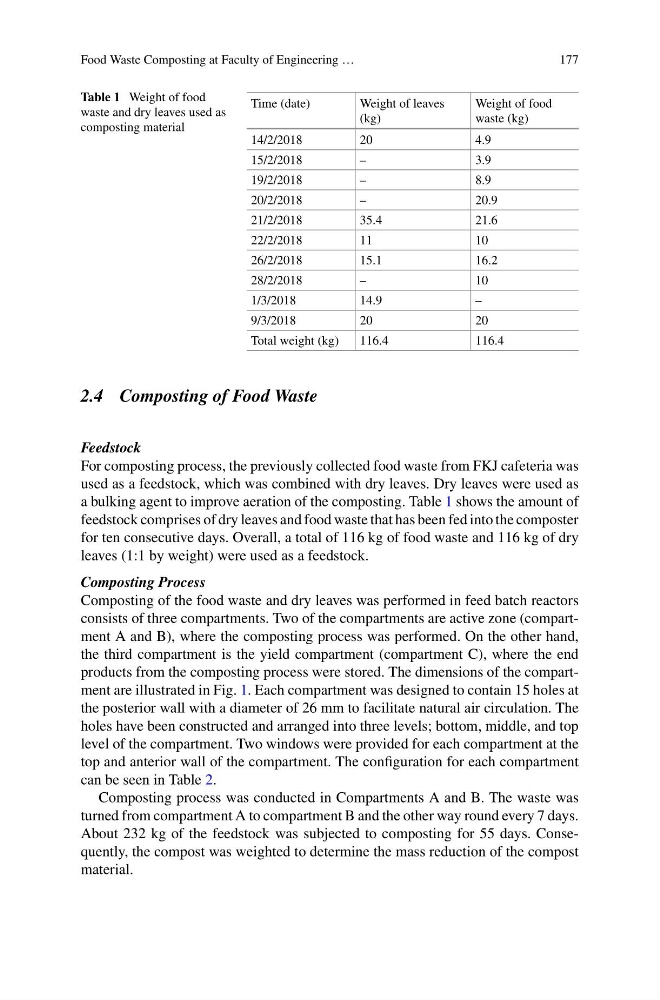
Table 1 Weight of food
waste and dry leaves used as
composting material
Time (date)
Weight of leaves
(kg)
Weight of food
waste (kg)
14/2/2018
20
4.9
15/2/2018
–
3.9
19/2/2018
–
8.9
20/2/2018
–
20.9
21/2/2018
35.4
21.6
22/2/2018
11
10
26/2/2018
15.1
16.2
28/2/2018
–
10
1/3/2018
14.9
–
9/3/2018
20
20
Total weight (kg)
116.4
116.4
2.4 Composting of Food Waste
Feedstock
For composting process, the previously collected food waste from FKJ cafeteria was
used as a feedstock, which was combined with dry leaves. Dry leaves were used as
a bulking agent to improve aeration of the composting. Table 1 shows the amount of
feedstock comprises of dry leaves and food waste that has been fed into the composter
for ten consecutive days. Overall, a total of 116 kg of food waste and 116 kg of dry
leaves (1:1 by weight) were used as a feedstock.
Composting Process
Composting of the food waste and dry leaves was performed in feed batch reactors
consists of three compartments. Two of the compartments are active zone (compartment A and B), where the composting process was performed. On the other hand,
the third compartment is the yield compartment (compartment C), where the end
products from the composting process were stored. The dimensions of the compartment are illustrated in Fig. 1. Each compartment was designed to contain 15 holes at
the posterior wall with a diameter of 26 mm to facilitate natural air circulation. The
holes have been constructed and arranged into three levels; bottom, middle, and top
level of the compartment. Two windows were provided for each compartment at the
top and anterior wall of the compartment. The configuration for each compartment
can be seen in Table 2.
Composting process was conducted in Compartments A and B. The waste was
turned from compartment A to compartment B and the other way round every 7 days.
About 232 kg of the feedstock was subjected to composting for 55 days. Consequently, the compost was weighted to determine the mass reduction of the compost
material.
177
Table 1 Weight of food
waste and dry leaves used as
composting material
Time (date)
Weight of leaves
(kg)
Weight of food
waste (kg)
14/2/2018
20
4.9
15/2/2018
–
3.9
19/2/2018
–
8.9
20/2/2018
–
20.9
21/2/2018
35.4
21.6
22/2/2018
11
10
26/2/2018
15.1
16.2
28/2/2018
–
10
1/3/2018
14.9
–
9/3/2018
20
20
Total weight (kg)
116.4
116.4
2.4 Composting of Food Waste
Feedstock
For composting process, the previously collected food waste from FKJ cafeteria was
used as a feedstock, which was combined with dry leaves. Dry leaves were used as
a bulking agent to improve aeration of the composting. Table 1 shows the amount of
feedstock comprises of dry leaves and food waste that has been fed into the composter
for ten consecutive days. Overall, a total of 116 kg of food waste and 116 kg of dry
leaves (1:1 by weight) were used as a feedstock.
Composting Process
Composting of the food waste and dry leaves was performed in feed batch reactors
consists of three compartments. Two of the compartments are active zone (compartment A and B), where the composting process was performed. On the other hand,
the third compartment is the yield compartment (compartment C), where the end
products from the composting process were stored. The dimensions of the compartment are illustrated in Fig. 1. Each compartment was designed to contain 15 holes at
the posterior wall with a diameter of 26 mm to facilitate natural air circulation. The
holes have been constructed and arranged into three levels; bottom, middle, and top
level of the compartment. Two windows were provided for each compartment at the
top and anterior wall of the compartment. The configuration for each compartment
can be seen in Table 2.
Composting process was conducted in Compartments A and B. The waste was
turned from compartment A to compartment B and the other way round every 7 days.
About 232 kg of the feedstock was subjected to composting for 55 days. Consequently, the compost was weighted to determine the mass reduction of the compost
material.