

176
S. Saalah et al.
2 Materials and Methods
2.1 Materials
Waste collected from the cafeteria of Faculty of Engineering, UMS. On the other
hand, the dry leaves used in this works is a landscape waste which was collected
from Faculty of Engineering campus area.
2.2 Determination of Waste Generation and Profile
Waste audit has been conducted in Faculty of Engineering cafeteria (FKJ Cafeteria)
UMS to provide food waste generation, according to a method described by Rispo
et al. (2015). The waste collected was unloaded on floor of a canvas 2 m
2 . The waste
collected represented materials disposed by the cafeteria for one day. The collected
waste were classified into five category namely food waste, eggshells, bones, plastic,
paper, others (glass, aluminium can). The cafeteria wastes were collected every day
after lunch hour. Segregation of wastes was conducted immediately after collection,
and the volume and weight were determined for each wastes category.
2.3 Physical Characterizations of Food Waste
The mass and volume of the segregated wastes were used to determine the densities
of food waste. The moisture content was determined by placing the Petri dishes
containing 10 g food waste into an oven for 24 h with a temperature of 104 °C (Yaser
et al. 2007). The weight of the Petri dish containing the food waste before and after
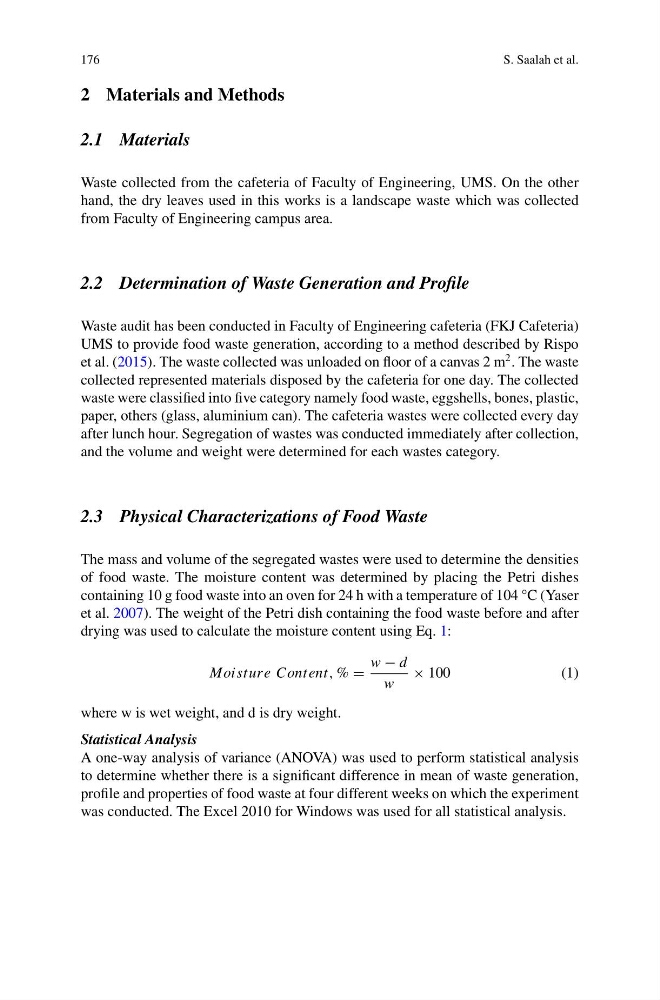
drying was used to calculate the moisture content using Eq. 1:
Moisture Content, % =
w − d
w
× 100
(1)
where w is wet weight, and d is dry weight.
Statistical Analysis
A one-way analysis of variance (ANOVA) was used to perform statistical analysis
to determine whether there is a significant difference in mean of waste generation,
profile and properties of food waste at four different weeks on which the experiment
was conducted. The Excel 2010 for Windows was used for all statistical analysis.
S. Saalah et al.
2 Materials and Methods
2.1 Materials
Waste collected from the cafeteria of Faculty of Engineering, UMS. On the other
hand, the dry leaves used in this works is a landscape waste which was collected
from Faculty of Engineering campus area.
2.2 Determination of Waste Generation and Profile
Waste audit has been conducted in Faculty of Engineering cafeteria (FKJ Cafeteria)
UMS to provide food waste generation, according to a method described by Rispo
et al. (2015). The waste collected was unloaded on floor of a canvas 2 m
2 . The waste
collected represented materials disposed by the cafeteria for one day. The collected
waste were classified into five category namely food waste, eggshells, bones, plastic,
paper, others (glass, aluminium can). The cafeteria wastes were collected every day
after lunch hour. Segregation of wastes was conducted immediately after collection,
and the volume and weight were determined for each wastes category.
2.3 Physical Characterizations of Food Waste
The mass and volume of the segregated wastes were used to determine the densities
of food waste. The moisture content was determined by placing the Petri dishes
containing 10 g food waste into an oven for 24 h with a temperature of 104 °C (Yaser
et al. 2007). The weight of the Petri dish containing the food waste before and after
drying was used to calculate the moisture content using Eq. 1:
Moisture Content, % =
w − d
w
× 100
(1)
where w is wet weight, and d is dry weight.
Statistical Analysis
A one-way analysis of variance (ANOVA) was used to perform statistical analysis
to determine whether there is a significant difference in mean of waste generation,
profile and properties of food waste at four different weeks on which the experiment
was conducted. The Excel 2010 for Windows was used for all statistical analysis.