

154
A. Kusumawanto and M. Setyowati
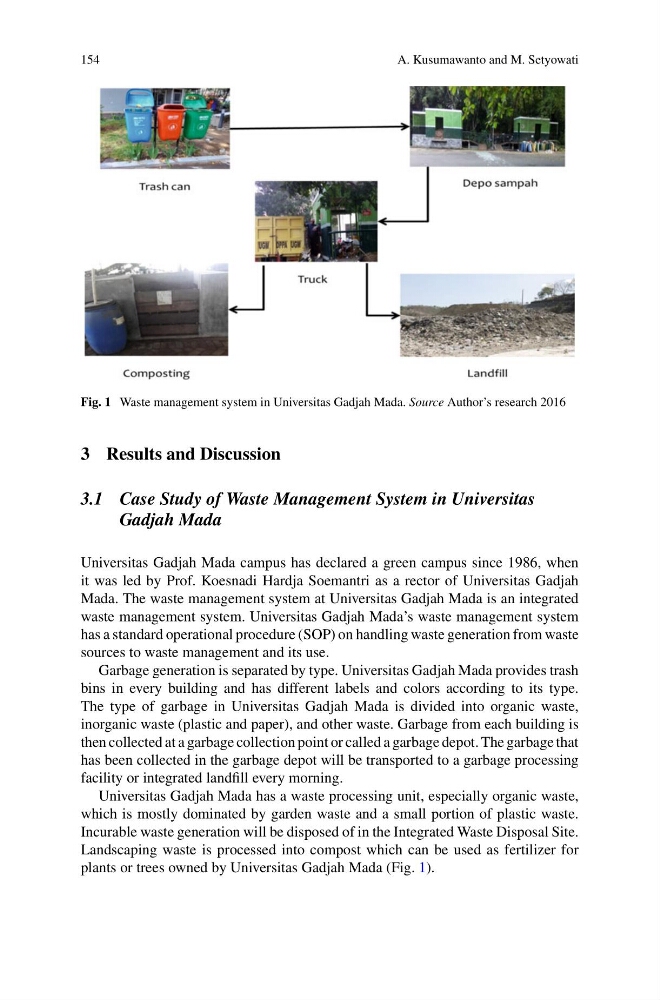
Fig. 1 Waste management system in Universitas Gadjah Mada. Source Author’s research 2016
3 Results and Discussion
3.1 Case Study of Waste Management System in Universitas
Gadjah Mada
Universitas Gadjah Mada campus has declared a green campus since 1986, when
it was led by Prof. Koesnadi Hardja Soemantri as a rector of Universitas Gadjah
Mada. The waste management system at Universitas Gadjah Mada is an integrated
waste management system. Universitas Gadjah Mada’s waste management system
has a standard operational procedure (SOP) on handling waste generation from waste
sources to waste management and its use.
Garbage generation is separated by type. Universitas Gadjah Mada provides trash
bins in every building and has different labels and colors according to its type.
The type of garbage in Universitas Gadjah Mada is divided into organic waste,
inorganic waste (plastic and paper), and other waste. Garbage from each building is
then collected at a garbage collection point or called a garbage depot. The garbage that
has been collected in the garbage depot will be transported to a garbage processing
facility or integrated landfill every morning.
Universitas Gadjah Mada has a waste processing unit, especially organic waste,
which is mostly dominated by garden waste and a small portion of plastic waste.
Incurable waste generation will be disposed of in the Integrated Waste Disposal Site.
Landscaping waste is processed into compost which can be used as fertilizer for
plants or trees owned by Universitas Gadjah Mada (Fig. 1).
A. Kusumawanto and M. Setyowati
Fig. 1 Waste management system in Universitas Gadjah Mada. Source Author’s research 2016
3 Results and Discussion
3.1 Case Study of Waste Management System in Universitas
Gadjah Mada
Universitas Gadjah Mada campus has declared a green campus since 1986, when
it was led by Prof. Koesnadi Hardja Soemantri as a rector of Universitas Gadjah
Mada. The waste management system at Universitas Gadjah Mada is an integrated
waste management system. Universitas Gadjah Mada’s waste management system
has a standard operational procedure (SOP) on handling waste generation from waste
sources to waste management and its use.
Garbage generation is separated by type. Universitas Gadjah Mada provides trash
bins in every building and has different labels and colors according to its type.
The type of garbage in Universitas Gadjah Mada is divided into organic waste,
inorganic waste (plastic and paper), and other waste. Garbage from each building is
then collected at a garbage collection point or called a garbage depot. The garbage that
has been collected in the garbage depot will be transported to a garbage processing
facility or integrated landfill every morning.
Universitas Gadjah Mada has a waste processing unit, especially organic waste,
which is mostly dominated by garden waste and a small portion of plastic waste.
Incurable waste generation will be disposed of in the Integrated Waste Disposal Site.
Landscaping waste is processed into compost which can be used as fertilizer for
plants or trees owned by Universitas Gadjah Mada (Fig. 1).