

128
M. Rajin et al.
76.0
77.0
78.0
79.0
80.0
81.0
82.0
83.0
84.0
85.0
86.0
0
1 0
2 0
3 0
4 0
5 0
Moisture Content, %
Time, days
Food Waste
Food Waste and
Lipase
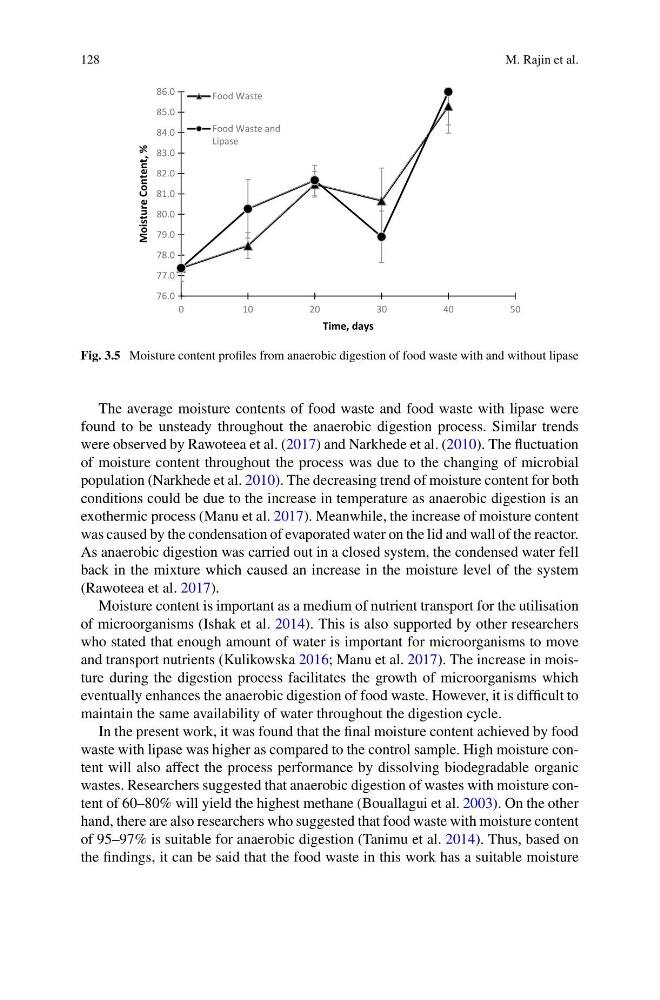
Fig. 3.5 Moisture content profiles from anaerobic digestion of food waste with and without lipase
The average moisture contents of food waste and food waste with lipase were
found to be unsteady throughout the anaerobic digestion process. Similar trends
were observed by Rawoteea et al. (2017) and Narkhede et al. (2010). The fluctuation
of moisture content throughout the process was due to the changing of microbial
population (Narkhede et al. 2010). The decreasing trend of moisture content for both
conditions could be due to the increase in temperature as anaerobic digestion is an
exothermic process (Manu et al. 2017). Meanwhile, the increase of moisture content
was caused by the condensation of evaporated water on the lid and wall of the reactor.
As anaerobic digestion was carried out in a closed system, the condensed water fell
back in the mixture which caused an increase in the moisture level of the system
(Rawoteea et al. 2017).
Moisture content is important as a medium of nutrient transport for the utilisation
of microorganisms (Ishak et al. 2014). This is also supported by other researchers
who stated that enough amount of water is important for microorganisms to move
and transport nutrients (Kulikowska 2016; Manu et al. 2017). The increase in moisture during the digestion process facilitates the growth of microorganisms which
eventually enhances the anaerobic digestion of food waste. However, it is difficult to
maintain the same availability of water throughout the digestion cycle.
In the present work, it was found that the final moisture content achieved by food
waste with lipase was higher as compared to the control sample. High moisture content will also affect the process performance by dissolving biodegradable organic
wastes. Researchers suggested that anaerobic digestion of wastes with moisture content of 60–80% will yield the highest methane (Bouallagui et al. 2003). On the other
hand, there are also researchers who suggested that food waste with moisture content
of 95–97% is suitable for anaerobic digestion (Tanimu et al. 2014). Thus, based on
the findings, it can be said that the food waste in this work has a suitable moisture
M. Rajin et al.
76.0
77.0
78.0
79.0
80.0
81.0
82.0
83.0
84.0
85.0
86.0
0
1 0
2 0
3 0
4 0
5 0
Moisture Content, %
Time, days
Food Waste
Food Waste and
Lipase
Fig. 3.5 Moisture content profiles from anaerobic digestion of food waste with and without lipase
The average moisture contents of food waste and food waste with lipase were
found to be unsteady throughout the anaerobic digestion process. Similar trends
were observed by Rawoteea et al. (2017) and Narkhede et al. (2010). The fluctuation
of moisture content throughout the process was due to the changing of microbial
population (Narkhede et al. 2010). The decreasing trend of moisture content for both
conditions could be due to the increase in temperature as anaerobic digestion is an
exothermic process (Manu et al. 2017). Meanwhile, the increase of moisture content
was caused by the condensation of evaporated water on the lid and wall of the reactor.
As anaerobic digestion was carried out in a closed system, the condensed water fell
back in the mixture which caused an increase in the moisture level of the system
(Rawoteea et al. 2017).
Moisture content is important as a medium of nutrient transport for the utilisation
of microorganisms (Ishak et al. 2014). This is also supported by other researchers
who stated that enough amount of water is important for microorganisms to move
and transport nutrients (Kulikowska 2016; Manu et al. 2017). The increase in moisture during the digestion process facilitates the growth of microorganisms which
eventually enhances the anaerobic digestion of food waste. However, it is difficult to
maintain the same availability of water throughout the digestion cycle.
In the present work, it was found that the final moisture content achieved by food
waste with lipase was higher as compared to the control sample. High moisture content will also affect the process performance by dissolving biodegradable organic
wastes. Researchers suggested that anaerobic digestion of wastes with moisture content of 60–80% will yield the highest methane (Bouallagui et al. 2003). On the other
hand, there are also researchers who suggested that food waste with moisture content
of 95–97% is suitable for anaerobic digestion (Tanimu et al. 2014). Thus, based on
the findings, it can be said that the food waste in this work has a suitable moisture