

The Effect of Enzyme Addition on the Anaerobic Digestion …
123
54.8
54.9
55.0
55.1
55.2
55.3
55.4
55.5
0
10
20
30
40
50
Total Organic Carbon, %
Time, days
Food Waste
Food Waste
and Lipase
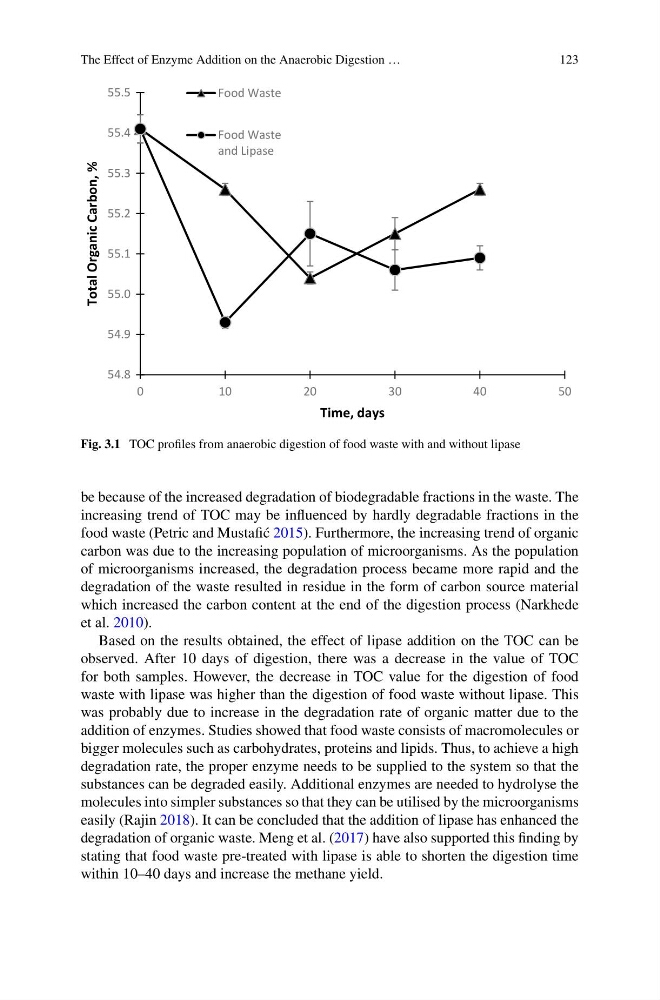
Fig. 3.1 TOC profiles from anaerobic digestion of food waste with and without lipase
be because of the increased degradation of biodegradable fractions in the waste. The
increasing trend of TOC may be influenced by hardly degradable fractions in the
food waste (Petric and Mustafi´ c 2015). Furthermore, the increasing trend of organic
carbon was due to the increasing population of microorganisms. As the population
of microorganisms increased, the degradation process became more rapid and the
degradation of the waste resulted in residue in the form of carbon source material
which increased the carbon content at the end of the digestion process (Narkhede
et al. 2010).
Based on the results obtained, the effect of lipase addition on the TOC can be
observed. After 10 days of digestion, there was a decrease in the value of TOC
for both samples. However, the decrease in TOC value for the digestion of food
waste with lipase was higher than the digestion of food waste without lipase. This
was probably due to increase in the degradation rate of organic matter due to the
addition of enzymes. Studies showed that food waste consists of macromolecules or
bigger molecules such as carbohydrates, proteins and lipids. Thus, to achieve a high
degradation rate, the proper enzyme needs to be supplied to the system so that the
substances can be degraded easily. Additional enzymes are needed to hydrolyse the
molecules into simpler substances so that they can be utilised by the microorganisms
easily (Rajin 2018). It can be concluded that the addition of lipase has enhanced the
degradation of organic waste. Meng et al. (2017) have also supported this finding by
stating that food waste pre-treated with lipase is able to shorten the digestion time
within 10–40 days and increase the methane yield.
123
54.8
54.9
55.0
55.1
55.2
55.3
55.4
55.5
0
10
20
30
40
50
Total Organic Carbon, %
Time, days
Food Waste
Food Waste
and Lipase
Fig. 3.1 TOC profiles from anaerobic digestion of food waste with and without lipase
be because of the increased degradation of biodegradable fractions in the waste. The
increasing trend of TOC may be influenced by hardly degradable fractions in the
food waste (Petric and Mustafi´ c 2015). Furthermore, the increasing trend of organic
carbon was due to the increasing population of microorganisms. As the population
of microorganisms increased, the degradation process became more rapid and the
degradation of the waste resulted in residue in the form of carbon source material
which increased the carbon content at the end of the digestion process (Narkhede
et al. 2010).
Based on the results obtained, the effect of lipase addition on the TOC can be
observed. After 10 days of digestion, there was a decrease in the value of TOC
for both samples. However, the decrease in TOC value for the digestion of food
waste with lipase was higher than the digestion of food waste without lipase. This
was probably due to increase in the degradation rate of organic matter due to the
addition of enzymes. Studies showed that food waste consists of macromolecules or
bigger molecules such as carbohydrates, proteins and lipids. Thus, to achieve a high
degradation rate, the proper enzyme needs to be supplied to the system so that the
substances can be degraded easily. Additional enzymes are needed to hydrolyse the
molecules into simpler substances so that they can be utilised by the microorganisms
easily (Rajin 2018). It can be concluded that the addition of lipase has enhanced the
degradation of organic waste. Meng et al. (2017) have also supported this finding by
stating that food waste pre-treated with lipase is able to shorten the digestion time
within 10–40 days and increase the methane yield.