

3.4.3 Sample
Troubleshooting
FIB Image Instability
The image may appear to drift or distort in the FIB view, especially
at high beam currents or magnifications. Check that there are no ice
or autogrid obstructions near the field of view that may be deflecting the ion beam. Check that the FIB accelerating voltage is at
30 kV. Increasing platinum sputtering time may help with drift.
Lamella Appears Skewed
Relative to Milling Axis
The grid surface in the FIB view is not perfectly flat. Use additional
scan rotation to make the FIB image appear horizontal (see Note 7
and Fig. 9).
Curtaining Artifacts
These artifacts manifest as ridges and grooves on the surface of the
lamella parallel to the milling axis. The FIB current is too high for
the lamella thickness or milling has not completed before narrowing the patterns. Reduce the current and extend the milling time to
ensure a flat lamella surface. Monitor the quality of the lamella at
regular intervals with the SEM. If the GIS platinum layer is wearing
away too quickly, the initial deposition time may be increased.
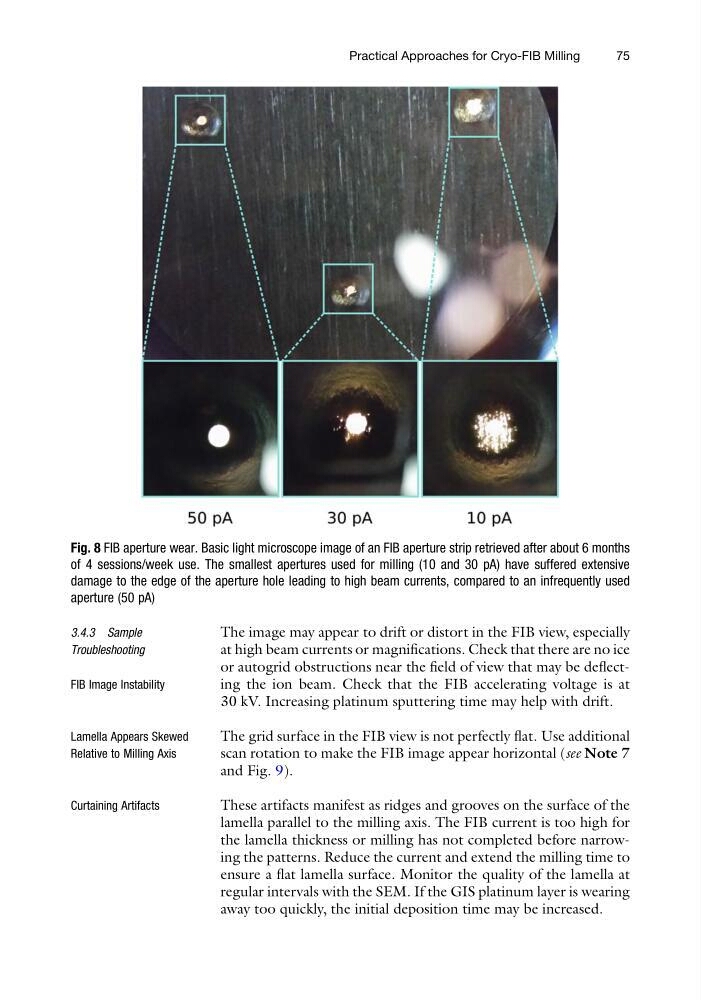
Fig. 8 FIB aperture wear. Basic light microscope image of an FIB aperture strip retrieved after about 6 months
of 4 sessions/week use. The smallest apertures used for milling (10 and 30 pA) have suffered extensive
damage to the edge of the aperture hole leading to high beam currents, compared to an infrequently used
aperture (50 pA)
Practical Approaches for Cryo-FIB Milling
75
Troubleshooting
FIB Image Instability
The image may appear to drift or distort in the FIB view, especially
at high beam currents or magnifications. Check that there are no ice
or autogrid obstructions near the field of view that may be deflecting the ion beam. Check that the FIB accelerating voltage is at
30 kV. Increasing platinum sputtering time may help with drift.
Lamella Appears Skewed
Relative to Milling Axis
The grid surface in the FIB view is not perfectly flat. Use additional
scan rotation to make the FIB image appear horizontal (see Note 7
and Fig. 9).
Curtaining Artifacts
These artifacts manifest as ridges and grooves on the surface of the
lamella parallel to the milling axis. The FIB current is too high for
the lamella thickness or milling has not completed before narrowing the patterns. Reduce the current and extend the milling time to
ensure a flat lamella surface. Monitor the quality of the lamella at
regular intervals with the SEM. If the GIS platinum layer is wearing
away too quickly, the initial deposition time may be increased.
Fig. 8 FIB aperture wear. Basic light microscope image of an FIB aperture strip retrieved after about 6 months
of 4 sessions/week use. The smallest apertures used for milling (10 and 30 pA) have suffered extensive
damage to the edge of the aperture hole leading to high beam currents, compared to an infrequently used
aperture (50 pA)
Practical Approaches for Cryo-FIB Milling
75