

the radius 1/λ of the corresponding Ewald sphere scales
inversely with the wavelength of the incident quanta. As a
result, given the markedly shorter wavelengths inherent to
electron diffraction, the curvature of the Ewald sphere is flattened, and its gently sloping arc is reliably approximated as a
plane at >100 keV. (This stands in stark contrast to X-ray
diffraction, in which the geometry of the Ewald sphere stays
true to its name.) Each observed reflection represents a crosssection between the surface of the Ewald sphere and a reciprocal lattice vector. Therefore, a wide, flattened Ewald sphere can
in principle accommodate many reciprocal lattice points per
angle. In practice, this advantage is attenuated by the restricted
tilt range available to TEM instruments.
17. If IDXREF produces an error beginning with “INSUFFICIENT PERCENTAGE (<50%) OF INDEXED REFLECTIONS,” proceed to step 9. If XDS fails to find an adequate
indexing solution (“IER ¼ 0”), inspect the values for the
parameters set in steps 3–5. Specifically, consider supplying a
different range of frames for SPOT_RANGE. If XDS cannot
determine an adequate indexing solution after multiple iterations of adjustments, it may indicate poor data quality.
18. The IDXREF error described in Note 17 may be caused by
many factors, including a limited tilt range. Unlike a multi-axis
goniometer, TEM instruments exhibit a restricted range of
motion. Thus, MicroED datasets may not always include a
large number of reflections within a given wedge of reciprocal
space, leading to indexing ambiguities. Other potentially causative factors include non-eucentric sample rotation and lens
aberrations [18].
19. Statistical analysis of each processing task implemented by XDS
(such as IDXREF) is stored in its respective log file (with an “.
LP” extension, such as IDXREF.LP). These log files contain a
preponderance of potentially useful information which could
enhance or facilitate an indexing solution. As an illustrative
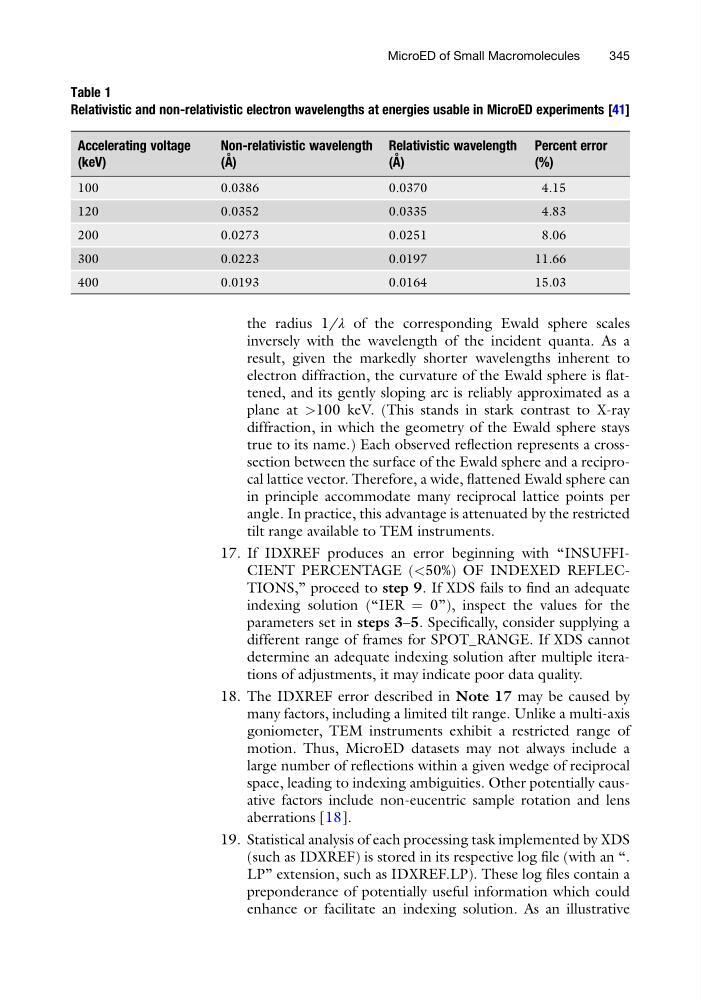
Table 1
Relativistic and non-relativistic electron wavelengths at energies usable in MicroED experiments [41]
Accelerating voltage
(keV)
Non-relativistic wavelength
(A ˚ )
Relativistic wavelength
(A ˚ )
Percent error
(%)
100
0.0386
0.0370
4.15
120
0.0352
0.0335
4.83
200
0.0273
0.0251
8.06
300
0.0223
0.0197
11.66
400
0.0193
0.0164
15.03
MicroED of Small Macromolecules
345
inversely with the wavelength of the incident quanta. As a
result, given the markedly shorter wavelengths inherent to
electron diffraction, the curvature of the Ewald sphere is flattened, and its gently sloping arc is reliably approximated as a
plane at >100 keV. (This stands in stark contrast to X-ray
diffraction, in which the geometry of the Ewald sphere stays
true to its name.) Each observed reflection represents a crosssection between the surface of the Ewald sphere and a reciprocal lattice vector. Therefore, a wide, flattened Ewald sphere can
in principle accommodate many reciprocal lattice points per
angle. In practice, this advantage is attenuated by the restricted
tilt range available to TEM instruments.
17. If IDXREF produces an error beginning with “INSUFFICIENT PERCENTAGE (<50%) OF INDEXED REFLECTIONS,” proceed to step 9. If XDS fails to find an adequate
indexing solution (“IER ¼ 0”), inspect the values for the
parameters set in steps 3–5. Specifically, consider supplying a
different range of frames for SPOT_RANGE. If XDS cannot
determine an adequate indexing solution after multiple iterations of adjustments, it may indicate poor data quality.
18. The IDXREF error described in Note 17 may be caused by
many factors, including a limited tilt range. Unlike a multi-axis
goniometer, TEM instruments exhibit a restricted range of
motion. Thus, MicroED datasets may not always include a
large number of reflections within a given wedge of reciprocal
space, leading to indexing ambiguities. Other potentially causative factors include non-eucentric sample rotation and lens
aberrations [18].
19. Statistical analysis of each processing task implemented by XDS
(such as IDXREF) is stored in its respective log file (with an “.
LP” extension, such as IDXREF.LP). These log files contain a
preponderance of potentially useful information which could
enhance or facilitate an indexing solution. As an illustrative
Table 1
Relativistic and non-relativistic electron wavelengths at energies usable in MicroED experiments [41]
Accelerating voltage
(keV)
Non-relativistic wavelength
(A ˚ )
Relativistic wavelength
(A ˚ )
Percent error
(%)
100
0.0386
0.0370
4.15
120
0.0352
0.0335
4.83
200
0.0273
0.0251
8.06
300
0.0223
0.0197
11.66
400
0.0193
0.0164
15.03
MicroED of Small Macromolecules
345