

14. To achieve optimal data quality, parameters such as camera
length, continuous rotation rate, exposure time, and crystal
orientation must be judiciously selected. A rotation rate of
0.1
–0.5
/s is recommended. Faster oscillations may result in
overlapping spots, while slower oscillations may result in an
insufficient number of spots due to sample degradation over
time. Additionally, exposure times between 0.1 and 10 s are
recommended. Longer exposures can increase the signal-tonoise ratio, but may place reflections from large unit cells in
danger of overlapping, even at slow oscillations. Data from
crystals that demonstrate orientation bias when deposited on
a grid is limited in its sampling of reciprocal space (i.e., via
collection of diffraction patterns at high tilt). Sufficient sampling is critical for obtaining high-completeness data.
15. Several procedures exist for identifying the location of the
beam center in a diffraction image. We describe a procedure
based on the relationship between the approximate locations of
Friedel mates. Here, one would draw lines connecting pairs of
Friedel mates to estimate the spatial coordinates of the beam
center. The position of the beam center may change or drift
between or within datasets. If this occurs, recalculate its value
accordingly.
16. XDS requires the user to supply the wavelength of the incident
radiation. While this is denoted X-ray for historical reasons, its
name has no bearing on the calculations performed by the
program. Calculation of this key parameter is straightforward
for X-rays (characteristic values include 0.7107 A ˚ for Mo Kα
and 1.5418 A ˚ for Cu Kα). In contrast, typical TEM accelerating voltages (i.e., >100 keV) suitable for MicroED produce a
high-energy beam in which each constituent electron is forcibly
propagated through a potential drop, ultimately generating a
beam of quanta traveling at a velocity greater than half the
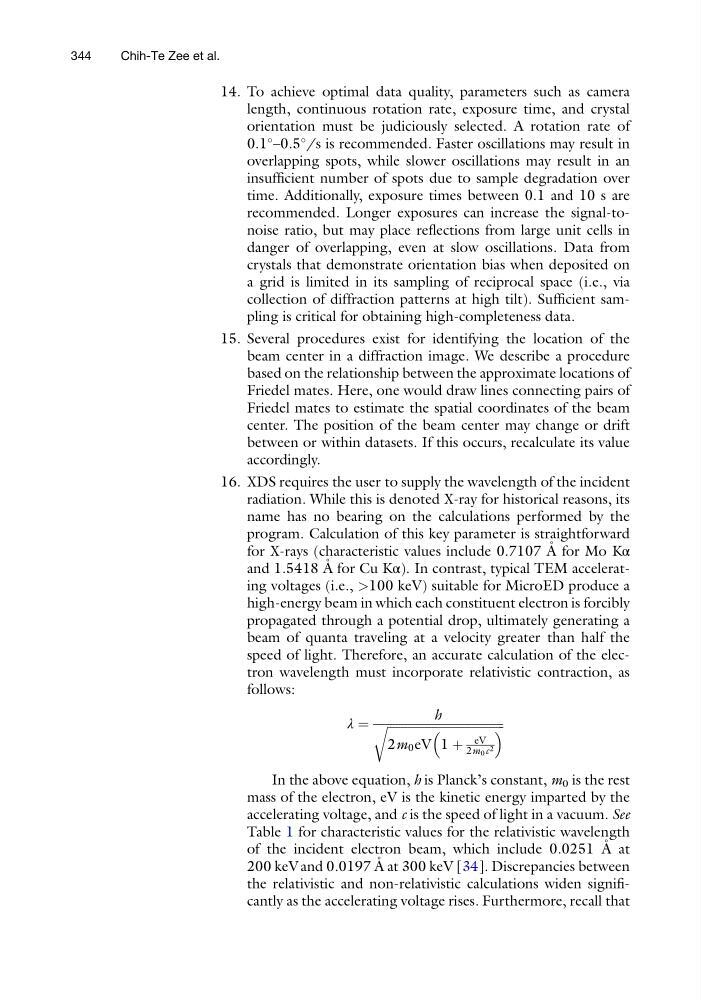
speed of light. Therefore, an accurate calculation of the electron wavelength must incorporate relativistic contraction, as
follows:
λ ¼
h
ffiffiffiffiffiffiffiffiffiffiffiffiffiffiffiffiffiffiffiffiffiffiffiffiffiffiffiffiffiffiffiffiffiffiffiffiffiffi ffi
2m 0 eV 1 þ
eV
2m 0 c 2
r
In the above equation, h is Planck’s constant, m 0 is the rest
mass of the electron, eV is the kinetic energy imparted by the
accelerating voltage, and c is the speed of light in a vacuum. See
Table 1 for characteristic values for the relativistic wavelength
of the incident electron beam, which include 0.0251 A ˚ at
200 keV and 0.0197 A ˚ at 300 keV [34]. Discrepancies between
the relativistic and non-relativistic calculations widen significantly as the accelerating voltage rises. Furthermore, recall that
344
Chih-Te Zee et al.
length, continuous rotation rate, exposure time, and crystal
orientation must be judiciously selected. A rotation rate of
0.1
–0.5
/s is recommended. Faster oscillations may result in
overlapping spots, while slower oscillations may result in an
insufficient number of spots due to sample degradation over
time. Additionally, exposure times between 0.1 and 10 s are
recommended. Longer exposures can increase the signal-tonoise ratio, but may place reflections from large unit cells in
danger of overlapping, even at slow oscillations. Data from
crystals that demonstrate orientation bias when deposited on
a grid is limited in its sampling of reciprocal space (i.e., via
collection of diffraction patterns at high tilt). Sufficient sampling is critical for obtaining high-completeness data.
15. Several procedures exist for identifying the location of the
beam center in a diffraction image. We describe a procedure
based on the relationship between the approximate locations of
Friedel mates. Here, one would draw lines connecting pairs of
Friedel mates to estimate the spatial coordinates of the beam
center. The position of the beam center may change or drift
between or within datasets. If this occurs, recalculate its value
accordingly.
16. XDS requires the user to supply the wavelength of the incident
radiation. While this is denoted X-ray for historical reasons, its
name has no bearing on the calculations performed by the
program. Calculation of this key parameter is straightforward
for X-rays (characteristic values include 0.7107 A ˚ for Mo Kα
and 1.5418 A ˚ for Cu Kα). In contrast, typical TEM accelerating voltages (i.e., >100 keV) suitable for MicroED produce a
high-energy beam in which each constituent electron is forcibly
propagated through a potential drop, ultimately generating a
beam of quanta traveling at a velocity greater than half the
speed of light. Therefore, an accurate calculation of the electron wavelength must incorporate relativistic contraction, as
follows:
λ ¼
h
ffiffiffiffiffiffiffiffiffiffiffiffiffiffiffiffiffiffiffiffiffiffiffiffiffiffiffiffiffiffiffiffiffiffiffiffiffiffi ffi
2m 0 eV 1 þ
eV
2m 0 c 2
r
In the above equation, h is Planck’s constant, m 0 is the rest
mass of the electron, eV is the kinetic energy imparted by the
accelerating voltage, and c is the speed of light in a vacuum. See
Table 1 for characteristic values for the relativistic wavelength
of the incident electron beam, which include 0.0251 A ˚ at
200 keV and 0.0197 A ˚ at 300 keV [34]. Discrepancies between
the relativistic and non-relativistic calculations widen significantly as the accelerating voltage rises. Furthermore, recall that
344
Chih-Te Zee et al.