

3. Prepare Vitrobot for freezing following manufacturer’s
instructions, filling the sample storage reservoir with liquid
nitrogen, placing a grid storage box in the liquid nitrogen
reservoir, placing the copper ethane cup at its center, and
linking them via a heat transfer apparatus. Condense ethane
into cup following safety protocols (see Note 5).
4. Secure grid using Vitrobot tweezers and place into Vitrobot
assembly following manufacturer’s instructions, as per the
Dubochet method [21].
5. Collect 5 μL or more of a slurry of crystal fragments of
sub-micron thickness suspended in mother liquor.
6. Place 1–3 μL of crystal slurry per side, on either one or both
sides of the grid (see Note 6).
7. Immediately follow Vitrobot procedures for blotting and
plunge freezing of grid into liquid ethane [32] (see Note 7),
then transfer the grid to a liquid nitrogen storage box.
8. Transfer grid boxes to permanent storage or to cryo holder
transfer station for immediate use.
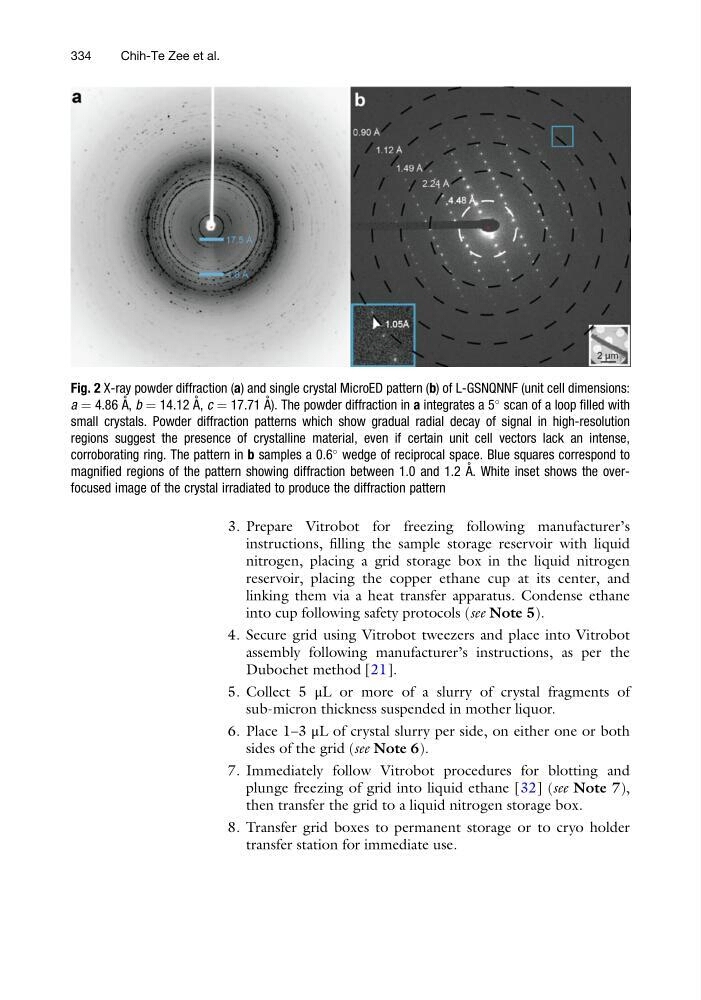
Fig. 2 X-ray powder diffraction (a) and single crystal MicroED pattern (b) of L-GSNQNNF (unit cell dimensions:
a ¼ 4.86 A ˚ , b ¼ 14.12 A ˚ , c ¼ 17.71 A ˚ ). The powder diffraction in a integrates a 5
scan of a loop filled with
small crystals. Powder diffraction patterns which show gradual radial decay of signal in high-resolution
regions suggest the presence of crystalline material, even if certain unit cell vectors lack an intense,
corroborating ring. The pattern in b samples a 0.6
wedge of reciprocal space. Blue squares correspond to
magnified regions of the pattern showing diffraction between 1.0 and 1.2 A ˚ . White inset shows the overfocused image of the crystal irradiated to produce the diffraction pattern
334
Chih-Te Zee et al.
instructions, filling the sample storage reservoir with liquid
nitrogen, placing a grid storage box in the liquid nitrogen
reservoir, placing the copper ethane cup at its center, and
linking them via a heat transfer apparatus. Condense ethane
into cup following safety protocols (see Note 5).
4. Secure grid using Vitrobot tweezers and place into Vitrobot
assembly following manufacturer’s instructions, as per the
Dubochet method [21].
5. Collect 5 μL or more of a slurry of crystal fragments of
sub-micron thickness suspended in mother liquor.
6. Place 1–3 μL of crystal slurry per side, on either one or both
sides of the grid (see Note 6).
7. Immediately follow Vitrobot procedures for blotting and
plunge freezing of grid into liquid ethane [32] (see Note 7),
then transfer the grid to a liquid nitrogen storage box.
8. Transfer grid boxes to permanent storage or to cryo holder
transfer station for immediate use.
Fig. 2 X-ray powder diffraction (a) and single crystal MicroED pattern (b) of L-GSNQNNF (unit cell dimensions:
a ¼ 4.86 A ˚ , b ¼ 14.12 A ˚ , c ¼ 17.71 A ˚ ). The powder diffraction in a integrates a 5
scan of a loop filled with
small crystals. Powder diffraction patterns which show gradual radial decay of signal in high-resolution
regions suggest the presence of crystalline material, even if certain unit cell vectors lack an intense,
corroborating ring. The pattern in b samples a 0.6
wedge of reciprocal space. Blue squares correspond to
magnified regions of the pattern showing diffraction between 1.0 and 1.2 A ˚ . White inset shows the overfocused image of the crystal irradiated to produce the diffraction pattern
334
Chih-Te Zee et al.