

same half-sets to prevent an inflation of the FSC curve. Normally,
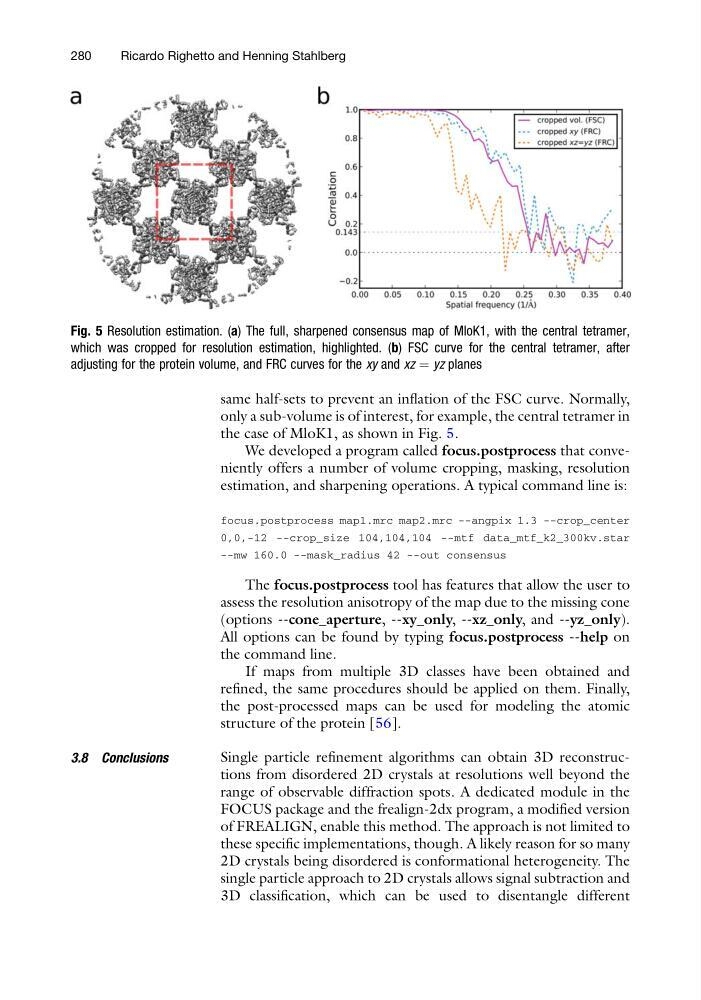
only a sub-volume is of interest, for example, the central tetramer in
the case of MloK1, as shown in Fig. 5.
We developed a program called focus.postprocess that conveniently offers a number of volume cropping, masking, resolution
estimation, and sharpening operations. A typical command line is:
focus.postprocess map1.mrc map2.mrc --angpix 1.3 --crop_center
0,0,-12 --crop_size 104,104,104 --mtf data_mtf_k2_300kv.star
--mw 160.0 --mask_radius 42 --out consensus
The focus.postprocess tool has features that allow the user to
assess the resolution anisotropy of the map due to the missing cone
(options --cone_aperture, --xy_only, --xz_only, and --yz_only).
All options can be found by typing focus.postprocess --help on
the command line.
If maps from multiple 3D classes have been obtained and
refined, the same procedures should be applied on them. Finally,
the post-processed maps can be used for modeling the atomic
structure of the protein [56].
3.8 Conclusions
Single particle refinement algorithms can obtain 3D reconstructions from disordered 2D crystals at resolutions well beyond the
range of observable diffraction spots. A dedicated module in the
FOCUS package and the frealign-2dx program, a modified version
of FREALIGN, enable this method. The approach is not limited to
these specific implementations, though. A likely reason for so many
2D crystals being disordered is conformational heterogeneity. The
single particle approach to 2D crystals allows signal subtraction and
3D classification, which can be used to disentangle different
Fig. 5 Resolution estimation. (a) The full, sharpened consensus map of MloK1, with the central tetramer,
which was cropped for resolution estimation, highlighted. (b) FSC curve for the central tetramer, after
adjusting for the protein volume, and FRC curves for the xy and xz ¼ yz planes
280
Ricardo Righetto and Henning Stahlberg
only a sub-volume is of interest, for example, the central tetramer in
the case of MloK1, as shown in Fig. 5.
We developed a program called focus.postprocess that conveniently offers a number of volume cropping, masking, resolution
estimation, and sharpening operations. A typical command line is:
focus.postprocess map1.mrc map2.mrc --angpix 1.3 --crop_center
0,0,-12 --crop_size 104,104,104 --mtf data_mtf_k2_300kv.star
--mw 160.0 --mask_radius 42 --out consensus
The focus.postprocess tool has features that allow the user to
assess the resolution anisotropy of the map due to the missing cone
(options --cone_aperture, --xy_only, --xz_only, and --yz_only).
All options can be found by typing focus.postprocess --help on
the command line.
If maps from multiple 3D classes have been obtained and
refined, the same procedures should be applied on them. Finally,
the post-processed maps can be used for modeling the atomic
structure of the protein [56].
3.8 Conclusions
Single particle refinement algorithms can obtain 3D reconstructions from disordered 2D crystals at resolutions well beyond the
range of observable diffraction spots. A dedicated module in the
FOCUS package and the frealign-2dx program, a modified version
of FREALIGN, enable this method. The approach is not limited to
these specific implementations, though. A likely reason for so many
2D crystals being disordered is conformational heterogeneity. The
single particle approach to 2D crystals allows signal subtraction and
3D classification, which can be used to disentangle different
Fig. 5 Resolution estimation. (a) The full, sharpened consensus map of MloK1, with the central tetramer,
which was cropped for resolution estimation, highlighted. (b) FSC curve for the central tetramer, after
adjusting for the protein volume, and FRC curves for the xy and xz ¼ yz planes
280
Ricardo Righetto and Henning Stahlberg