

12. Carefully watch for sparks during evaporation. Watch for
changes in pressure in parallel. The pressure should not
increase abruptly.
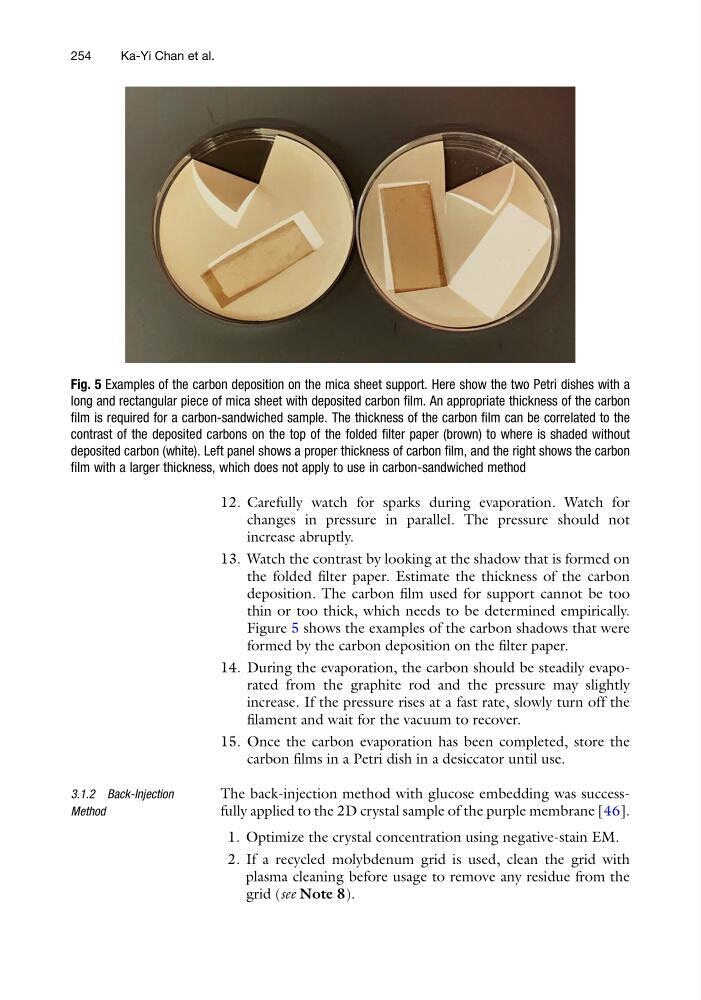
13. Watch the contrast by looking at the shadow that is formed on
the folded filter paper. Estimate the thickness of the carbon
deposition. The carbon film used for support cannot be too
thin or too thick, which needs to be determined empirically.
Figure 5 shows the examples of the carbon shadows that were
formed by the carbon deposition on the filter paper.
14. During the evaporation, the carbon should be steadily evaporated from the graphite rod and the pressure may slightly
increase. If the pressure rises at a fast rate, slowly turn off the
filament and wait for the vacuum to recover.
15. Once the carbon evaporation has been completed, store the
carbon films in a Petri dish in a desiccator until use.
3.1.2 Back-Injection
Method
The back-injection method with glucose embedding was successfully applied to the 2D crystal sample of the purple membrane [46].
1. Optimize the crystal concentration using negative-stain EM.
2. If a recycled molybdenum grid is used, clean the grid with
plasma cleaning before usage to remove any residue from the
grid (see Note 8).
Fig. 5 Examples of the carbon deposition on the mica sheet support. Here show the two Petri dishes with a
long and rectangular piece of mica sheet with deposited carbon film. An appropriate thickness of the carbon
film is required for a carbon-sandwiched sample. The thickness of the carbon film can be correlated to the
contrast of the deposited carbons on the top of the folded filter paper (brown) to where is shaded without
deposited carbon (white). Left panel shows a proper thickness of carbon film, and the right shows the carbon
film with a larger thickness, which does not apply to use in carbon-sandwiched method
254
Ka-Yi Chan et al.
changes in pressure in parallel. The pressure should not
increase abruptly.
13. Watch the contrast by looking at the shadow that is formed on
the folded filter paper. Estimate the thickness of the carbon
deposition. The carbon film used for support cannot be too
thin or too thick, which needs to be determined empirically.
Figure 5 shows the examples of the carbon shadows that were
formed by the carbon deposition on the filter paper.
14. During the evaporation, the carbon should be steadily evaporated from the graphite rod and the pressure may slightly
increase. If the pressure rises at a fast rate, slowly turn off the
filament and wait for the vacuum to recover.
15. Once the carbon evaporation has been completed, store the
carbon films in a Petri dish in a desiccator until use.
3.1.2 Back-Injection
Method
The back-injection method with glucose embedding was successfully applied to the 2D crystal sample of the purple membrane [46].
1. Optimize the crystal concentration using negative-stain EM.
2. If a recycled molybdenum grid is used, clean the grid with
plasma cleaning before usage to remove any residue from the
grid (see Note 8).
Fig. 5 Examples of the carbon deposition on the mica sheet support. Here show the two Petri dishes with a
long and rectangular piece of mica sheet with deposited carbon film. An appropriate thickness of the carbon
film is required for a carbon-sandwiched sample. The thickness of the carbon film can be correlated to the
contrast of the deposited carbons on the top of the folded filter paper (brown) to where is shaded without
deposited carbon (white). Left panel shows a proper thickness of carbon film, and the right shows the carbon
film with a larger thickness, which does not apply to use in carbon-sandwiched method
254
Ka-Yi Chan et al.