

4 Summary
Despite great advances in cryo-EM techniques, there is still a need
to integrate data for solving the structure of macromolecular
assemblies. This brings with it a set of problems of modeling atomic
structure, density fitting, refinement, and validation. In this review,
we described some of these methods and strategies that we have
developed in this context. The data used in such an integrative
modeling approach is often sparse, noisy, and ambiguous. Therefore, it is important to choose an adequate representation of the
structure (depending on the resolution of the map, the accuracy of
the candidate model, and the amount of missing information in
both the structure and the map) so that the data to fit can be
represented in the most accurate way possible. Structure flexibility
is an important issue to explore due to the dynamic nature of
macromolecular assemblies revealed from EM data. So is the assessment of final models (both in terms of standard geometries and
local and global fit to the data), due to variable local resolution and
missing information. It is important that the final model(s) reflect
uncertainty and completeness of the input information. Future
developments will focus on further automation of our protocols,
exploration of inherent protein flexibility, incorporation of additional experimental restraints into the model fitting process, and
new methods for map and model validation.
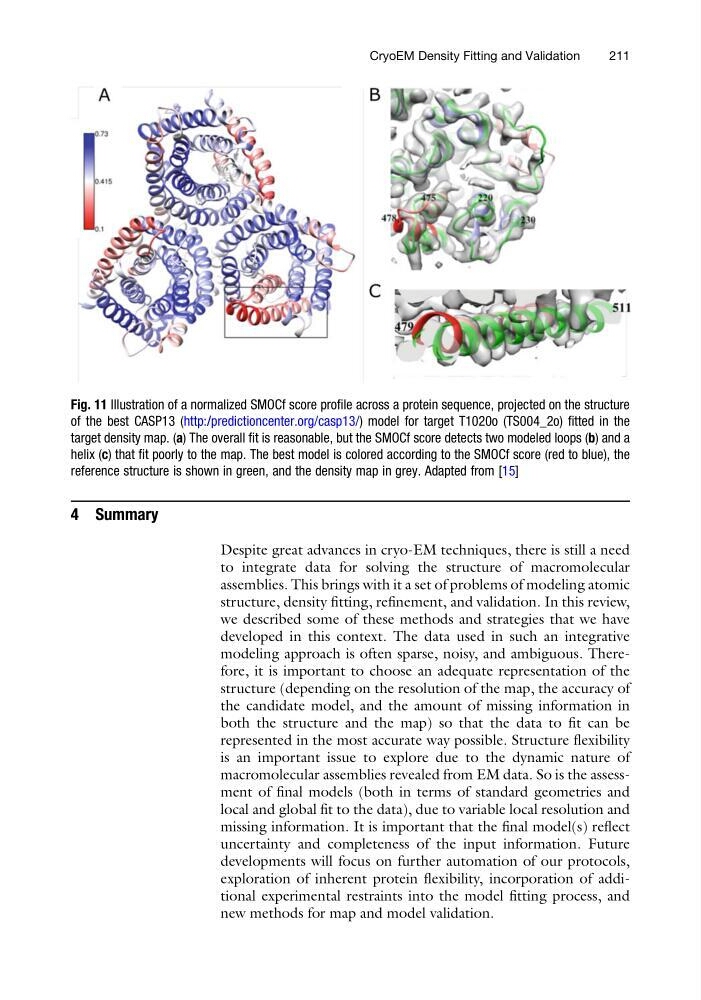
Fig. 11 Illustration of a normalized SMOCf score profile across a protein sequence, projected on the structure
of the best CASP13 (http:/ /predictioncenter.org/casp13/) model for target T1020o (TS004_2o) fitted in the
target density map. (a) The overall fit is reasonable, but the SMOCf score detects two modeled loops (b) and a
helix (c) that fit poorly to the map. The best model is colored according to the SMOCf score (red to blue), the
reference structure is shown in green, and the density map in grey. Adapted from [15]
CryoEM Density Fitting and Validation
211
Despite great advances in cryo-EM techniques, there is still a need
to integrate data for solving the structure of macromolecular
assemblies. This brings with it a set of problems of modeling atomic
structure, density fitting, refinement, and validation. In this review,
we described some of these methods and strategies that we have
developed in this context. The data used in such an integrative
modeling approach is often sparse, noisy, and ambiguous. Therefore, it is important to choose an adequate representation of the
structure (depending on the resolution of the map, the accuracy of
the candidate model, and the amount of missing information in
both the structure and the map) so that the data to fit can be
represented in the most accurate way possible. Structure flexibility
is an important issue to explore due to the dynamic nature of
macromolecular assemblies revealed from EM data. So is the assessment of final models (both in terms of standard geometries and
local and global fit to the data), due to variable local resolution and
missing information. It is important that the final model(s) reflect
uncertainty and completeness of the input information. Future
developments will focus on further automation of our protocols,
exploration of inherent protein flexibility, incorporation of additional experimental restraints into the model fitting process, and
new methods for map and model validation.
Fig. 11 Illustration of a normalized SMOCf score profile across a protein sequence, projected on the structure
of the best CASP13 (http:/ /predictioncenter.org/casp13/) model for target T1020o (TS004_2o) fitted in the
target density map. (a) The overall fit is reasonable, but the SMOCf score detects two modeled loops (b) and a
helix (c) that fit poorly to the map. The best model is colored according to the SMOCf score (red to blue), the
reference structure is shown in green, and the density map in grey. Adapted from [15]
CryoEM Density Fitting and Validation
211