

3.7.2 Assessing
the Local Quality
Map Assessment
By using SMOC or SCCC, it is possible to detect specific regions
with low fit to the data (Fig. 11). This can be useful either in terms
of refinement, for example, if a putative model was fit rigidly, and
loop optimization (see Subheading 3.5) is necessary; or to identify a
low-resolution or high-flexibility region of the map or a distortion
of SSEs [16]. As mentioned above (see Subheading 2.3.2), SMOC
and SCCC are useful both at high and intermediate range of
resolutions. For models where the residues are placed accurately
at near-atomic resolution EMRinger [73] can be useful to assess the
quality of the backbone; by testing different position of the C γ
atom, by altering the χ 1 dihedral angle, EMRinger produces a
profile of the correlation coefficient as a function of the dihedral
angle. The score obtained for the current conformation of each side
chain can be aggregated in a single global score [74].
Local Structure
Knowledge-based scoring methods often used for global scoring
(such as QMEAN, DOPE) also provide a residue-level profile that
can be used for local assessment of the structure (see Fig. 8). The
MolProbity package [75] is commonly used and reported for
structural models generated from cryo-EM, X-ray, and other experimental structural data sources. By analyzing the geometric properties of the proposed model, such as distances, angles, and dihedrals
between atoms, MolProbity identifies regions that present clashes
or have significant outliers compared to other models, highlighting
potential issues in the modeling. MolProbity has been used to
check and improve interfaces in protein complexes solved by
cryo-EM [54, 76]. Although originally developed for highresolution structure checking, the method has been extended
with the Cα-based low-resolution annotation method (CaBLAM)
[77], that checks dihedral over multiple residues and provide a
quality measure for intermediate-resolution models where the
backbone trace can be more reliably fitted to the EM data than a
full-atom model.
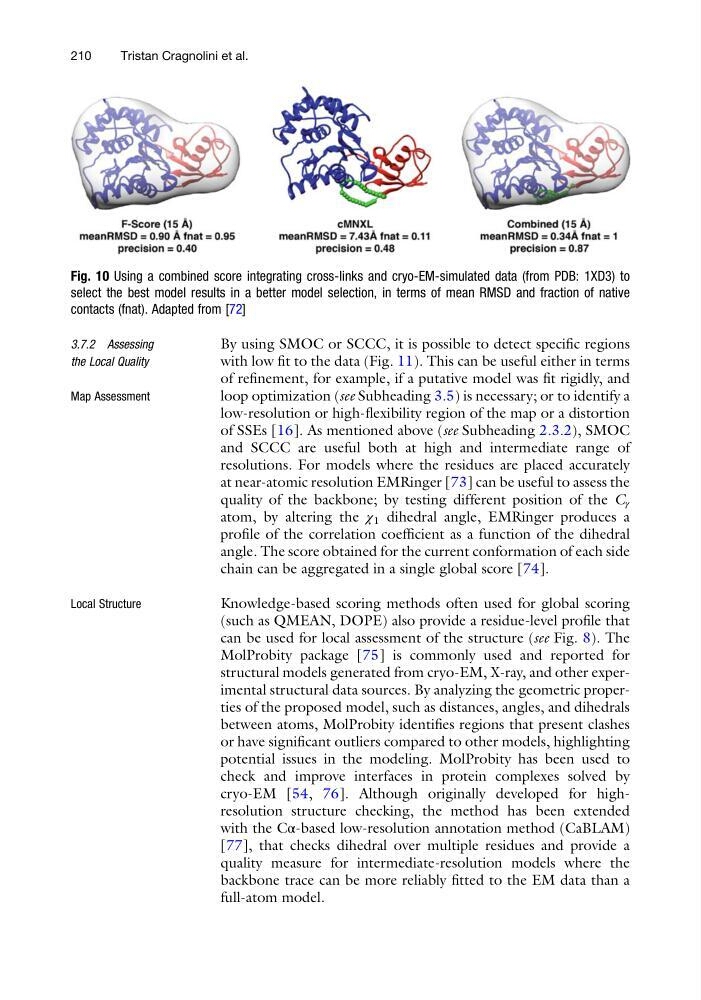
Fig. 10 Using a combined score integrating cross-links and cryo-EM-simulated data (from PDB: 1XD3) to
select the best model results in a better model selection, in terms of mean RMSD and fraction of native
contacts (fnat). Adapted from [72]
210
Tristan Cragnolini et al.
the Local Quality
Map Assessment
By using SMOC or SCCC, it is possible to detect specific regions
with low fit to the data (Fig. 11). This can be useful either in terms
of refinement, for example, if a putative model was fit rigidly, and
loop optimization (see Subheading 3.5) is necessary; or to identify a
low-resolution or high-flexibility region of the map or a distortion
of SSEs [16]. As mentioned above (see Subheading 2.3.2), SMOC
and SCCC are useful both at high and intermediate range of
resolutions. For models where the residues are placed accurately
at near-atomic resolution EMRinger [73] can be useful to assess the
quality of the backbone; by testing different position of the C γ
atom, by altering the χ 1 dihedral angle, EMRinger produces a
profile of the correlation coefficient as a function of the dihedral
angle. The score obtained for the current conformation of each side
chain can be aggregated in a single global score [74].
Local Structure
Knowledge-based scoring methods often used for global scoring
(such as QMEAN, DOPE) also provide a residue-level profile that
can be used for local assessment of the structure (see Fig. 8). The
MolProbity package [75] is commonly used and reported for
structural models generated from cryo-EM, X-ray, and other experimental structural data sources. By analyzing the geometric properties of the proposed model, such as distances, angles, and dihedrals
between atoms, MolProbity identifies regions that present clashes
or have significant outliers compared to other models, highlighting
potential issues in the modeling. MolProbity has been used to
check and improve interfaces in protein complexes solved by
cryo-EM [54, 76]. Although originally developed for highresolution structure checking, the method has been extended
with the Cα-based low-resolution annotation method (CaBLAM)
[77], that checks dihedral over multiple residues and provide a
quality measure for intermediate-resolution models where the
backbone trace can be more reliably fitted to the EM data than a
full-atom model.
Fig. 10 Using a combined score integrating cross-links and cryo-EM-simulated data (from PDB: 1XD3) to
select the best model results in a better model selection, in terms of mean RMSD and fraction of native
contacts (fnat). Adapted from [72]
210
Tristan Cragnolini et al.