

Since the reliable information contained within a map at intermediate resolutions (~4–15 A ˚ ) can be variable (from domains at
~15 A ˚ to long alpha helices at resolutions closer to 10 A ˚ , to short
helices and even separated beta strands at resolutions close to 4 A ˚ ),
at these resolutions, maintaining some rigidity of the amino acids
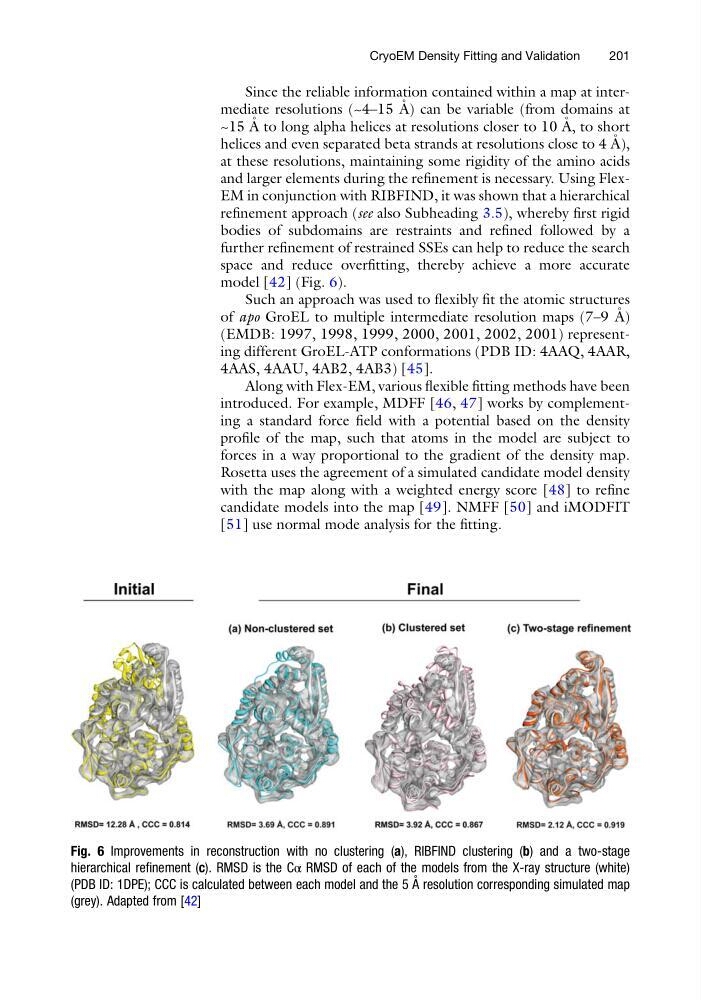
and larger elements during the refinement is necessary. Using FlexEM in conjunction with RIBFIND, it was shown that a hierarchical
refinement approach (see also Subheading 3.5), whereby first rigid
bodies of subdomains are restraints and refined followed by a
further refinement of restrained SSEs can help to reduce the search
space and reduce overfitting, thereby achieve a more accurate
model [42] (Fig. 6).
Such an approach was used to flexibly fit the atomic structures
of apo GroEL to multiple intermediate resolution maps (7–9 A ˚ )
(EMDB: 1997, 1998, 1999, 2000, 2001, 2002, 2001) representing different GroEL-ATP conformations (PDB ID: 4AAQ, 4AAR,
4AAS, 4AAU, 4AB2, 4AB3) [45].
Along with Flex-EM, various flexible fitting methods have been
introduced. For example, MDFF [46, 47] works by complementing a standard force field with a potential based on the density
profile of the map, such that atoms in the model are subject to
forces in a way proportional to the gradient of the density map.
Rosetta uses the agreement of a simulated candidate model density
with the map along with a weighted energy score [48] to refine
candidate models into the map [49]. NMFF [50] and iMODFIT
[51] use normal mode analysis for the fitting.
Fig. 6 Improvements in reconstruction with no clustering (a), RIBFIND clustering (b) and a two-stage
hierarchical refinement (c). RMSD is the Cα RMSD of each of the models from the X-ray structure (white)
(PDB ID: 1DPE); CCC is calculated between each model and the 5 A ˚ resolution corresponding simulated map
(grey). Adapted from [42]
CryoEM Density Fitting and Validation
201
~15 A ˚ to long alpha helices at resolutions closer to 10 A ˚ , to short
helices and even separated beta strands at resolutions close to 4 A ˚ ),
at these resolutions, maintaining some rigidity of the amino acids
and larger elements during the refinement is necessary. Using FlexEM in conjunction with RIBFIND, it was shown that a hierarchical
refinement approach (see also Subheading 3.5), whereby first rigid
bodies of subdomains are restraints and refined followed by a
further refinement of restrained SSEs can help to reduce the search
space and reduce overfitting, thereby achieve a more accurate
model [42] (Fig. 6).
Such an approach was used to flexibly fit the atomic structures
of apo GroEL to multiple intermediate resolution maps (7–9 A ˚ )
(EMDB: 1997, 1998, 1999, 2000, 2001, 2002, 2001) representing different GroEL-ATP conformations (PDB ID: 4AAQ, 4AAR,
4AAS, 4AAU, 4AB2, 4AB3) [45].
Along with Flex-EM, various flexible fitting methods have been
introduced. For example, MDFF [46, 47] works by complementing a standard force field with a potential based on the density
profile of the map, such that atoms in the model are subject to
forces in a way proportional to the gradient of the density map.
Rosetta uses the agreement of a simulated candidate model density
with the map along with a weighted energy score [48] to refine
candidate models into the map [49]. NMFF [50] and iMODFIT
[51] use normal mode analysis for the fitting.
Fig. 6 Improvements in reconstruction with no clustering (a), RIBFIND clustering (b) and a two-stage
hierarchical refinement (c). RMSD is the Cα RMSD of each of the models from the X-ray structure (white)
(PDB ID: 1DPE); CCC is calculated between each model and the 5 A ˚ resolution corresponding simulated map
(grey). Adapted from [42]
CryoEM Density Fitting and Validation
201