

3.3.3 γ-TEMPy (Genetic
Algorithm for Modeling
Macromolecular
Assemblies with Template
and EM Comparison Using
Python)
In γ-Tempy, a genetic algorithm is used to iteratively refine candidate assemblies and improve their match to the map, judged by a
global score (see Subheading 2.3 above) [34]. After an initial VQ
run, positions and rotations are generated for each component,
each around a separate codebook vector. A number of those sets
are generated, producing the initial “population” of assembly fits. A
new “generation” of assemblies are created by mutating (i.e., randomly changing) the position and rotation values for the components and by combining values from two “parents.” The set of
“parents” and “children” are scored and ranked, and the best
candidates are kept for the next “generation.” The fitness (scoring)
function that is used combines a map score (MI) and a penalty clash
score to keep the components apart from each other. The result
from multiple runs can be collected, refined with Flex-EM (or some
other flexible refinement method, see Subheading 3.3 on flexible
fitting), and the best results brought forward for analysis. This
method was shown capable of producing reasonable fit for assemblies up to eight components (with no symmetry), in particular at
10 A ˚ resolution (Fig. 3) but also at as low as 20 A ˚ [34].
When a large number of models are generated, it can prove
useful to cluster them: many models may represent closely related
alternative fits, and clustering may reveal common features of the
fit even in cases where different assemblies are scored similarly
[17, 36].
3.4 Flexible Fitting
(Refinement)
Once an atomic candidate model (or multiple models) have been
fitted rigidly in a region of the cryo-EM map, it is often noticeable
that its conformation is different from the conformation
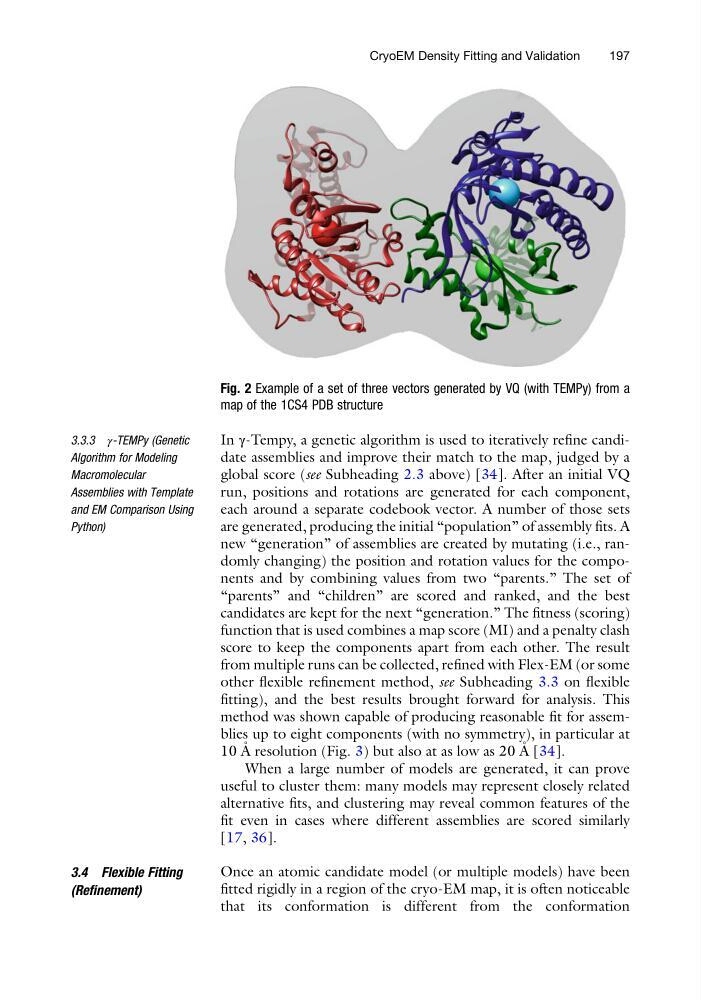
Fig. 2 Example of a set of three vectors generated by VQ (with TEMPy) from a
map of the 1CS4 PDB structure
CryoEM Density Fitting and Validation
197
Algorithm for Modeling
Macromolecular
Assemblies with Template
and EM Comparison Using
Python)
In γ-Tempy, a genetic algorithm is used to iteratively refine candidate assemblies and improve their match to the map, judged by a
global score (see Subheading 2.3 above) [34]. After an initial VQ
run, positions and rotations are generated for each component,
each around a separate codebook vector. A number of those sets
are generated, producing the initial “population” of assembly fits. A
new “generation” of assemblies are created by mutating (i.e., randomly changing) the position and rotation values for the components and by combining values from two “parents.” The set of
“parents” and “children” are scored and ranked, and the best
candidates are kept for the next “generation.” The fitness (scoring)
function that is used combines a map score (MI) and a penalty clash
score to keep the components apart from each other. The result
from multiple runs can be collected, refined with Flex-EM (or some
other flexible refinement method, see Subheading 3.3 on flexible
fitting), and the best results brought forward for analysis. This
method was shown capable of producing reasonable fit for assemblies up to eight components (with no symmetry), in particular at
10 A ˚ resolution (Fig. 3) but also at as low as 20 A ˚ [34].
When a large number of models are generated, it can prove
useful to cluster them: many models may represent closely related
alternative fits, and clustering may reveal common features of the
fit even in cases where different assemblies are scored similarly
[17, 36].
3.4 Flexible Fitting
(Refinement)
Once an atomic candidate model (or multiple models) have been
fitted rigidly in a region of the cryo-EM map, it is often noticeable
that its conformation is different from the conformation
Fig. 2 Example of a set of three vectors generated by VQ (with TEMPy) from a
map of the 1CS4 PDB structure
CryoEM Density Fitting and Validation
197