

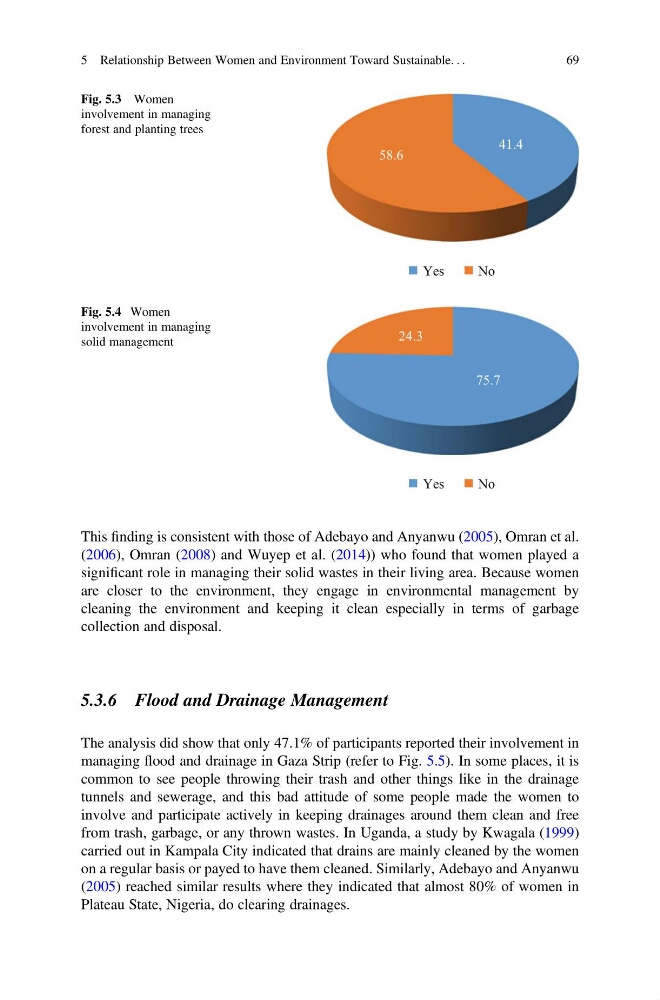
This finding is consistent with those of Adebayo and Anyanwu (2005), Omran et al.
(2006), Omran (2008) and Wuyep et al. (2014)) who found that women played a
significant role in managing their solid wastes in their living area. Because women
are closer to the environment, they engage in environmental management by
cleaning the environment and keeping it clean especially in terms of garbage
collection and disposal.
5.3.6 Flood and Drainage Management
The analysis did show that only 47.1% of participants reported their involvement in
managing flood and drainage in Gaza Strip (refer to Fig. 5.5). In some places, it is
common to see people throwing their trash and other things like in the drainage
tunnels and sewerage, and this bad attitude of some people made the women to
involve and participate actively in keeping drainages around them clean and free
from trash, garbage, or any thrown wastes. In Uganda, a study by Kwagala (1999)
carried out in Kampala City indicated that drains are mainly cleaned by the women
on a regular basis or payed to have them cleaned. Similarly, Adebayo and Anyanwu
(2005) reached similar results where they indicated that almost 80% of women in
Plateau State, Nigeria, do clearing drainages.
41.4
58.6
Yes
No
Fig. 5.3 Women
involvement in managing
forest and planting trees
75.7
24.3
Yes
No
Fig. 5.4 Women
involvement in managing
solid management
5 Relationship Between Women and Environment Toward Sustainable. . .
69
(2006), Omran (2008) and Wuyep et al. (2014)) who found that women played a
significant role in managing their solid wastes in their living area. Because women
are closer to the environment, they engage in environmental management by
cleaning the environment and keeping it clean especially in terms of garbage
collection and disposal.
5.3.6 Flood and Drainage Management
The analysis did show that only 47.1% of participants reported their involvement in
managing flood and drainage in Gaza Strip (refer to Fig. 5.5). In some places, it is
common to see people throwing their trash and other things like in the drainage
tunnels and sewerage, and this bad attitude of some people made the women to
involve and participate actively in keeping drainages around them clean and free
from trash, garbage, or any thrown wastes. In Uganda, a study by Kwagala (1999)
carried out in Kampala City indicated that drains are mainly cleaned by the women
on a regular basis or payed to have them cleaned. Similarly, Adebayo and Anyanwu
(2005) reached similar results where they indicated that almost 80% of women in
Plateau State, Nigeria, do clearing drainages.
41.4
58.6
Yes
No
Fig. 5.3 Women
involvement in managing
forest and planting trees
75.7
24.3
Yes
No
Fig. 5.4 Women
involvement in managing
solid management
5 Relationship Between Women and Environment Toward Sustainable. . .
69