

employer of women (3%). In Greece, approximately 38% of women (of all family
workers in agriculture) are employed in agriculture. In Portugal, over 50% of the
agricultural workforce is female (Wikigender 2008). In Africa, 80% of the agricultural production comes from small farmers, who are mostly rural women
(Wikigender 2017). In sub-Saharan Africa and the Caribbean, women produce
80% of basic food stuffs, while, in Asia, women provide 50–90% of the labor
force for rice cultivation. Lastly, a total of 60% of women are involved in farming
in Adamawa State, Nigeria (Adebayo and Anyanwu 2005).
5.3.4 Involvement in Forest Management and Tree Planting
The results corroborated that women’s role in managing forests and tree planting is
not that significant, where nearly 95% (58.6%) reported that they do not participate
in agricultural activities (Fig. 5.3). The results are in agreement with the finding of
Maye (1994) who validated that women propagate seedlings and flowers at nurseries
to beautify their environment. The latter finding is also in line with that of
Adebayo and Anyanwu (2005) who affirmed that 70% of women in Adamawa
State, Nigeria, have planted trees in their compounds in the last 5 years, with 21%
of trees having been planted on their farms. Furthermore, Adebayo and Anyanwu
(2005) confirmed that 79.2% of the women are involved in farming activities and
contribute significantly to land/soil conservation and that 78.4% of them have
planted trees or flowers in the last 5 years.
5.3.5 Solid Waste Management
Women play a big role in cleaning the environment and keeping it clean. As shown
in Fig. 5.4, it can be found from the obtained results that 75.7% of women
participated actively in managing their solid waste. Women play a big role in
cleaning the environment especially for managing solid waste and its activities.
71.4
28.6
Yes
No
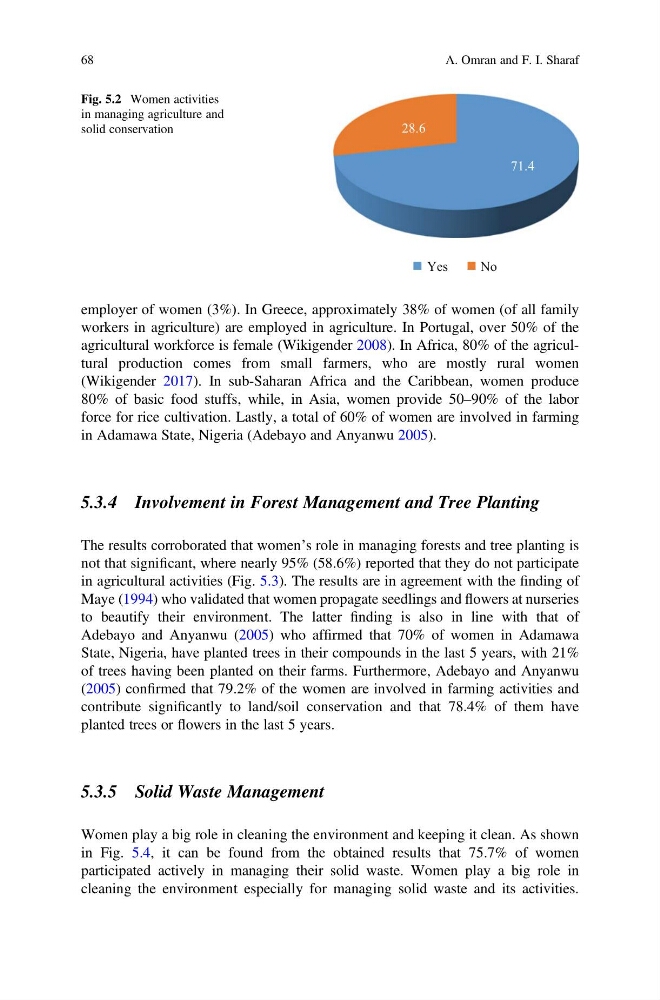
Fig. 5.2 Women activities
in managing agriculture and
solid conservation
68
A. Omran and F. I. Sharaf
workers in agriculture) are employed in agriculture. In Portugal, over 50% of the
agricultural workforce is female (Wikigender 2008). In Africa, 80% of the agricultural production comes from small farmers, who are mostly rural women
(Wikigender 2017). In sub-Saharan Africa and the Caribbean, women produce
80% of basic food stuffs, while, in Asia, women provide 50–90% of the labor
force for rice cultivation. Lastly, a total of 60% of women are involved in farming
in Adamawa State, Nigeria (Adebayo and Anyanwu 2005).
5.3.4 Involvement in Forest Management and Tree Planting
The results corroborated that women’s role in managing forests and tree planting is
not that significant, where nearly 95% (58.6%) reported that they do not participate
in agricultural activities (Fig. 5.3). The results are in agreement with the finding of
Maye (1994) who validated that women propagate seedlings and flowers at nurseries
to beautify their environment. The latter finding is also in line with that of
Adebayo and Anyanwu (2005) who affirmed that 70% of women in Adamawa
State, Nigeria, have planted trees in their compounds in the last 5 years, with 21%
of trees having been planted on their farms. Furthermore, Adebayo and Anyanwu
(2005) confirmed that 79.2% of the women are involved in farming activities and
contribute significantly to land/soil conservation and that 78.4% of them have
planted trees or flowers in the last 5 years.
5.3.5 Solid Waste Management
Women play a big role in cleaning the environment and keeping it clean. As shown
in Fig. 5.4, it can be found from the obtained results that 75.7% of women
participated actively in managing their solid waste. Women play a big role in
cleaning the environment especially for managing solid waste and its activities.
71.4
28.6
Yes
No
Fig. 5.2 Women activities
in managing agriculture and
solid conservation
68
A. Omran and F. I. Sharaf