

Considering the scope of rural development strategies, it has covered far beyond
any particular activity or single sector. A well-designed rural development initiative,
either at the local, state, regional, or national level, ought to include a variety or
combination of different activities, including projects or programmes to increase
agricultural productivity and production; provide employment; improve health,
education, and infrastructure; expand communication; and improve housing. Thus,
considering the expected scope of rural development initiatives, experts and scholars
have commonly posited that an effective rural development initiative would demand
some form of coordinated development at the rural level, and, therefore, this led to
the introduction of the concept of integrated rural development (IRD), which is a
model that stresses the proper coordination of related sectors, the state, or region, at
the local level. Considering its nature, the IRD has become a complex and
multisectoral model, the success of which has been dependent on the interaction of
multiple factors and the performance of different entities, whose integration is a
necessary prerequisite to effective implementation.
3.4 Rural Development Models and Theories
There are quite a number of rural development models, and for that reason, it is,
therefore, vital to examine the various models of rural development which have been
practically tested in some developing countries. The most adopted rural development
models have been presented by Ayichi (1995), including:
(i) Integrated rural development model
(ii) Sectoral development model
(iii) Urban development model
(iv) Industrial development model
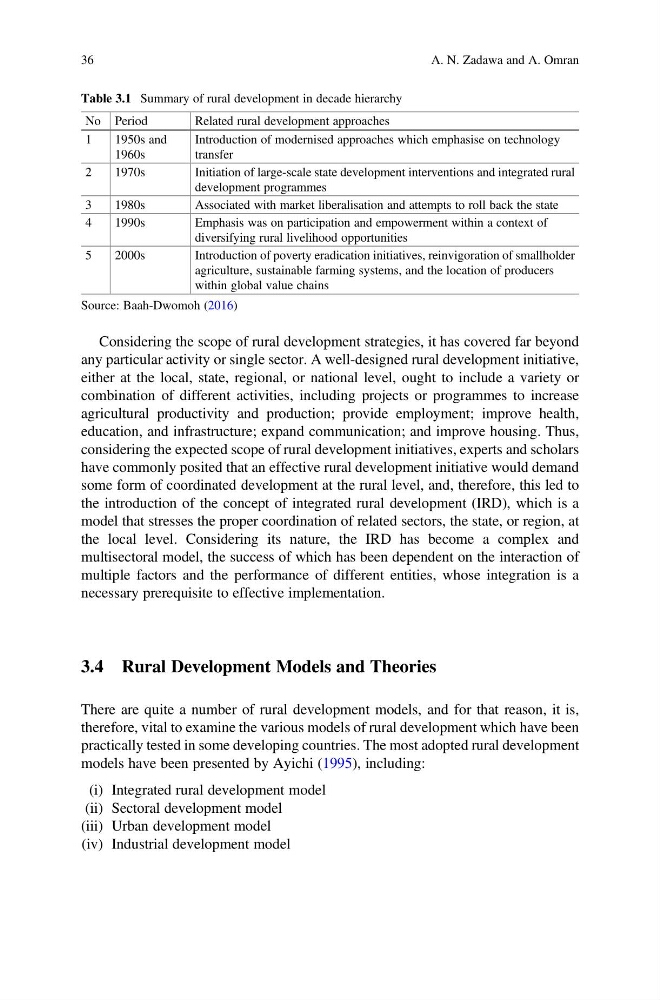
Table 3.1 Summary of rural development in decade hierarchy
No Period
Related rural development approaches
1
1950s and
1960s
Introduction of modernised approaches which emphasise on technology
transfer
2
1970s
Initiation of large-scale state development interventions and integrated rural
development programmes
3
1980s
Associated with market liberalisation and attempts to roll back the state
4
1990s
Emphasis was on participation and empowerment within a context of
diversifying rural livelihood opportunities
5
2000s
Introduction of poverty eradication initiatives, reinvigoration of smallholder
agriculture, sustainable farming systems, and the location of producers
within global value chains
Source: Baah-Dwomoh (2016)
36
A. N. Zadawa and A. Omran
any particular activity or single sector. A well-designed rural development initiative,
either at the local, state, regional, or national level, ought to include a variety or
combination of different activities, including projects or programmes to increase
agricultural productivity and production; provide employment; improve health,
education, and infrastructure; expand communication; and improve housing. Thus,
considering the expected scope of rural development initiatives, experts and scholars
have commonly posited that an effective rural development initiative would demand
some form of coordinated development at the rural level, and, therefore, this led to
the introduction of the concept of integrated rural development (IRD), which is a
model that stresses the proper coordination of related sectors, the state, or region, at
the local level. Considering its nature, the IRD has become a complex and
multisectoral model, the success of which has been dependent on the interaction of
multiple factors and the performance of different entities, whose integration is a
necessary prerequisite to effective implementation.
3.4 Rural Development Models and Theories
There are quite a number of rural development models, and for that reason, it is,
therefore, vital to examine the various models of rural development which have been
practically tested in some developing countries. The most adopted rural development
models have been presented by Ayichi (1995), including:
(i) Integrated rural development model
(ii) Sectoral development model
(iii) Urban development model
(iv) Industrial development model
Table 3.1 Summary of rural development in decade hierarchy
No Period
Related rural development approaches
1
1950s and
1960s
Introduction of modernised approaches which emphasise on technology
transfer
2
1970s
Initiation of large-scale state development interventions and integrated rural
development programmes
3
1980s
Associated with market liberalisation and attempts to roll back the state
4
1990s
Emphasis was on participation and empowerment within a context of
diversifying rural livelihood opportunities
5
2000s
Introduction of poverty eradication initiatives, reinvigoration of smallholder
agriculture, sustainable farming systems, and the location of producers
within global value chains
Source: Baah-Dwomoh (2016)
36
A. N. Zadawa and A. Omran