

solids equivalent, DSE) beneficially reused (89.69% of the 86,288 tonnes generated)
across Queensland. The majority of this reuse occurs in SEQ with nearly
48,000 tonnes (DSE) utilised by fibre (cotton) farmers in the agricultural region of
Darling Downs–Maranoa. There are restrictions on the surface application of biosolids to pasture for grazing, and the promotion of the immediate incorporation into
the soil reduces the likelihood of any organic contaminant accumulation by grazing
animals, and their application is prohibited to food (horticulture) crops. Whilst the
end of waste code (currently transitioning from the former general beneficial use
approval (Queensland Government 2016a)) methodology sets strict guidelines on
the level of stabilisation required, limits of pathogens and concentrations of heavy
metals and pesticides, many of the emerging organic contaminants are not included
in the required analysis with contaminants restricted to ‘traditional’ pollutants and by
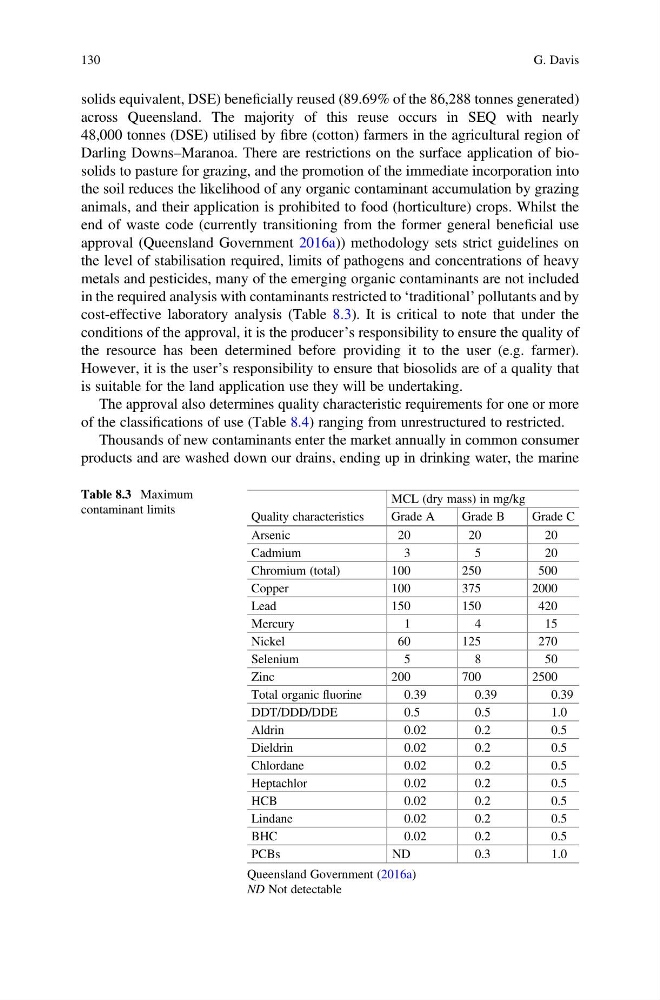
cost-effective laboratory analysis (Table 8.3). It is critical to note that under the
conditions of the approval, it is the producer’s responsibility to ensure the quality of
the resource has been determined before providing it to the user (e.g. farmer).
However, it is the user’s responsibility to ensure that biosolids are of a quality that
is suitable for the land application use they will be undertaking.
The approval also determines quality characteristic requirements for one or more
of the classifications of use (Table 8.4) ranging from unrestructured to restricted.
Thousands of new contaminants enter the market annually in common consumer
products and are washed down our drains, ending up in drinking water, the marine
Table 8.3 Maximum
contaminant limits
Quality characteristics
MCL (dry mass) in mg/kg
Grade A
Grade B
Grade C
Arsenic
20
20
20
Cadmium
3
5
20
Chromium (total)
100
250
500
Copper
100
375
2000
Lead
150
150
420
Mercury
1
4
15
Nickel
60
125
270
Selenium
5
8
50
Zinc
200
700
2500
Total organic fluorine
0.39
0.39
0.39
DDT/DDD/DDE
0.5
0.5
1.0
Aldrin
0.02
0.2
0.5
Dieldrin
0.02
0.2
0.5
Chlordane
0.02
0.2
0.5
Heptachlor
0.02
0.2
0.5
HCB
0.02
0.2
0.5
Lindane
0.02
0.2
0.5
BHC
0.02
0.2
0.5
PCBs
ND
0.3
1.0
Queensland Government (2016a)
ND Not detectable
130
G. Davis
across Queensland. The majority of this reuse occurs in SEQ with nearly
48,000 tonnes (DSE) utilised by fibre (cotton) farmers in the agricultural region of
Darling Downs–Maranoa. There are restrictions on the surface application of biosolids to pasture for grazing, and the promotion of the immediate incorporation into
the soil reduces the likelihood of any organic contaminant accumulation by grazing
animals, and their application is prohibited to food (horticulture) crops. Whilst the
end of waste code (currently transitioning from the former general beneficial use
approval (Queensland Government 2016a)) methodology sets strict guidelines on
the level of stabilisation required, limits of pathogens and concentrations of heavy
metals and pesticides, many of the emerging organic contaminants are not included
in the required analysis with contaminants restricted to ‘traditional’ pollutants and by
cost-effective laboratory analysis (Table 8.3). It is critical to note that under the
conditions of the approval, it is the producer’s responsibility to ensure the quality of
the resource has been determined before providing it to the user (e.g. farmer).
However, it is the user’s responsibility to ensure that biosolids are of a quality that
is suitable for the land application use they will be undertaking.
The approval also determines quality characteristic requirements for one or more
of the classifications of use (Table 8.4) ranging from unrestructured to restricted.
Thousands of new contaminants enter the market annually in common consumer
products and are washed down our drains, ending up in drinking water, the marine
Table 8.3 Maximum
contaminant limits
Quality characteristics
MCL (dry mass) in mg/kg
Grade A
Grade B
Grade C
Arsenic
20
20
20
Cadmium
3
5
20
Chromium (total)
100
250
500
Copper
100
375
2000
Lead
150
150
420
Mercury
1
4
15
Nickel
60
125
270
Selenium
5
8
50
Zinc
200
700
2500
Total organic fluorine
0.39
0.39
0.39
DDT/DDD/DDE
0.5
0.5
1.0
Aldrin
0.02
0.2
0.5
Dieldrin
0.02
0.2
0.5
Chlordane
0.02
0.2
0.5
Heptachlor
0.02
0.2
0.5
HCB
0.02
0.2
0.5
Lindane
0.02
0.2
0.5
BHC
0.02
0.2
0.5
PCBs
ND
0.3
1.0
Queensland Government (2016a)
ND Not detectable
130
G. Davis