

The continuing impact of extreme weather events is significantly impacting
primary producers across Australia, from crop damage to livestock stress. Climate
change is exacerbating the effects of extreme weather events, such as drought, and
rural and regional communities are disproportionally impacted (Climate Council
2016). Extreme weather or climate events include heatwaves, bushfires, droughts,
tropical cyclones, cold snaps and extreme rainfall (storms, hail, floods) and extreme
events are defined as the occurrence of a weather or climate variable above
(or below) a threshold value near the upper (or lower) end of the range of observed
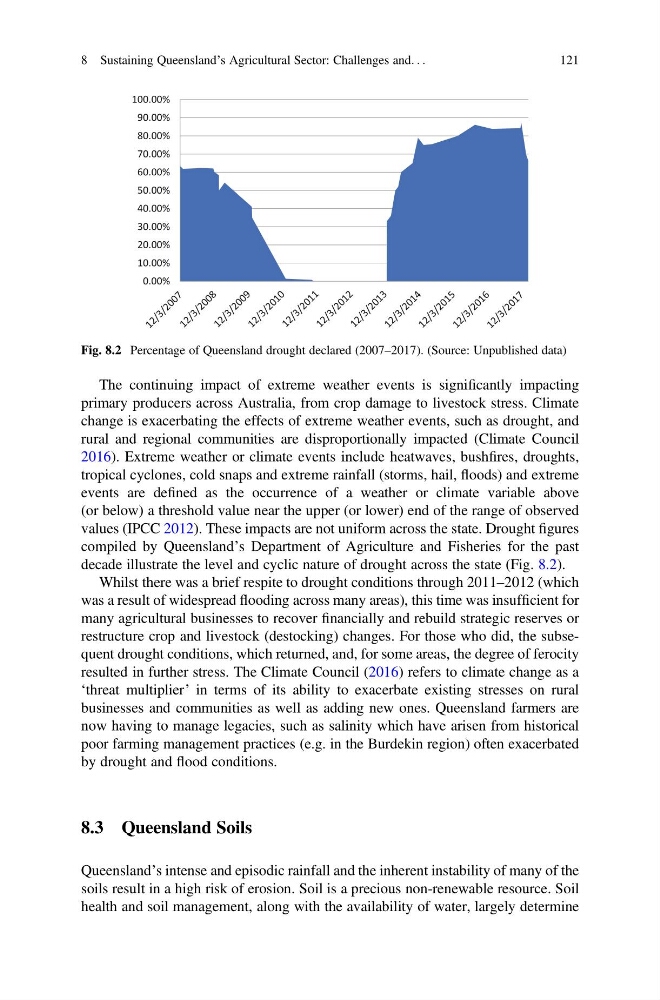
values (IPCC 2012). These impacts are not uniform across the state. Drought figures
compiled by Queensland’s Department of Agriculture and Fisheries for the past
decade illustrate the level and cyclic nature of drought across the state (Fig. 8.2).
Whilst there was a brief respite to drought conditions through 2011–2012 (which
was a result of widespread flooding across many areas), this time was insufficient for
many agricultural businesses to recover financially and rebuild strategic reserves or
restructure crop and livestock (destocking) changes. For those who did, the subsequent drought conditions, which returned, and, for some areas, the degree of ferocity
resulted in further stress. The Climate Council (2016) refers to climate change as a
‘threat multiplier’ in terms of its ability to exacerbate existing stresses on rural
businesses and communities as well as adding new ones. Queensland farmers are
now having to manage legacies, such as salinity which have arisen from historical
poor farming management practices (e.g. in the Burdekin region) often exacerbated
by drought and flood conditions.
8.3 Queensland Soils
Queensland’s intense and episodic rainfall and the inherent instability of many of the
soils result in a high risk of erosion. Soil is a precious non-renewable resource. Soil
health and soil management, along with the availability of water, largely determine
0.00%
10.00%
20.00%
30.00%
40.00%
50.00%
60.00%
70.00%
80.00%
90.00%
100.00%
Fig. 8.2 Percentage of Queensland drought declared (2007–2017). (Source: Unpublished data)
8 Sustaining Queensland’s Agricultural Sector: Challenges and. . .
121
primary producers across Australia, from crop damage to livestock stress. Climate
change is exacerbating the effects of extreme weather events, such as drought, and
rural and regional communities are disproportionally impacted (Climate Council
2016). Extreme weather or climate events include heatwaves, bushfires, droughts,
tropical cyclones, cold snaps and extreme rainfall (storms, hail, floods) and extreme
events are defined as the occurrence of a weather or climate variable above
(or below) a threshold value near the upper (or lower) end of the range of observed
values (IPCC 2012). These impacts are not uniform across the state. Drought figures
compiled by Queensland’s Department of Agriculture and Fisheries for the past
decade illustrate the level and cyclic nature of drought across the state (Fig. 8.2).
Whilst there was a brief respite to drought conditions through 2011–2012 (which
was a result of widespread flooding across many areas), this time was insufficient for
many agricultural businesses to recover financially and rebuild strategic reserves or
restructure crop and livestock (destocking) changes. For those who did, the subsequent drought conditions, which returned, and, for some areas, the degree of ferocity
resulted in further stress. The Climate Council (2016) refers to climate change as a
‘threat multiplier’ in terms of its ability to exacerbate existing stresses on rural
businesses and communities as well as adding new ones. Queensland farmers are
now having to manage legacies, such as salinity which have arisen from historical
poor farming management practices (e.g. in the Burdekin region) often exacerbated
by drought and flood conditions.
8.3 Queensland Soils
Queensland’s intense and episodic rainfall and the inherent instability of many of the
soils result in a high risk of erosion. Soil is a precious non-renewable resource. Soil
health and soil management, along with the availability of water, largely determine
0.00%
10.00%
20.00%
30.00%
40.00%
50.00%
60.00%
70.00%
80.00%
90.00%
100.00%
Fig. 8.2 Percentage of Queensland drought declared (2007–2017). (Source: Unpublished data)
8 Sustaining Queensland’s Agricultural Sector: Challenges and. . .
121