

are numerous agricultural businesses who grow a large variety of crops (at various
scales), deploy different irrigation methods and utilise various equipment to produce
food and fibre (NSW DPI 2018a). For example, water delivery to crops can occur via
one or two stages, from a water source to storage and from source/storage to the crop.
This may require further ‘on-farm’ pumping for one or both stages. Agricultural
methods are also diverse. Some growers apply surface water irrigation (e.g. flood or
furrow) where water is distributed by gravity, whilst others have installed sprinkler
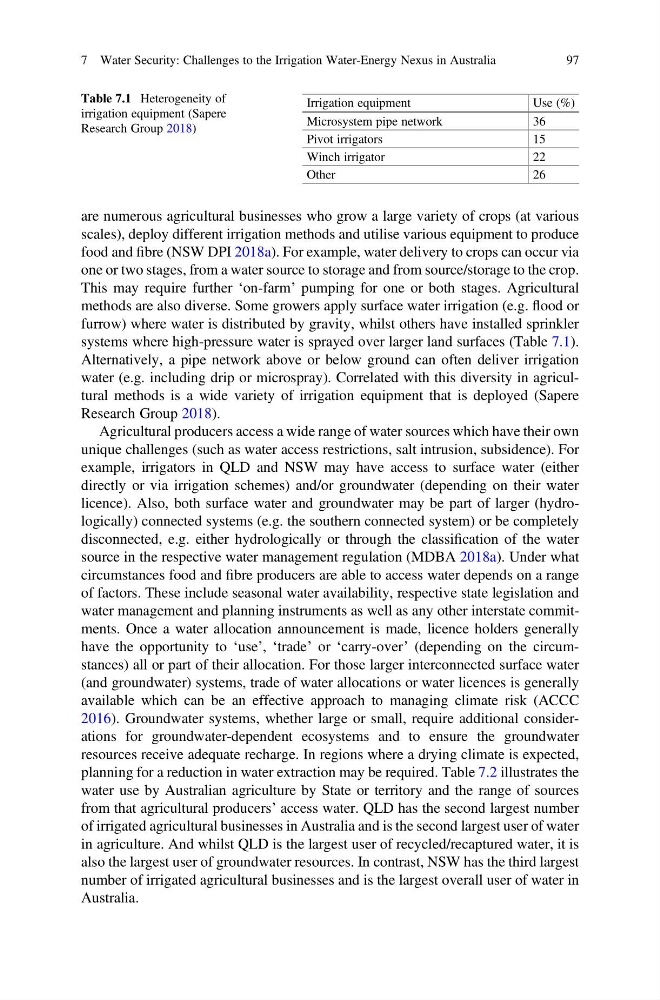
systems where high-pressure water is sprayed over larger land surfaces (Table 7.1).
Alternatively, a pipe network above or below ground can often deliver irrigation
water (e.g. including drip or microspray). Correlated with this diversity in agricultural methods is a wide variety of irrigation equipment that is deployed (Sapere
Research Group 2018).
Agricultural producers access a wide range of water sources which have their own
unique challenges (such as water access restrictions, salt intrusion, subsidence). For
example, irrigators in QLD and NSW may have access to surface water (either
directly or via irrigation schemes) and/or groundwater (depending on their water
licence). Also, both surface water and groundwater may be part of larger (hydrologically) connected systems (e.g. the southern connected system) or be completely
disconnected, e.g. either hydrologically or through the classification of the water
source in the respective water management regulation (MDBA 2018a). Under what
circumstances food and fibre producers are able to access water depends on a range
of factors. These include seasonal water availability, respective state legislation and
water management and planning instruments as well as any other interstate commitments. Once a water allocation announcement is made, licence holders generally
have the opportunity to ‘use’, ‘trade’ or ‘carry-over’ (depending on the circumstances) all or part of their allocation. For those larger interconnected surface water
(and groundwater) systems, trade of water allocations or water licences is generally
available which can be an effective approach to managing climate risk (ACCC
2016). Groundwater systems, whether large or small, require additional considerations for groundwater-dependent ecosystems and to ensure the groundwater
resources receive adequate recharge. In regions where a drying climate is expected,
planning for a reduction in water extraction may be required. Table 7.2 illustrates the
water use by Australian agriculture by State or territory and the range of sources
from that agricultural producers’ access water. QLD has the second largest number
of irrigated agricultural businesses in Australia and is the second largest user of water
in agriculture. And whilst QLD is the largest user of recycled/recaptured water, it is
also the largest user of groundwater resources. In contrast, NSW has the third largest
number of irrigated agricultural businesses and is the largest overall user of water in
Australia.
Table 7.1 Heterogeneity of
irrigation equipment (Sapere
Research Group 2018)
Irrigation equipment
Use (%)
Microsystem pipe network
36
Pivot irrigators
15
Winch irrigator
22
Other
26
7 Water Security: Challenges to the Irrigation Water-Energy Nexus in Australia
97
scales), deploy different irrigation methods and utilise various equipment to produce
food and fibre (NSW DPI 2018a). For example, water delivery to crops can occur via
one or two stages, from a water source to storage and from source/storage to the crop.
This may require further ‘on-farm’ pumping for one or both stages. Agricultural
methods are also diverse. Some growers apply surface water irrigation (e.g. flood or
furrow) where water is distributed by gravity, whilst others have installed sprinkler
systems where high-pressure water is sprayed over larger land surfaces (Table 7.1).
Alternatively, a pipe network above or below ground can often deliver irrigation
water (e.g. including drip or microspray). Correlated with this diversity in agricultural methods is a wide variety of irrigation equipment that is deployed (Sapere
Research Group 2018).
Agricultural producers access a wide range of water sources which have their own
unique challenges (such as water access restrictions, salt intrusion, subsidence). For
example, irrigators in QLD and NSW may have access to surface water (either
directly or via irrigation schemes) and/or groundwater (depending on their water
licence). Also, both surface water and groundwater may be part of larger (hydrologically) connected systems (e.g. the southern connected system) or be completely
disconnected, e.g. either hydrologically or through the classification of the water
source in the respective water management regulation (MDBA 2018a). Under what
circumstances food and fibre producers are able to access water depends on a range
of factors. These include seasonal water availability, respective state legislation and
water management and planning instruments as well as any other interstate commitments. Once a water allocation announcement is made, licence holders generally
have the opportunity to ‘use’, ‘trade’ or ‘carry-over’ (depending on the circumstances) all or part of their allocation. For those larger interconnected surface water
(and groundwater) systems, trade of water allocations or water licences is generally
available which can be an effective approach to managing climate risk (ACCC
2016). Groundwater systems, whether large or small, require additional considerations for groundwater-dependent ecosystems and to ensure the groundwater
resources receive adequate recharge. In regions where a drying climate is expected,
planning for a reduction in water extraction may be required. Table 7.2 illustrates the
water use by Australian agriculture by State or territory and the range of sources
from that agricultural producers’ access water. QLD has the second largest number
of irrigated agricultural businesses in Australia and is the second largest user of water
in agriculture. And whilst QLD is the largest user of recycled/recaptured water, it is
also the largest user of groundwater resources. In contrast, NSW has the third largest
number of irrigated agricultural businesses and is the largest overall user of water in
Australia.
Table 7.1 Heterogeneity of
irrigation equipment (Sapere
Research Group 2018)
Irrigation equipment
Use (%)
Microsystem pipe network
36
Pivot irrigators
15
Winch irrigator
22
Other
26
7 Water Security: Challenges to the Irrigation Water-Energy Nexus in Australia
97