

796
Aside from their modest gravesites, mottos, and enormous impact on math, physics, and engineering, the scintillating minutiae neither add to nor subtract from the
ethical dilemmas that share an interface with numbers, perceived dimensions, and
endless permutations. We struggle in vain to assign numeric values to integral content, an ecologically hopeless situation. For example, when the 508-million-yearold Burgess Shale fossil deposits in British Columbia, first discovered by
paleontologist Charles Walcott in 1909, began to yield in the early 1960s the true,
heretofore unexpected vastness of Middle Cambrian biodiversity, it became far
more clear that climate change-related flux during the past half-billion years could
help inform our present crisis on earth with numbers, but not corresponding ethical
injunctions. Of course, it is imperative we rapidly and massively reduce global
warming. But we won’t. Cast out into a sea of human metapopulations, such a warning to the vast collective is a lost cautionary tale. Its paleontological import has
demonstrated that we may glean, at best, general alarm at the record of our historical pasts, but are crazily emboldened to think that, somehow, we are not altogether
products of those pasts. Our concepts of Self are entirely rogue, commensurate with
this uncanny, cumulative stray dog sensibility of consciousness, concretized into
hostile units that are amassed, weaponized, politically strewn in such crude and
antipathetic ways as to defy the learning tools of which memory and cognition are
purportedly constructed
3
.
Nachrichten: 253–297. and Hilbert, David (1901). “[no title cited]”. Archiv der Mathematik und
Physik. 3. 1: 44–63, 213–237.
3 See Peter Douglas Ward, Under a Green Sky; Global Warming, the Mass Extinctions of the Past,
and What They Can Tell Us About Our Future, Smithsonian Books/Collins, New York,
2007. OCLC 224875122. Lay summary (July–August 2007). by Christopher Cokinos, Orion magazine; See also, Bennett, Drake (January 11, 2009). “Dark green. A scientist argues that the natural
world isn’t benevolent and sustaining: it’s bent on self-destruction”. Boston Globe.
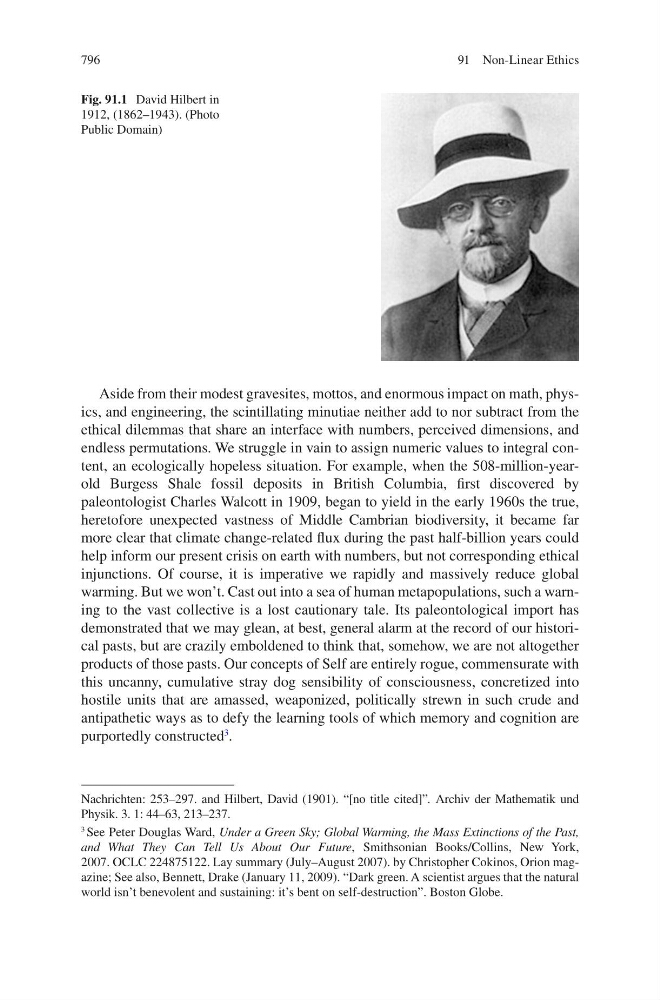
Fig. 91.1 David Hilbert in
1912, (1862–1943). (Photo
Public Domain)
91 Non-Linear Ethics