

768
Our fanciful notions of destiny that have girded one doomed civilization after
another form the full circumference of a uniformly irreligious distress. Within the
orbit of those enduring anxieties, the natural disassembly of the body, external causes
of injury and mortal wounds, there will always emerge some Symeon the Stylite
(390–459) to cheer us up. The saint and his pantheon of prayers bolsters the great ash
tree, the formidable ziggurat in every dream of Nature; the dialectic out of which God
grows and plays fanatically with the credulous. The stage where mercy contends and
victors are null; where one ultimately walks away to get on with his/her life, never
to be heard from again, though it matters not, this is the aftermath of prayer, looks
forward, looks back, the biology of the faithful and faithless, both
3
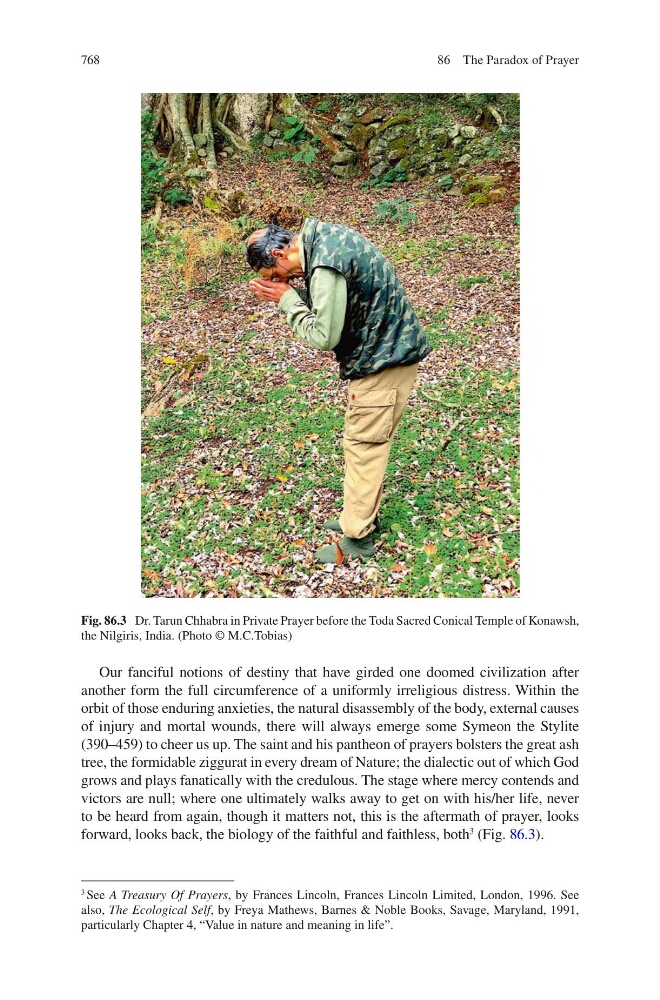
(Fig. 86.3).
3 See A Treasury Of Prayers, by Frances Lincoln, Frances Lincoln Limited, London, 1996. See
also, The Ecological Self, by Freya Mathews, Barnes & Noble Books, Savage, Maryland, 1991,
particularly Chapter 4, “Value in nature and meaning in life”.
Fig. 86.3 Dr. Tarun Chhabra in Private Prayer before the Toda Sacred Conical Temple of Konawsh,
the Nilgiris, India. (Photo © M.C.Tobias)
86 The Paradox of Prayer