

767
human penchant for getting into trouble. The endless extremes that invite prayer,
and other forms of deep meditacioun, offer no formulas, no clear histories, only the
private lives embedded day after day in solitary deaths across the magnificent ecosystem of cemeteries, a perpetual solace that forms the most crucial of all philosophical categories, in juxtaposition with those of life. Writing of the monks at
Mount Athos, Ralph Harper would say, “Monks do not learn by studying…but
mainly by their daily round of prayer… And as they pray, they are reminded by the
ikons of the lives of the saints, of the community of those who live the mystery,
those who once knew better than we what the source of the mystery is…”
2
.
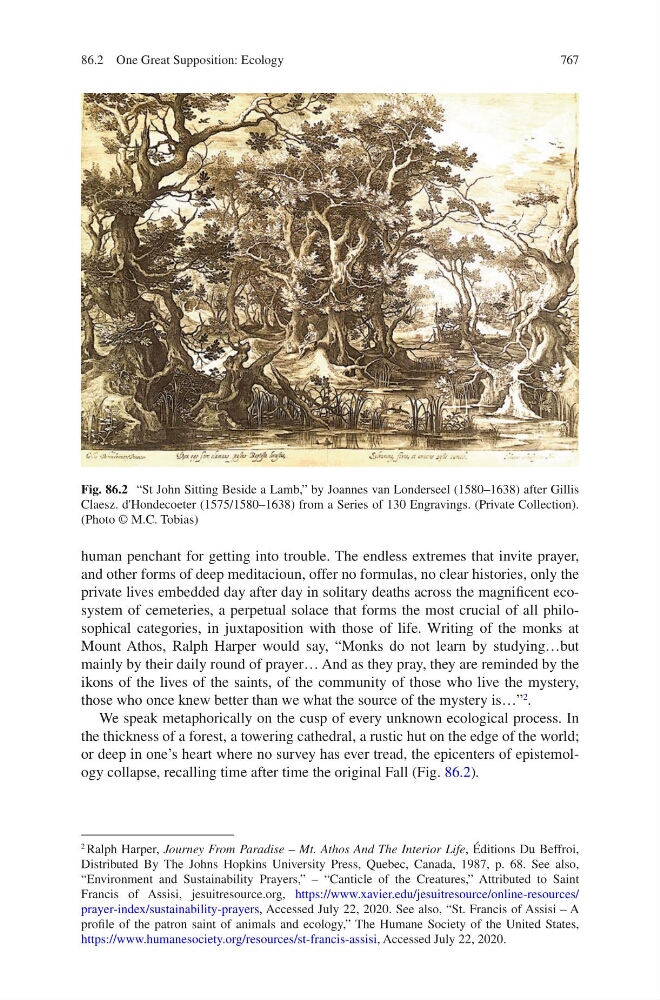
We speak metaphorically on the cusp of every unknown ecological process. In
the thickness of a forest, a towering cathedral, a rustic hut on the edge of the world;
or deep in one’s heart where no survey has ever tread, the epicenters of epistemology collapse, recalling time after time the original Fall (Fig. 86.2).
2 Ralph Harper, Journey From Paradise – Mt. Athos And The Interior Life, Éditions Du Beffroi,
Distributed By The Johns Hopkins University Press, Quebec, Canada, 1987, p. 68. See also,
“Environment and Sustainability Prayers,” – “Canticle of the Creatures,” Attributed to Saint
Francis of Assisi, jesuitresource.org, https://www.xavier.edu/jesuitresource/online-resources/
prayer-index/sustainability-prayers, Accessed July 22, 2020. See also, “St. Francis of Assisi – A
profile of the patron saint of animals and ecology,” The Humane Society of the United States,
https://www.humanesociety.org/resources/st-francis-assisi, Accessed July 22, 2020.
Fig. 86.2 “St John Sitting Beside a Lamb,” by Joannes van Londerseel (1580–1638) after Gillis
Claesz. d'Hondecoeter (1575/1580–1638) from a Series of 130 Engravings. (Private Collection).
(Photo © M.C. Tobias)
86.2 One Great Supposition: Ecology