

719
Fleeing its ruins, later generations looked back at Babel in wonder, turned poetically nostalgic toward good shepherds, wisemen, explorers, and gypsies, all of
whom have lent the nomadic heart a distinctive whisper. Like all those mountains
and rivers of the Shobogenzo by Soto Zen-founder, Dōgen Kigen (1200–1253),
many beetling cliffs, brant, and scrape; the wine dark illuminations beloved by all
those from Homer to Aert van Der Neer, a Chopin’s Etudes. In every fine museum
library, symphony hall… lives and breathless, the fantasies and enquiries that
remain in ponderous limbo. Fixated on that which is intimated, only partially
approached, encompassed, or even envisioned.
Therein, upon the objects and scenes of vague and indeterminate proximity, is
our one hope.
Lodged obliquely between mass genuflection and suicide. The artistic notion of
zoology. Philosophers of rock and sand. Ontological echoes whose chords harmonize in total emptiness. A pantheist’s reunion of voids. Memories once divine gone
brittle and acrid, yet, somehow, coming back each spring to offer us a second chance
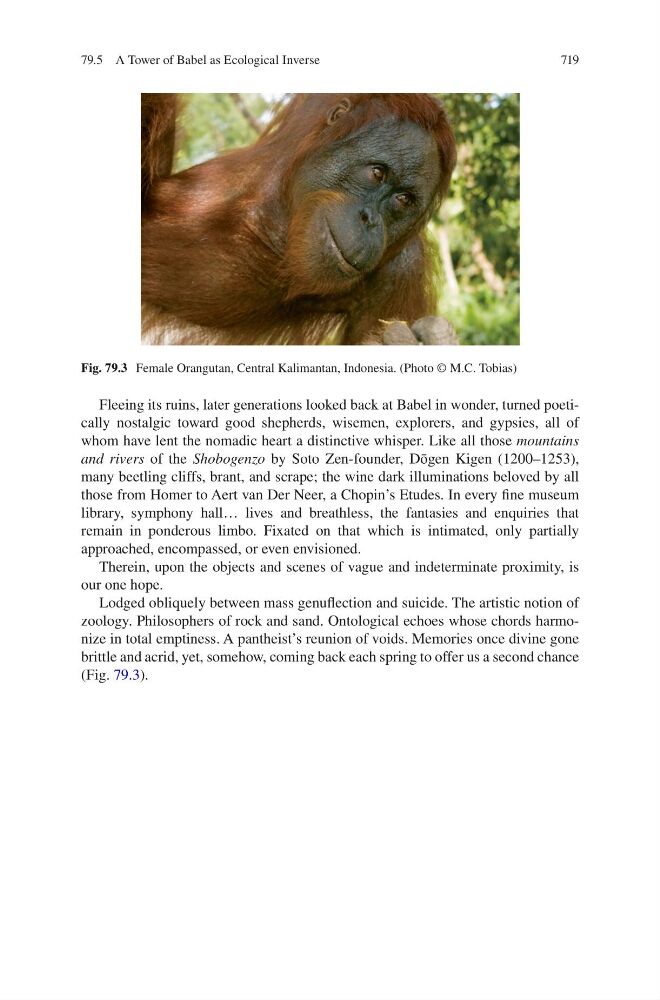
(Fig. 79.3).
Fig. 79.3 Female Orangutan, Central Kalimantan, Indonesia. (Photo © M.C. Tobias)
79.5 A Tower of Babel as Ecological Inverse