

718
to the extent they have been organized and expressed according to general deep
rules of structure, including every human idiolect and self-expression, provide one
key to escaping an otherwise unresolvable fate. And that is the clear and possibly
unassailable truth of the inexpressible. “…like those that pass or things always and
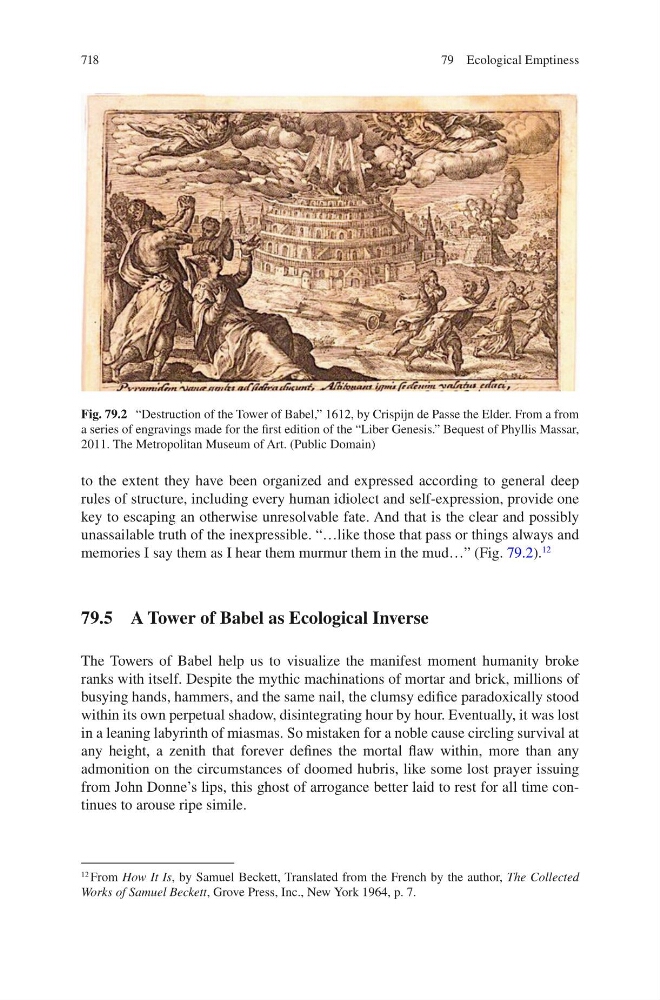
memories I say them as I hear them murmur them in the mud…” (Fig. 79.2).
12
79.5 A Tower of Babel as Ecological Inverse
The Towers of Babel help us to visualize the manifest moment humanity broke
ranks with itself. Despite the mythic machinations of mortar and brick, millions of
busying hands, hammers, and the same nail, the clumsy edifice paradoxically stood
within its own perpetual shadow, disintegrating hour by hour. Eventually, it was lost
in a leaning labyrinth of miasmas. So mistaken for a noble cause circling survival at
any height, a zenith that forever defines the mortal flaw within, more than any
admonition on the circumstances of doomed hubris, like some lost prayer issuing
from John Donne’s lips, this ghost of arrogance better laid to rest for all time continues to arouse ripe simile.
12 From How It Is, by Samuel Beckett, Translated from the French by the author, The Collected
Works of Samuel Beckett, Grove Press, Inc., New York 1964, p. 7.
Fig. 79.2 “Destruction of the Tower of Babel,” 1612, by Crispijn de Passe the Elder. From a from
a series of engravings made for the first edition of the “Liber Genesis.” Bequest of Phyllis Massar,
2011. The Metropolitan Museum of Art. (Public Domain)
79 Ecological Emptiness