

677
And on this day back in The Hague, the world is pacing dumbstruck over at the
Mauritshuis, where yet another dozen or so Rembrandt’s are on quiet, darkened
display, amid the three Vermeers, three Ter Borgs, and the inexhaustible Roelandt
Savery and Jan Breughel/Rubens paradise. Each framed jewel is held in pinioned
repose by a certain aerial solemnity to a specific place in time and human nostalgia.
All of it is stunned and sadly hopeful for some lost past, much remarked upon by
everyone who has ever lived, this feeling of repose in melancholy at the state of
biology within our species’ impermanent, yet imprisoned guise. These are emotional flash points that spell every coordinate of ecological crisis. Why is it this
way? A constellation of longing and despondency. The great yearning gives way to
some intangible modifier, we hold off that tempting overdose, or the tall bridge in
the night, as paintings such as these, and their entire collective neighborhoods—real
places inhabited by real people—lend a persuasive window upon the possibilities
for all of us. The more desperate, the more alluring those openings into another
reality.
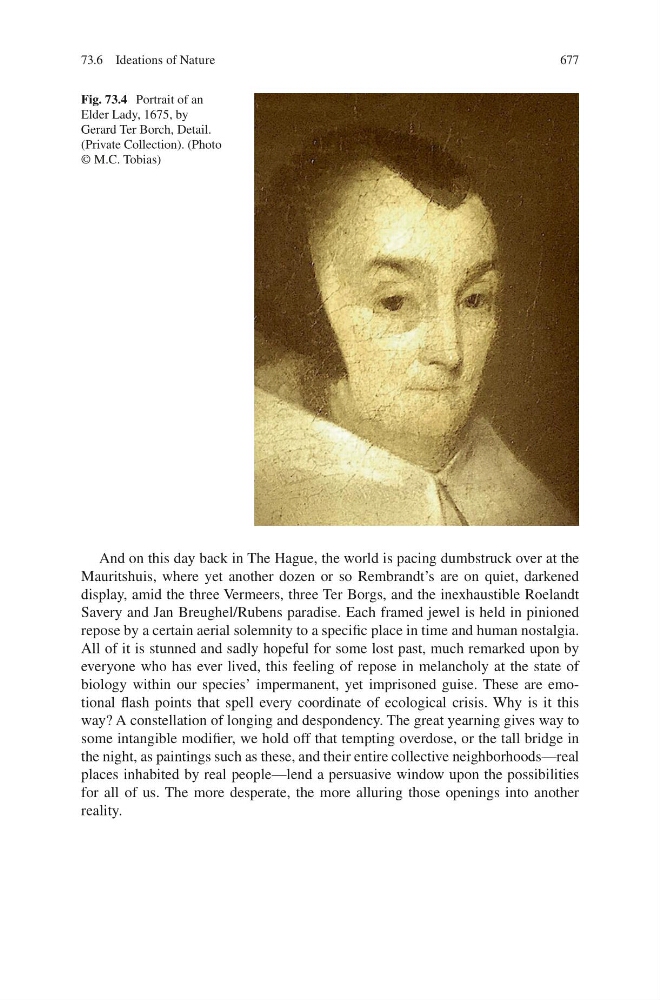
Fig. 73.4 Portrait of an
Elder Lady, 1675, by
Gerard Ter Borch, Detail.
(Private Collection). (Photo
© M.C. Tobias)
73.6 Ideations of Nature