

651
And later, Aristotle declares, “Now, if all units are comparable and without difference, we get the mathematical numbers and of one kind only, and the Ideas cannot be these numbers. For what kind of a number will Man Himself or Animal Itself
or any other Form be?”
16
Aristotle’s contention outlined in his Historia Animalium
amplified the scope of such discourse when he laid claim to the fact that all animals
were comprised of both body and soul, of “psychical qualities or attitudes… In a
number of animals we observe gentleness or fierceness, mildness or cross temper,
courage or timidity, fear or confidence, high spirit or low cunning, and, with regard
to intelligence, something equivalent to sagacity.”
17
Two thousand years later,
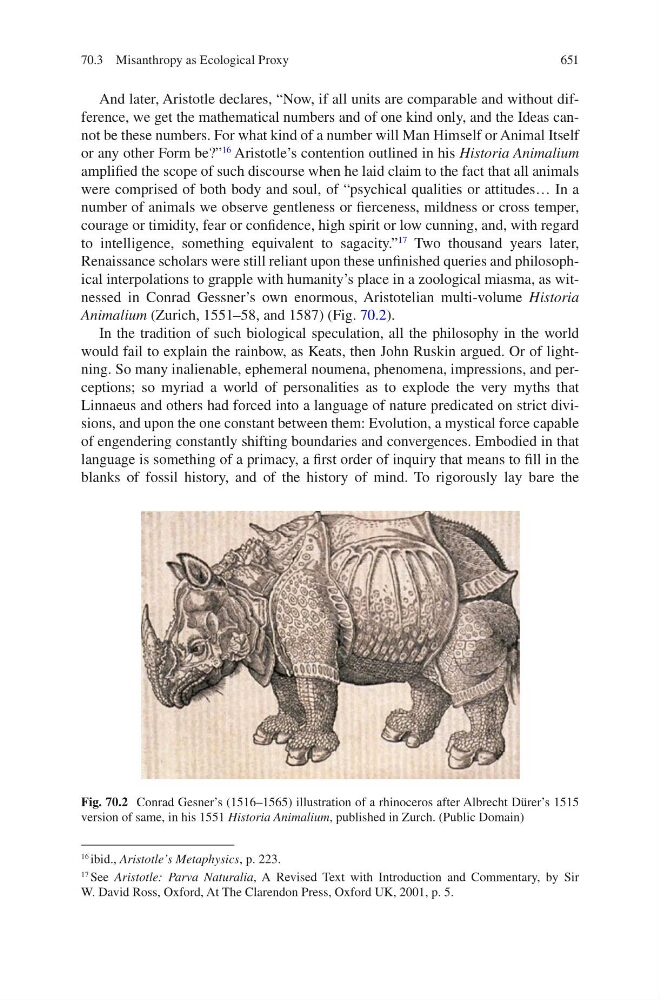
Renaissance scholars were still reliant upon these unfinished queries and philosophical interpolations to grapple with humanity’s place in a zoological miasma, as witnessed in Conrad Gessner’s own enormous, Aristotelian multi-volume Historia
Animalium (Zurich, 1551–58, and 1587) (Fig. 70.2).
In the tradition of such biological speculation, all the philosophy in the world
would fail to explain the rainbow, as Keats, then John Ruskin argued. Or of lightning. So many inalienable, ephemeral noumena, phenomena, impressions, and perceptions; so myriad a world of personalities as to explode the very myths that
Linnaeus and others had forced into a language of nature predicated on strict divisions, and upon the one constant between them: Evolution, a mystical force capable
of engendering constantly shifting boundaries and convergences. Embodied in that
language is something of a primacy, a first order of inquiry that means to fill in the
blanks of fossil history, and of the history of mind. To rigorously lay bare the
16 ibid., Aristotle’s Metaphysics, p. 223.
17 See Aristotle: Parva Naturalia, A Revised Text with Introduction and Commentary, by Sir
W. David Ross, Oxford, At The Clarendon Press, Oxford UK, 2001, p. 5.
Fig. 70.2 Conrad Gesner’s (1516–1565) illustration of a rhinoceros after Albrecht Dürer’s 1515
version of same, in his 1551 Historia Animalium, published in Zurch. (Public Domain)
70.3 Misanthropy as Ecological Proxy